
Complete Guide to Aquarium Fish Food: Flakes, Pellets, Frozen Food, and Live Food
What you feed your fish determines their colour, health, breeding success, and lifespan. This complete guide covers every category of aquarium fish food available in Singapore, with practical recommendations for every type of tropical freshwater fish.
The Four Food Categories
1. Dry Foods (Flakes and Pellets)
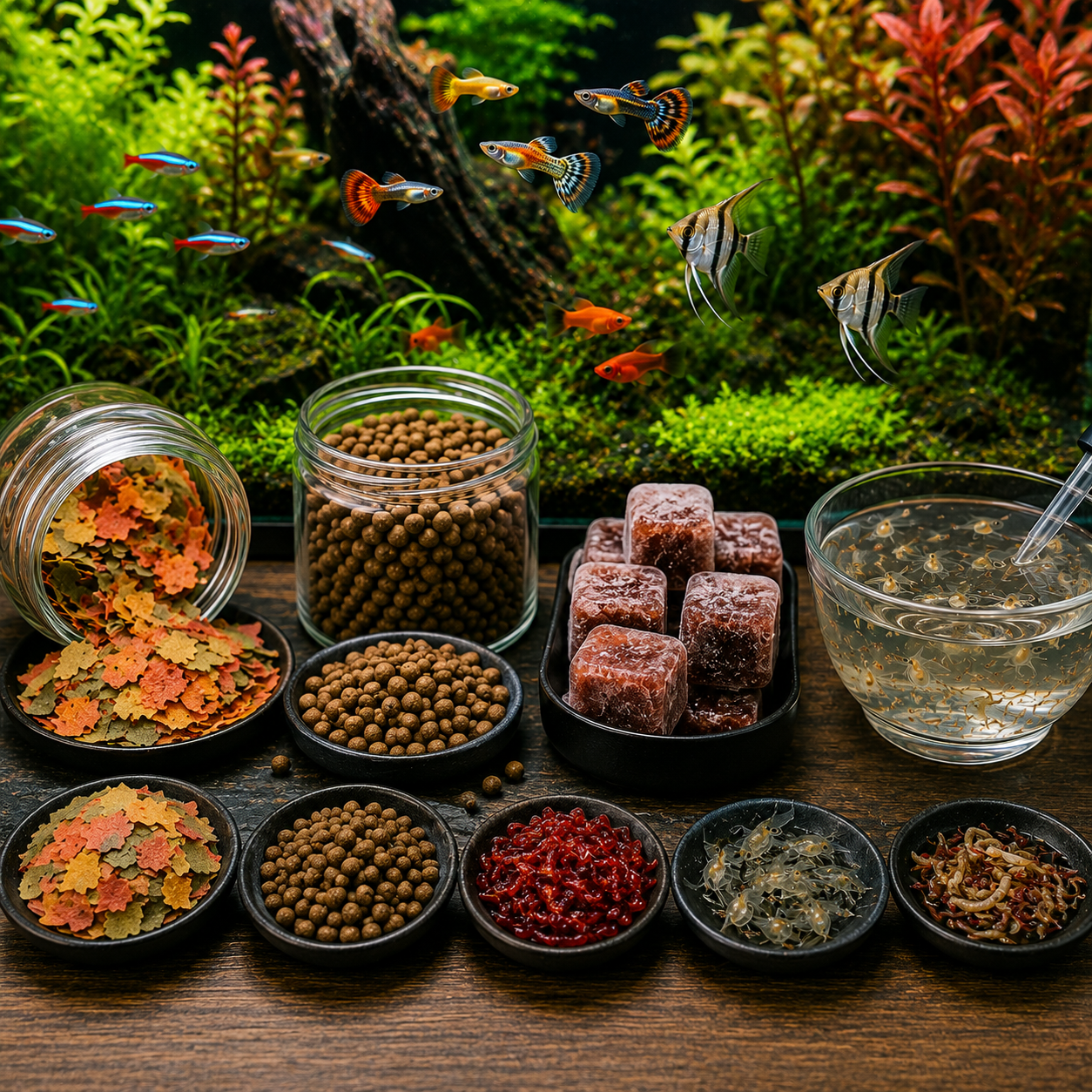
Dry foods are the daily staple for most aquarium fish. They are convenient, shelf-stable, nutritionally complete, and available in formulations for almost every species.
Flakes:
- Float initially, then slowly sink
- Best for surface and mid-water feeders
- Crush between fingers for nano fish
- Limitation: lower protein density than equivalent pellets; cloud water if overfed
Pellets:
- Available in floating, slow-sinking, and sinking forms
- Higher nutrient density per gram than flake
- Easier to portion accurately
- Sinking pellets essential for bottom feeders (corydoras, loaches)
- Preferred by most experienced hobbyists
Wafers and discs:
- Designed for algae eaters, plecos, and corydoras
- Sink immediately and dissolve slowly on the substrate
- Spirulina-based wafers for herbivores; protein-based for omnivores
2. Frozen Foods
Frozen foods are nutritionally superior to dry foods in almost every category and are essential for breeding conditioning, colour enhancement, and carnivore feeding.
Best frozen foods for tropical freshwater fish:
| Food | Best for | Notes |
|---|---|---|
| Bloodworm | Carnivores, bettas, cichlids | High protein; excellent colour enhancer |
| Brine shrimp | Most community fish | Good all-rounder; high in carotenoids |
| Daphnia | Most species | Natural laxative; good for digestion |
| Tubifex | Carnivores | High protein; use sparingly |
| Mysis shrimp | Marine fish; larger freshwater | Higher fat content than brine shrimp |
| Cyclops | Nano fish, shrimp | Tiny size; ideal for small mouths |
How to feed frozen food:
- Defrost a small cube in a cup of tank water
- Pour the water + food into the tank slowly
- Feed only what fish consume in 3–5 minutes
- Never refreeze partially thawed food
3. Live Foods
Live foods offer the best nutritional profile and trigger strong feeding, breeding, and colour responses — but carry disease risk.
Common live foods:
- Live brine shrimp (Artemia): Hatch from eggs; suitable for most fish; excellent for fry
- Daphnia: Natural water flea; easy to culture at home; great for all freshwater fish
- Micro worms: Tiny free-living nematodes; essential first food for very small fry
- Blackworms (Lumbriculus): High nutrition; popular for conditioning bettas and cichlids
- Grindal worms: Small, easy to culture; excellent for small-to-medium fish
Disease risk management: Source live food only from reputable suppliers. Quarantine tanks fed exclusively live food before adding new fish.
4. Freeze-Dried Foods
Freeze-dried foods (bloodworm, tubifex, krill) provide most of the nutritional benefits of live food with none of the disease risk and longer shelf life.
Limitation: Some fish initially refuse freeze-dried food as it moves differently from live or frozen food. Soak in tank water for 30 seconds before feeding to improve acceptance.
Feeding by Fish Type
| Fish type | Staple | Supplement |
|---|---|---|
| Tetras and rasboras | Quality micro-pellet or flake | Frozen brine shrimp or cyclops |
| Bettas | Betta pellets (high protein) | Frozen or freeze-dried bloodworm |
| Corydoras | Sinking wafer or pellet | Frozen bloodworm, blanched zucchini |
| Plecos (algae eaters) | Algae wafer, spirulina disc | Blanched vegetables (zucchini, cucumber) |
| Cichlids | Cichlid pellets (size appropriate) | Frozen mysis, bloodworm, krill |
| Discus | Quality discus beef heart pellet | Frozen bloodworm, frozen beef heart |
| Shrimp | Shrimp wafer, algae wafer | Blanched spinach or zucchini |
How Much and How Often
- Amount: What fish consume in 2–3 minutes; zero food on the substrate after 5 minutes
- Frequency: Twice daily for most community fish; once daily for large, slower-metabolising species
- Fasting: One fasting day per week improves digestion and water quality
Feeding Schedule Template
| Day | Morning | Evening |
|---|---|---|
| Mon | Pellets | Frozen brine shrimp |
| Tue | Pellets | Pellets |
| Wed | Pellets | Frozen bloodworm |
| Thu | Pellets | Pellets |
| Fri | Pellets | Frozen daphnia |
| Sat | Pellets | Pellets |
| Sun | Fasting day | — |
Browse our complete fish food range — dry, frozen, and specialty foods available for delivery across Singapore.