
Why Are My Aquarium Plants Growing Slowly? Light, Nutrients, and Plant Choice Explained
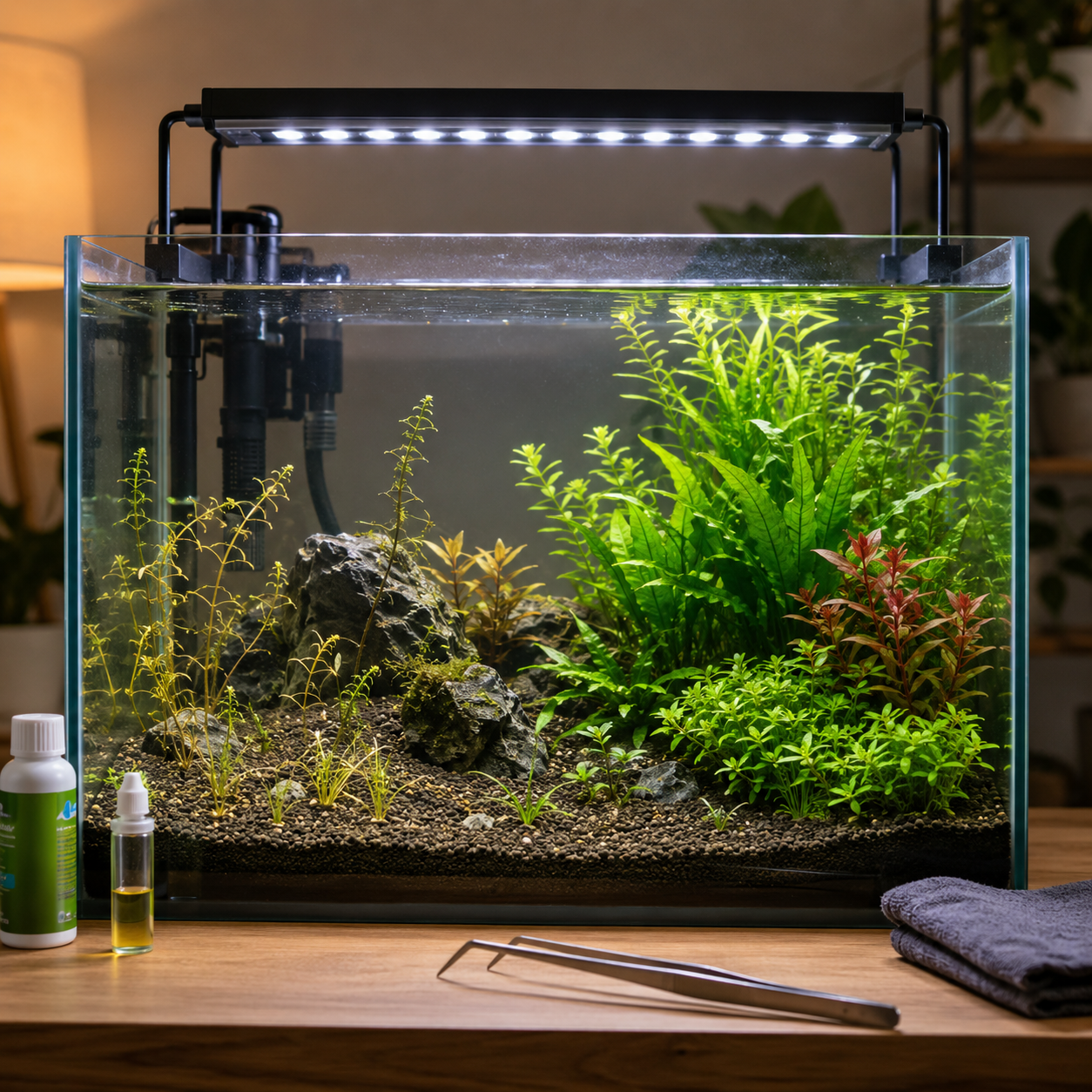
Slow plant growth in a freshwater aquarium is frustrating — but it is almost always fixable. The three main causes are light, nutrients, and plant selection. Understanding which limitation applies to your tank lets you fix the problem efficiently rather than guessing.
The Growth Triangle: Light, CO2, and Nutrients
Aquarium plants need three inputs to grow:
- Light — the energy source for photosynthesis
- CO2 — the carbon source for building plant tissue
- Nutrients — nitrogen, phosphorus, potassium, iron, and micronutrients
If any one of these is deficient, growth slows — even if the other two are abundant. This is called Liebig's Law of the Minimum.
Cause 1: Insufficient Light
Light is the most common cause of slow plant growth in beginner setups. Signs:
- Plants grow slowly or not at all
- Red plants turn green or pale
- Leaves stretch toward the light (etiolation)
- Carpeting plants melt or fail to spread
How to check: Use a PAR meter or phone app to measure light intensity at plant level. Most planted tanks need:
- Low-light plants (anubias, java fern, mosses): 15–30 PAR
- Medium-light plants (crypts, most stem plants): 30–50 PAR
- High-light plants (HC Cuba, rotala): 50–100+ PAR
Fix:
- Upgrade to a quality planted tank LED (Chihiros, Fluval Plant, Twinstar)
- Increase photoperiod to 8–10 hours
- Reduce depth (shallow tanks receive more light at the substrate)
Cause 2: CO2 Deficiency
CO2 is the most transformative addition to a planted tank. Without injected CO2:
- Demanding plants (HC Cuba, rotala wallichii, ludwigia super red) grow extremely slowly
- Algae competes more effectively for available carbon
- Red plants cannot maintain their colour
Fix options:
- DIY CO2 (yeast-based): Low cost, variable output — suitable for small tanks under 60 litres
- Pressurised CO2 system: Cylinder, regulator, diffuser — consistent output; the correct choice for serious planted tanks
- Plant more robust low-tech species: Anubias, java fern, crypts, and mosses grow well without CO2
Cause 3: Nutrient Deficiency
Plants show specific visual symptoms when deficient in particular nutrients:
| Deficiency | Symptoms |
|---|---|
| Nitrogen (N) | Pale green or yellowing of older leaves |
| Iron (Fe) | Yellowing between veins on new growth |
| Potassium (K) | Holes in leaves, leaf edge browning |
| Calcium (Ca) | Deformed or stunted new growth |
| Phosphorus (P) | Purple or reddish tinge on leaves |
Fix:
- Dose a complete liquid fertiliser (Seachem Flourish, TNC, or equivalent) weekly
- Use an iron supplement if red plants are losing colour
- Switch to a nutrient-rich aquasoil substrate if using plain gravel or sand
Cause 4: Wrong Plant for Your Setup
Some plants simply do not grow well in low-tech setups without CO2 and strong lighting — no matter how well you care for them.
Low-tech plants (thrive without CO2): Anubias, java fern, all mosses, bucephalandra, most crypts, vallisneria
High-tech plants (require CO2 and strong light): HC Cuba, rotala wallichii, ludwigia super red, all carpeting plants except marsilea
If you have a low-tech setup, switching to low-tech plants is faster and more rewarding than fighting for demanding species.
Browse our plant collection — all plants listed with difficulty rating, light requirement, and CO2 needs.