

How to Choose an Aquarium Test Kit for Beginners
You cannot see ammonia, nitrite, nitrate, or pH with your eyes — but your fish feel every shift. Water testing is the single most important diagnostic tool in fishkeeping, and choosing the right test kit makes the difference between actionable information and unreliable guesswork.
What Should You Test?
For a freshwater aquarium, the minimum essential parameters to test are:
| Parameter | Why it matters | Safe range |
|---|---|---|
| Ammonia (NH3/NH4) | Toxic even at 0.25 ppm | 0 ppm |
| Nitrite (NO2) | Toxic; indicates incomplete cycle | 0 ppm |
| Nitrate (NO3) | Accumulates; triggers algae | < 20 ppm |
| pH | Affects fish health and bacterial activity | 6.5–7.5 for most community fish |
Additional parameters for specific setups:
- GH/KH (hardness): Essential for shrimp tanks, livebearers, and Rift Lake cichlids
- Phosphate: Useful for diagnosing algae problems in planted tanks
Test Strips vs Liquid Test Kits
Test Strips
- How they work: Dip a paper strip in tank water; compare colour change to a chart
- Pros: Fast (results in 60 seconds); convenient for routine checks; inexpensive per strip
- Cons: Notoriously inaccurate — colour perception varies; strips degrade after opening; often cannot detect the difference between 0 and 0.25 ppm ammonia
- Verdict: Acceptable for quick, rough monitoring. Never rely on strips for cycle diagnosis or emergency troubleshooting.
Liquid Test Kits (API, Salifert, JBL)
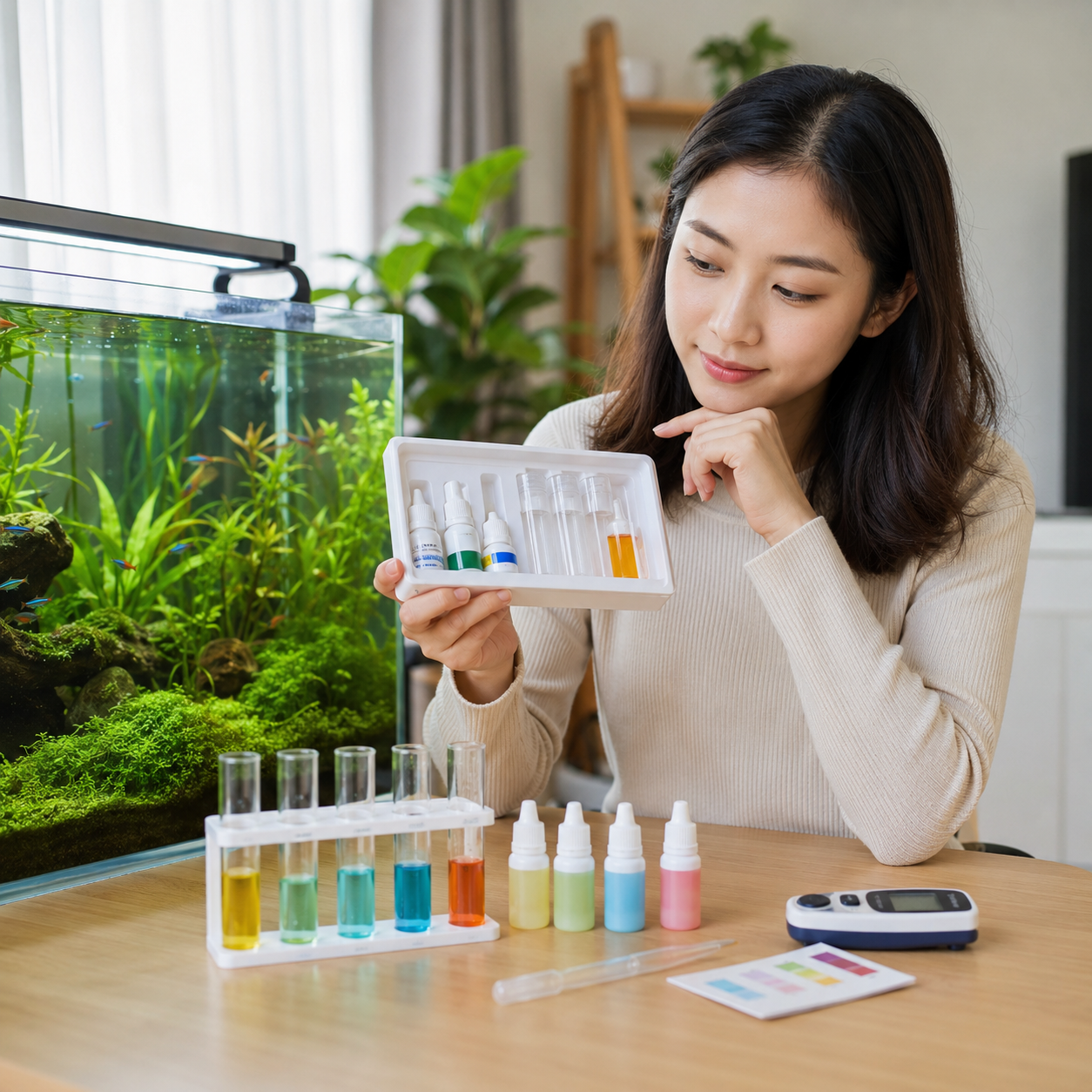
- How they work: Add drops of chemical reagent to a test tube of tank water; compare colour to a reference card
- Pros: Much more accurate; can detect small differences in parameter levels; long shelf life if stored correctly; cost-effective per test long term
- Cons: Slower (5–15 minutes per test); requires careful technique for accurate results; reagents expire after 2–3 years
- Verdict: The correct choice for all serious testing. The API Master Test Kit is the industry standard entry-level liquid kit.
Recommended Kits for Beginners
API Freshwater Master Test Kit: Tests ammonia, nitrite, nitrate, and pH. Includes test tubes, comparator cards, and enough reagent for 800 tests. The best starting point for any freshwater aquarium.
GH/KH Test Kit (API or JBL): Essential if you keep shrimp, livebearers, or are working with RO water.
API Phosphate Test Kit: Add this if you are dealing with persistent algae problems in a planted tank.
How Often Should You Test?
| Stage | Frequency |
|---|---|
| During cycling (before adding fish) | Every 2 days |
| First month after stocking | Weekly |
| Established tank (6+ months) | Monthly, or when problems appear |
| After adding new fish | 3 days after addition |
| After medication | Throughout treatment |
Common Mistakes to Avoid
- Shaking the wrong reagent bottles: API nitrate kit requires vigorous shaking of both bottle 2 and the test tube — skipping this gives a false low reading
- Reading results in the wrong light: Compare colours in natural light or under a white LED, not under warm-yellow indoor lighting
- Ignoring expiry: Reagents older than 2–3 years may give inaccurate results
Browse our water testing range including API test kits and individual parameter tests available now in Singapore.