

Complete Guide to Aquarium Water Testing for Beginners
You cannot keep fish well without testing the water. The parameters you cannot see — ammonia, nitrite, nitrate, pH — are the ones that kill fish. This guide covers everything a beginner aquarium keeper in Singapore needs to know about water testing: what to test, how to test accurately, what numbers mean, and what to do when readings are wrong.
The Core Parameters
Ammonia (NH3/NH4+)
What it is: Produced by fish waste, uneaten food, and decaying organic matter. In new and inadequately cycled tanks, ammonia accumulates rapidly.
Safe level: 0 ppm
Danger threshold: Any detectable ammonia (0.25 ppm+) is stressful. Above 1 ppm for extended periods is lethal for most fish.
If elevated: Perform a 30–50% water change immediately. Do not add more fish. Check if your filter is functioning and adequately seeded with beneficial bacteria.
Nitrite (NO2-)
What it is: The second product of the nitrogen cycle — bacteria convert ammonia to nitrite. Nitrite is toxic to fish by binding to haemoglobin, preventing oxygen transport.
Safe level: 0 ppm
If elevated: Same as ammonia — immediate water change. Nitrite spike in an established tank may indicate a filter crash or a sudden increase in bioload.
Nitrate (NO3-)
What it is: The final product of the nitrogen cycle — relatively less toxic than ammonia and nitrite, but accumulates over time and causes chronic stress and illness at high levels.
Safe level: < 20 ppm (under 10 ppm preferred for sensitive species)
If elevated: Increase water change frequency and volume. Add live plants (especially fast-growing or floating plants). Reduce feeding. Check for dead animals or decaying matter.
pH
What it is: The measure of acidity/alkalinity on a logarithmic scale from 0–14. Most freshwater community fish thrive at 6.5–7.5.
Key point: Stability matters more than the specific value. A fish in pH 7.8 that stays at 7.8 is healthier than a fish in pH that swings between 6.8 and 7.6.
If abnormal: Do not attempt to correct pH directly with pH-up or pH-down products — they cause rapid swings. Instead, address the underlying cause (substrate, water source, botanicals) and make changes gradually through water changes.
GH (General Hardness)
What it is: Total dissolved calcium and magnesium ions. Affects fish osmoregulation and plant mineral nutrition.
- Soft water (GH 1–6°): Ideal for tetras, discus, apistogrammas, caridina shrimp
- Hard water (GH 10–20°): Required for livebearers, Rift Lake cichlids, snails
KH (Carbonate Hardness)
What it is: The water's ability to resist pH change (buffering capacity).
- KH < 2°: pH highly unstable; crashes possible
- KH 4–8°: Good stability for most setups
- Very high KH: pH locked above 7.5 regardless of acidifying efforts
Testing Equipment
Liquid Test Kits (Recommended)
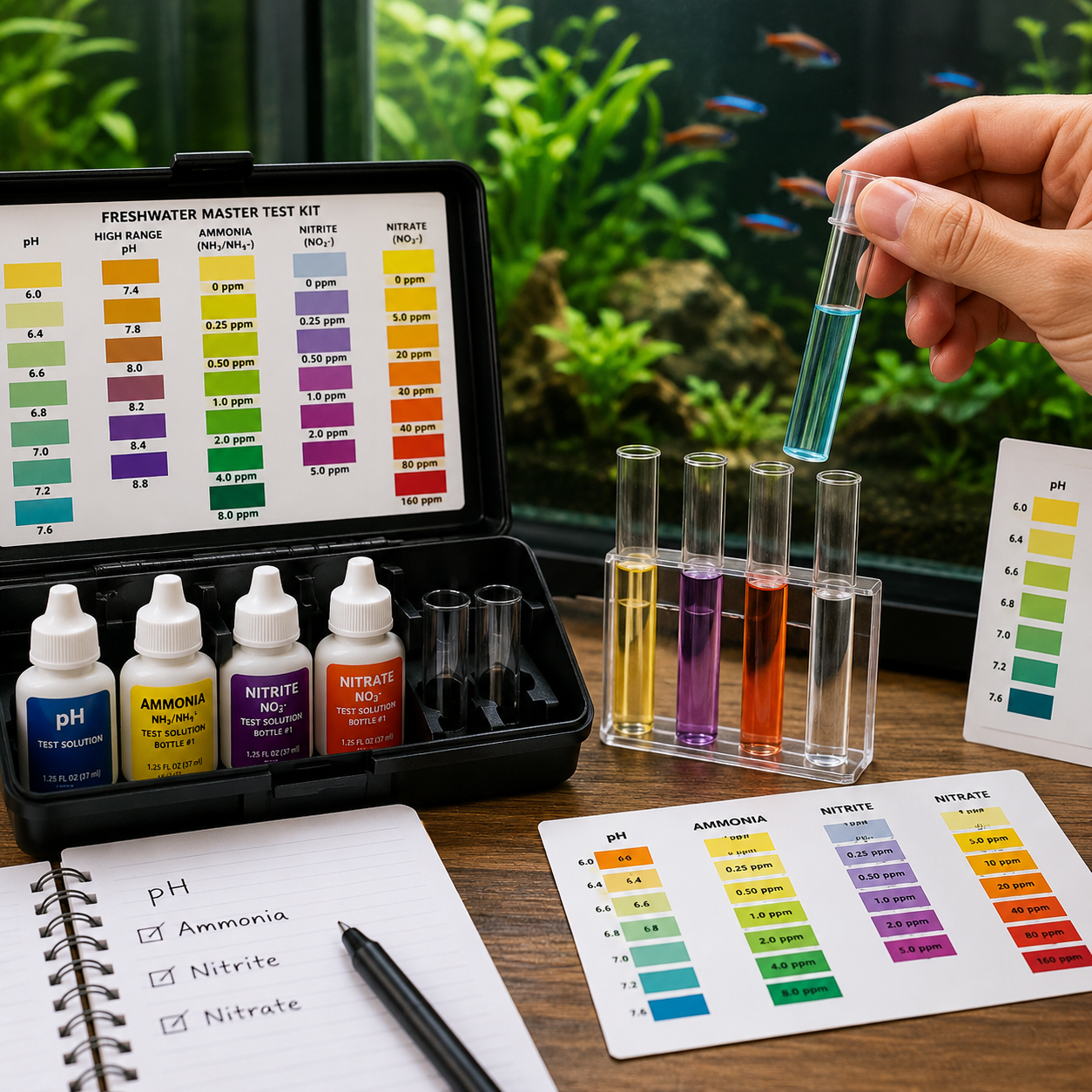
The API Freshwater Master Test Kit is the industry standard entry-level test kit. It tests ammonia, nitrite, nitrate, and pH with 800 tests of reagent included.
Reading tips:
- Always test in natural light or under a white LED
- Read results at the prescribed time — do not wait longer
- Shake the nitrate reagent bottle 2 vigorously before and after adding it to the tube
Test Strips (Convenience Use Only)
Test strips are acceptable for quick routine checks but are not accurate enough for:
- Diagnosing disease-related water quality issues
- Cycling a new tank
- Any reading where the difference between 0 and 0.25 ppm matters
When to Test
| Situation | What to test | When |
|---|---|---|
| New tank cycling | Ammonia, nitrite, nitrate | Every 2–3 days |
| Just added fish | Ammonia, nitrite | 3 days after addition |
| Fish acting sick/lethargic | Full panel: NH3, NO2, NO3, pH | Immediately |
| Routine maintenance | Ammonia, nitrate, pH | Monthly |
| After medication | Ammonia, nitrate | Throughout and after treatment |
| After large water change | pH, GH/KH | Same day |
Understanding Cycling
A "cycled" tank has a colony of beneficial bacteria (primarily Nitrosomonas and Nitrospira) established in the filter media that converts ammonia → nitrite → nitrate continuously.
Signs your tank is fully cycled:
- Ammonia: 0 ppm
- Nitrite: 0 ppm
- Nitrate: >0 ppm (nitrate present confirms the cycle is running)
Until these conditions are met, do not add fish to the tank.
Water Testing Quick Reference
| Parameter | Safe range | Emergency action |
|---|---|---|
| Ammonia | 0 ppm | 30–50% water change immediately |
| Nitrite | 0 ppm | 30–50% water change immediately |
| Nitrate | < 20 ppm | Increase water change frequency |
| pH | 6.5–7.5 (species dependent) | Identify cause; adjust via water changes |
| GH | Species dependent | Adjust water source or remineralise |
| KH | 4–8° for most setups | Add buffer if below 2° |
Browse our complete water testing range — API test kits, GH/KH tests, and water care products available in Singapore.