
Aquascaping Mistakes Beginners Make: Layout, Planting, Lighting, and Maintenance Errors
The gap between a planted tank that looks impressive and one that looks chaotic is almost never about expensive plants or equipment. It is almost always about a small set of design and management decisions that experienced aquascapers follow as second nature. Here are the most common aquascaping mistakes beginners make.
Layout and Design Mistakes
1. Centring Everything
The mistake: Placing the main rock, driftwood, or specimen plant in the exact centre of the tank.
Why it fails: Perfect symmetry looks artificial and static. Natural landscapes are asymmetric — the beauty of a mountain or forest comes from its imperfect, dynamic balance.
The fix: Use the rule of thirds or Golden Ratio. Place the focal element one-third from the left or right wall — never in the middle.
2. All Plants the Same Height
The mistake: Planting everything at roughly equal height, creating a flat "wall of green" across the entire tank.
Why it fails: Without height variation, the tank has no depth or visual layers. Everything looks equally distant and equally important.
The fix: Use three height zones — low foreground, medium midground, tall background. The height difference creates perspective and depth.
3. Too Many Species
The mistake: Buying 10–15 different plant species for a 60-litre tank, creating a chaotic mix of textures and colours.
Why it fails: Strong aquascapes use few species in deliberate quantities. Many species in small amounts creates visual noise, not visual richness.
The fix: Use 4–6 species maximum in a beginner layout. Plant each species in a clearly defined group of at least 5–7 plants of the same species.
4. No Negative Space
The mistake: Filling every centimetre of the tank with plants, rocks, and decoration.
Why it fails: Without open space, the eye has nowhere to rest, and nothing stands out as focal. Everything competes equally for attention.
The fix: Leave at least 20–30% of the visible substrate as open foreground. Open sand or carpet beside a planted section makes the planting look more lush, not less.
Planting Mistakes
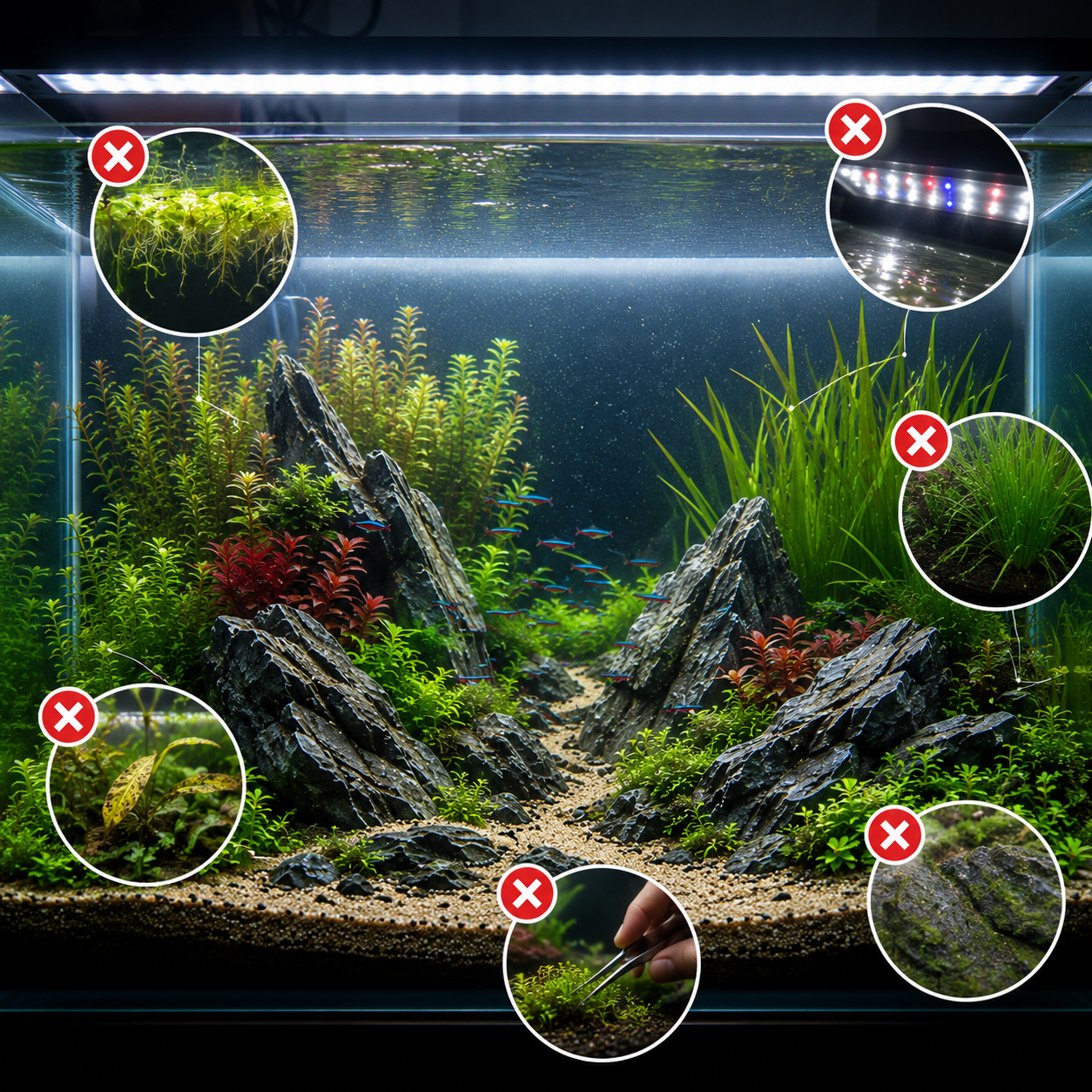
5. Burying Anubias Rhizomes
The mistake: Planting anubias with the rhizome (horizontal stem) buried in substrate.
Why it fails: The anubias rhizome rots when buried. The plant yellows, leaves drop, and it eventually dies.
The fix: Attach anubias to driftwood or rocks with fishing line or glue. If planting in substrate, ensure the entire rhizome sits above the substrate surface.
6. Planting Stem Plants Too Deep
The mistake: Burying the lower 5–10 cm of stem plants in substrate to "secure" them.
Why it fails: The buried section becomes anaerobic and rots. The plant loses its anchor and floats to the surface within days.
The fix: Plant stem plants with only 1–2 cm of stem in substrate — just enough for the roots to anchor. Use planting tweezers to insert individual stems vertically.
7. Not Planting Dense Enough
The mistake: Spacing plants too widely, expecting them to "grow in and fill the gap" over time.
Why it fails: Sparse planting invites algae to colonise the open substrate between plants before the plants can cover it. The "fill in" rarely happens as expected.
The fix: Plant densely from the start — closer together than seems necessary. For stem plants, 2–3 cm spacing. For carpet plants, tight plugs covering 70–80% of the target area.
Lighting Mistakes
8. Too Long a Photoperiod
The mistake: Running aquarium lights for 12–14 hours per day, thinking "more light = better growth."
Why it fails: In the absence of matching CO2 and nutrients, long photoperiods cause algae blooms rather than plant growth.
The fix: 8 hours per day maximum for low-tech tanks; 8–10 hours for high-tech CO2-injected tanks. Use a timer — never rely on manual on/off.
9. Wrong Light Spectrum
The mistake: Using generic household LED bulbs for aquarium lighting.
Why it fails: Regular household LEDs are not spectrally optimised for plant photosynthesis. They may provide visible light but limited photosynthetically active radiation (PAR).
The fix: Use a planted tank LED designed for aquarium use (Chihiros, Fluval Plant, Twinstar, or similar). These are optimised for plant growth and available in Singapore.
Maintenance Mistakes
10. Skipping Water Changes
The mistake: Assuming a planted tank is "balanced" and does not need regular water changes.
Why it fails: Even heavily planted tanks accumulate nitrates, phosphates, and waste compounds over time. Without water changes, algae eventually takes hold and water quality degrades.
The fix: 25–30% water change weekly. Planted tanks do need this; the plants help but do not eliminate the requirement.
11. Over-Cleaning the Filter
The mistake: Cleaning or replacing all filter media at once, or cleaning the filter with tap water.
Why it fails: Beneficial bacteria live in filter media. Removing all media at once or using chlorinated tap water destroys the bacterial colony and triggers a new nitrogen cycle spike.
The fix: Clean only half the filter media at a time. Always use tank water (not tap water) to rinse filter sponges.
Browse our planted tank equipment, substrates, and plant range to set up your aquascape correctly from the start.