
Beginner Aquascaping Guide: How to Design Your First Planted Aquarium Layout
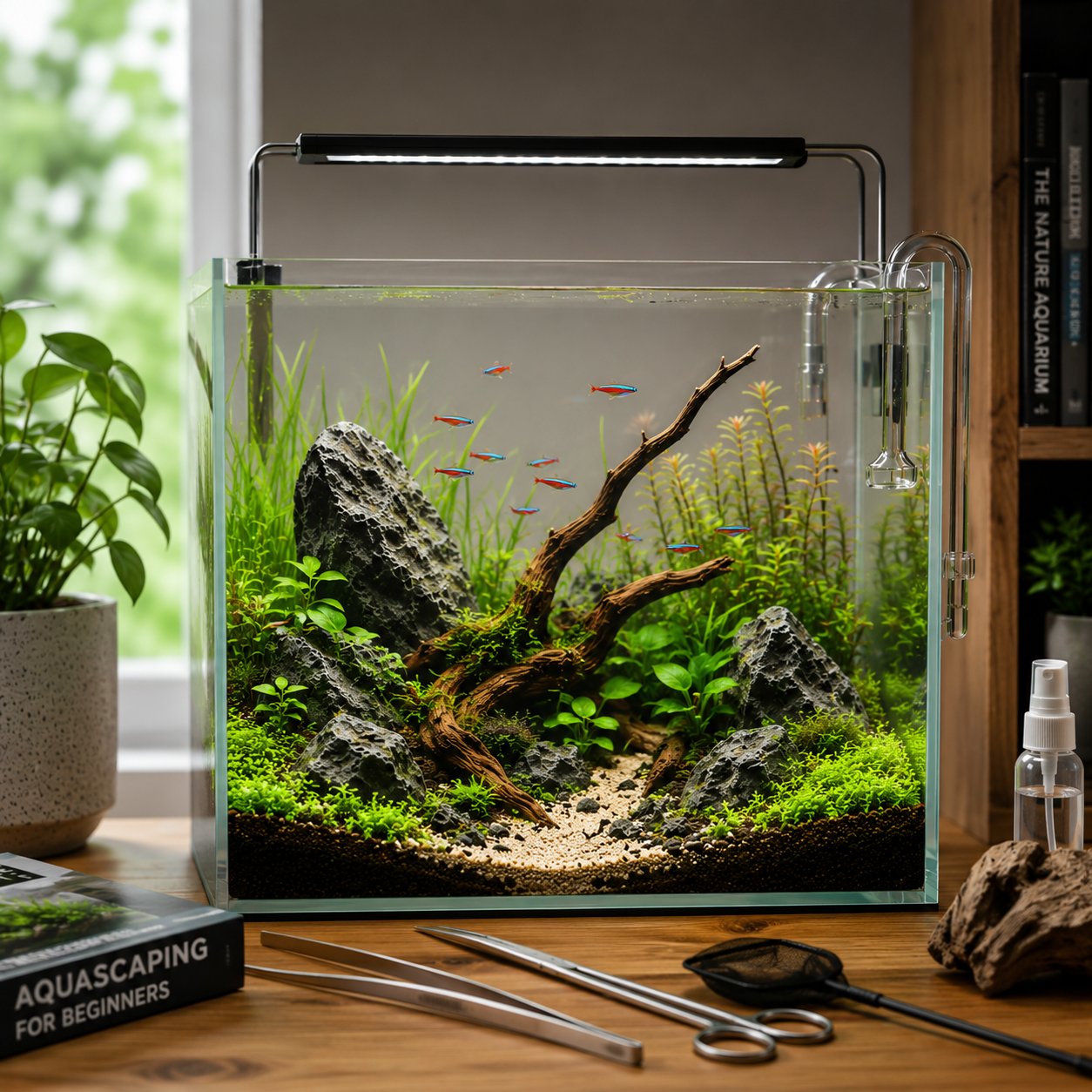
Aquascaping is the art of designing and arranging plants, rocks, and driftwood inside an aquarium to create a visual composition — a living landscape in miniature. The gap between a random collection of plants and a beautiful aquascape is not talent or expensive equipment: it is understanding a small set of compositional rules.
This guide gives you those rules, a concrete starting point, and a first-tank plan you can execute immediately.
Start with a Style Decision
Before buying anything, decide which style suits your goals and skill level:
| Style | Difficulty | CO2 needed | Best first tank? |
|---|---|---|---|
| Jungle / natural | Easy | No | ✓ Best starting point |
| Nature Aquarium | Moderate | Yes | Possible with low-tech plants |
| Iwagumi | Hard | Yes | Not recommended first |
| Dutch | Hard | Yes | Not recommended first |
Recommendation for beginners: Start with a Nature Aquarium-inspired layout using low-tech plants. This gives you the compositional lessons of proper style without the CO2 and high-tech demands.
The Core Design Rules
Rule 1: Odd Numbers
Group plants, rocks, and decorations in odd numbers (1, 3, 5) — never 2 or 4. Even numbers look deliberately placed; odd numbers look natural.
Rule 2: The Golden Ratio / Rule of Thirds
Divide the tank into thirds horizontally and vertically. Place your focal point — the main rock, driftwood, or plant group — at one of the intersection points, not in the dead centre.
Rule 3: Vary Heights
Plant taller species at the back, medium species in the midground, short species at the front. Never let all plants be the same height — this creates a "flat" layout with no depth.
Rule 4: One Focal Point
A beginner aquascape should have one clear focal point — one area where the most visual interest is concentrated. Multiple competing focal points create a confusing layout.
Rule 5: Leave Negative Space
Resist the urge to fill every square centimetre. Open substrate in the foreground, clear swimming areas — these create breathing room and make the planted sections look more lush by contrast.
Your First Tank: The Simple Triangle (60 litre)
A triangular composition is the most achievable first layout:
What to buy:
- 1 bag quality aquasoil (ADA Amazonia, Tropica, or similar)
- 1 piece of interesting driftwood (spider wood or Malaysian)
- 3 pots of Anubias nana petite (tied to driftwood)
- 1 portion of Java moss (tied to driftwood and lower wood sections)
- 1 bunch of Cryptocoryne wendtii (midground left or right)
- 1 bunch of Vallisneria nana (background left)
- 1 cup Java moss mat or Monte Carlo (foreground)
How to plant it:
- Add substrate: slope from 8 cm at the back to 4 cm at the front
- Position driftwood slightly off-centre (at 1/3 or 2/3 position)
- Attach anubias to driftwood with thread
- Plant crypts in the midground on one side
- Plant vallisneria in the back corner on the same side as the crypts
- Spread java moss or plant Monte Carlo across the foreground
- Leave the opposite foreground corner open
Low-Tech Plant Choices for Beginners
These plants require no CO2, low-medium light, and minimal fertilisation:
- Anubias (any variety): Indestructible; tied to hardscape
- Java fern (any variety): Extremely hardy; tied to hardscape or substrate
- Cryptocoryne (wendtii, balansae): Grows slowly but reliably
- Java moss: Works everywhere; no requirements
- Vallisneria nana: Fast background filler; very easy
- Bucephalandra: Slow but stunning; attached to hardscape
Cycling Before Adding Fish
Always cycle the tank before adding fish:
- Set up the tank with substrate, plants, and filter
- Run the filter for 4–6 weeks (fishless cycle using ammonia or bacterial starter)
- Test weekly: when ammonia = 0, nitrite = 0, nitrate > 0 — the cycle is complete
- Add fish gradually, starting with the most hardy species
Common Beginner Mistakes to Avoid
- Buying too many plant species — 4–6 species is plenty for a first tank
- Planting everything at the same height
- No focal point — the eye has nowhere to land
- Skipping the cycle — adding fish to an uncycled tank causes rapid deaths
Browse our beginner plant collections and starter kits — all species listed available for delivery across Singapore.