
Complete Guide to Blackwater Aquariums: Fish, Botanicals, Tannins, and Maintenance
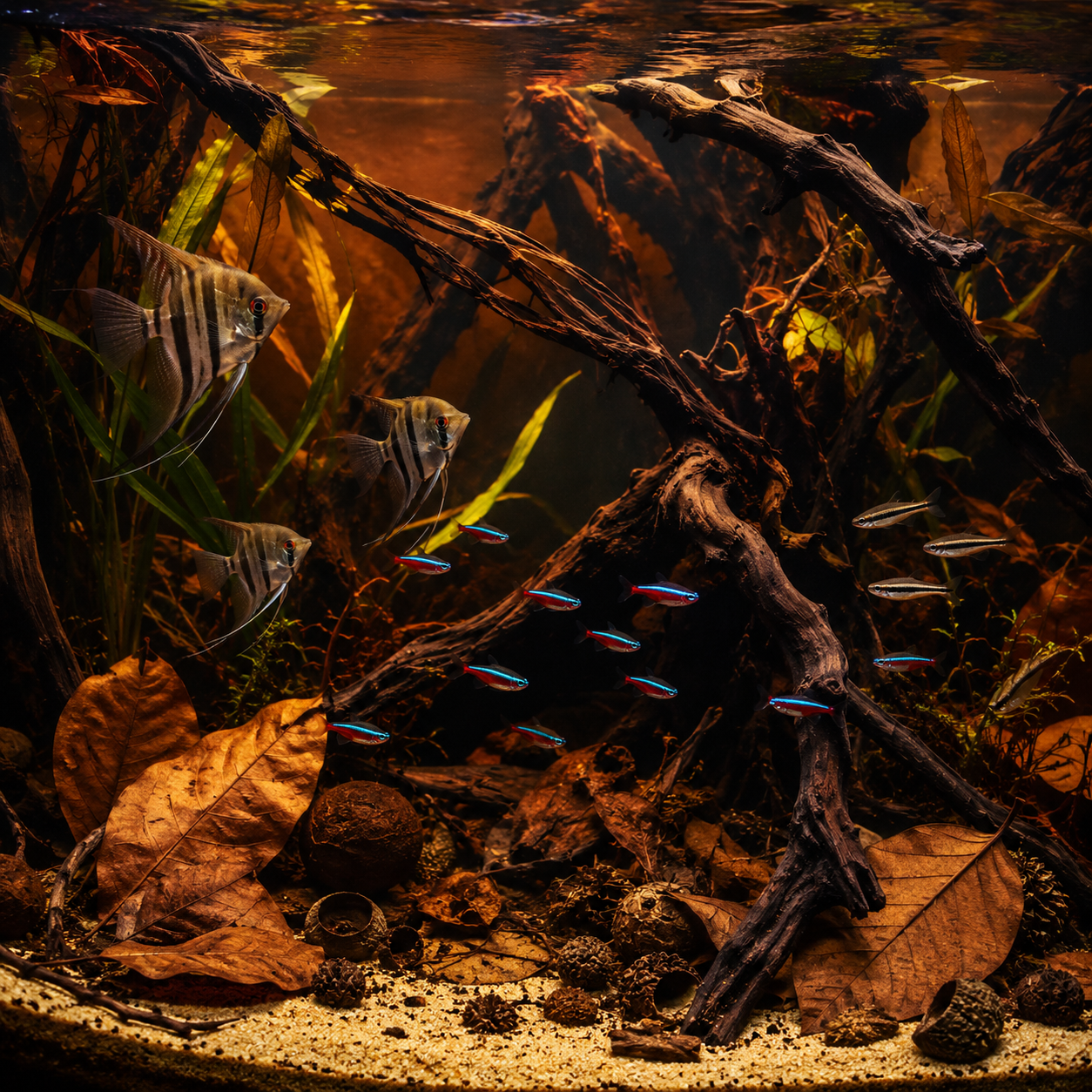
Blackwater aquariums recreate the wild rivers and peat swamps of Southeast Asia and the Amazon — environments characterised by soft, acidic water stained amber with dissolved tannins. In the aquarium, this aesthetic is achieved with botanicals, specific fish choices, and careful water chemistry management.
What Makes Water "Black"?
Natural blackwater is not actually black — it is clear with an amber or tea-brown tint, the colour of strong black tea. This colouration comes from:
- Humic acids — released by decomposing organic matter
- Tannins — polyphenol compounds from leaves, wood, and seed pods
- Fulvic acids — smaller organic molecules that contribute to the amber colour
In aquariums, these compounds come from botanicals added to the tank.
Water Chemistry
Blackwater fish are adapted to:
- pH: 4.5–6.5 (soft and acidic)
- GH: Very low (1–6°)
- KH: Very low (0–3°)
- TDS: Low (50–150 ppm)
- Temperature: 25–30°C
Singapore tap water (pH ~7.0–7.2, GH ~6°, KH ~2°) is usable as a starting point for less demanding blackwater fish with the addition of botanicals. For specialist species (chocolate gourami, licorice gourami, crystal red shrimp), RO water remineralised to blackwater parameters is ideal.
Best Fish for Blackwater Tanks
| Fish | Tank size | Difficulty | Notes |
|---|---|---|---|
| Cardinal tetra | 60+ litres | Easy | Iconic blackwater schooling fish |
| Rummy nose tetra | 80+ litres | Easy | Schools tightly; stunning in amber water |
| Discus | 150+ litres | Expert | Deepest colouration in blackwater |
| Apistogramma | 60+ litres | Moderate | Stunning dwarf cichlids; breed in blackwater |
| Chocolate gourami | 60+ litres | Advanced | Requires true blackwater parameters |
| Pencilfish (Nannostomus) | 40+ litres | Moderate | Elegant diagonal swimmers |
| Wild betta (Betta imbellis etc.) | 30+ litres | Moderate | Native to blackwater streams |
Essential Botanicals
Catappa Leaves (Indian Almond Leaves)
The foundation of most blackwater tanks. Add 1–2 leaves per 20 litres; replace as they decompose over 4–6 weeks.
Alder Cones
Small, slow-releasing tannin source. Excellent for nano blackwater tanks and betta setups.
Seed Pods (Cariniana, Mokha, Banana)
Provide structural microhabitat in addition to tannin release. Shrimp and small fish explore pod interiors immediately.
Driftwood and Wood Bark
Long-term tannin release; creates permanent hardscape structure.
Plants in Blackwater Setups
Most aquarium plants grow poorly at very low pH. Best choices for blackwater planted tanks:
- Mosses (java moss, christmas moss) — tolerate very soft, acidic water well
- Bucephalandra — native to Borneo blackwater streams; thrives in low pH
- Anubias — robust; tolerates low pH though not native to blackwater
- Floating plants (frogbit, water sprite) — essential for natural dappled light; remove nutrients rapidly
- Vallisneria — avoid in very low pH; prefers neutral water
Lighting
Blackwater tanks call for warm, dim lighting:
- Colour temperature: 2700K–4000K (warm white)
- Intensity: Low to medium
- Floating plants to create natural dappling
- Avoid cool-white or blue-tinted LED — it creates an unattractive clinical look over amber water
Maintenance Routine
Weekly:
- 20–25% water change with soft water
- Vacuum botanical debris from substrate
- Check pH — add catappa leaves if too high
Monthly:
- Replace 30–40% of botanicals (staggered)
- Clean filter sponge in tank water
- Check TDS and GH — adjust remineralisation if using RO
Avoid These Common Mistakes
- Using activated carbon in the filter — removes tannins immediately
- Adding too many botanicals at once — causes rapid pH crash; add in stages over 1–2 weeks
- Hard water fish in blackwater — mollies, livebearers, and Rift Lake cichlids are incompatible with soft, acidic conditions
Browse our botanical collection and specialty livestock for your blackwater aquarium setup.