

Complete Guide to Breeding Freshwater Aquarium Fish at Home
Breeding freshwater fish at home is achievable at almost every level of the hobby — from the accidental guppy fry that appears in a community tank to the deliberate spawning of discus pairs in a dedicated setup. This guide covers the fundamentals of freshwater fish breeding, fry care, and what you need to succeed.
Part 1: Livebearers (Easiest to Breed)
Livebearers — guppies, platies, mollies, endlers — give birth to fully formed, free-swimming fry. They breed readily without any special conditioning.
Why Livebearers Are Ideal for Beginners
- No egg care required — fry are born independent
- Females can store sperm for months — a single female can produce multiple batches without a male present
- Very obvious breeding signs (swollen belly, gravid spot darkening on females)
- Fry are large enough to eat commercial fry food from birth
Livebearer Breeding Setup
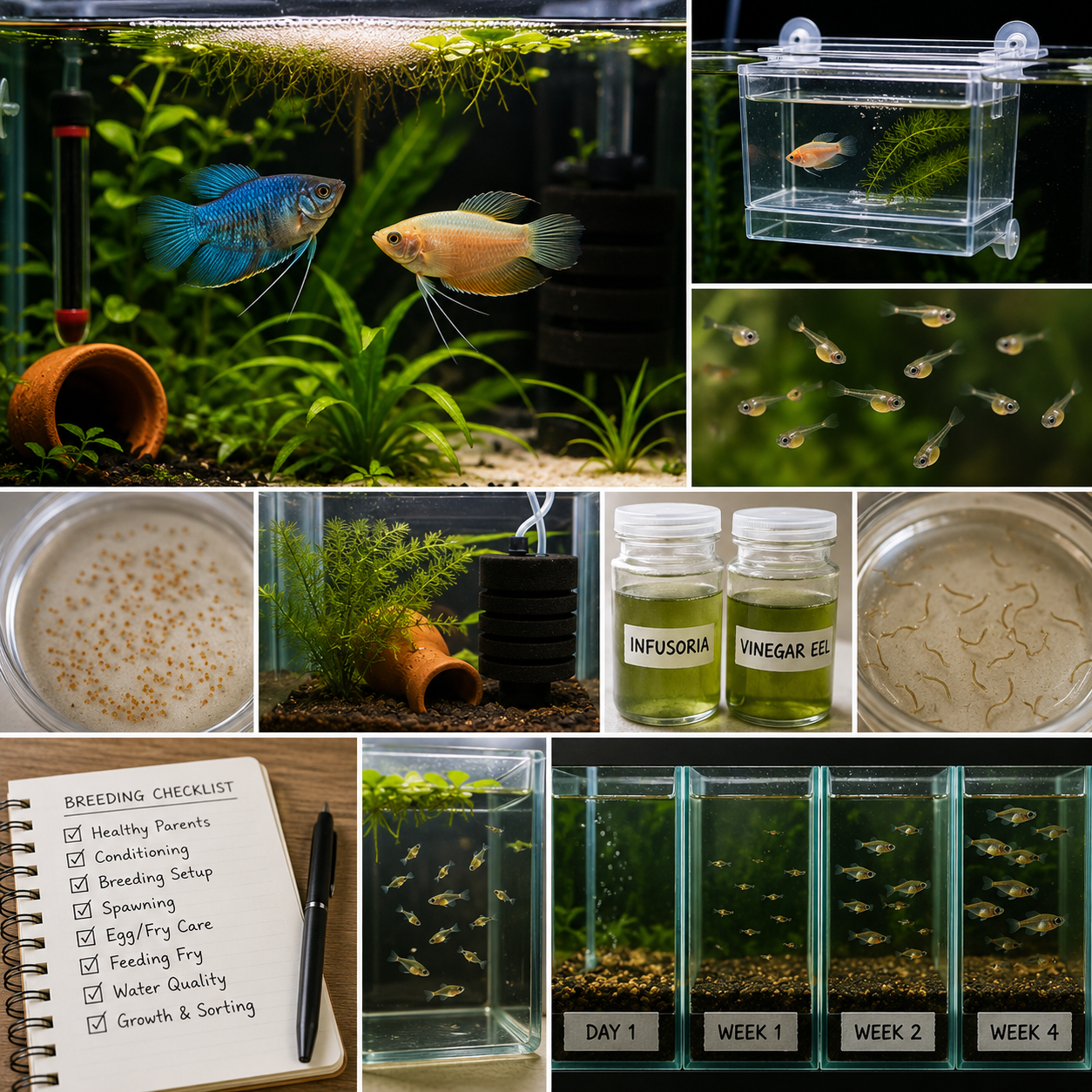
Basic community approach: A planted tank with java moss and floating plants allows 10–30% of fry to survive naturally — adults eat fry they encounter but cannot catch all of them in a densely planted tank.
Breeding box: For higher survival, isolate heavily pregnant females in a breeding box 1–2 days before expected birth. Remove the female immediately after birth — she will eat fry.
Nursery tank: A 10–20 litre tank with a sponge filter, java moss, and floating plants; raise fry here for 4–6 weeks until large enough to join adults.
Part 2: Egg Layers
Most tetras, rasboras, corydoras, and killifish are egg layers. They require more deliberate conditioning and usually a separate breeding setup.
Spawning Triggers
Common triggers for egg-layer spawning:
- Water changes with slightly cooler water: Mimics the start of the rainy season
- Improving diet: Increase frozen food feeding for 1–2 weeks before attempted spawning
- Lowering pH slightly: For soft-water tetras and rasboras
- Separating males and females for 1 week before reuniting in a spawning tank
Egg Protection
Most tetras, rasboras, and barbs eat their own eggs immediately after spawning. Solutions:
- Use a spawning mop or dense java moss where eggs fall through and hide
- Use a mesh or marbles on the substrate — eggs fall through and parents cannot reach them
- Remove parents immediately after spawning
Fry Feeding Progression
| Age | Food |
|---|---|
| Day 1–3 | Yolk sac absorption — do not feed |
| Day 4–10 | Infusoria or commercial liquid fry food |
| Day 10–21 | Baby brine shrimp (newly hatched Artemia) |
| Day 21+ | Micro-pellets, crushed flake |
| Week 6–8 | Standard fry pellets |
Part 3: Cichlid Breeding
Cichlids are the most rewarding fish to breed — many species pair bond, spawn repeatedly, and provide elaborate parental care.
Substrate Spawners (Corydoras, Dwarf Cichlids)
- Spawn on flat stones, broad leaves, or in cave structures
- Both parents typically guard eggs and fry
- Provide smooth flat rocks and caves in the tank
Mouthbrooders (Many African Cichlids)
- Female (or sometimes male) holds eggs and fry in the mouth
- Do not disturb mouthbrooding females
- Separate fry when released and large enough to feed independently
German Blue Ram Breeding
- Bond as a pair and spawn on flat substrate
- Both parents guard eggs aggressively (will chase away all tankmates)
- Eggs hatch in 48–72 hours; fry become free-swimming in 5–7 days
- Feed fry baby brine shrimp from free-swimming stage
Part 4: Shrimp Breeding
Neocaridina shrimp breed readily in any established, well-planted tank:
- Female carries 15–25 eggs under her tail for 4–5 weeks (she is "berried")
- Juveniles emerge fully formed and immediately independent
- They are essentially self-sustaining once established
Essential Breeding Equipment
| Equipment | Use |
|---|---|
| Sponge filter (small) | Nursery tank filtration — safe for fry |
| Breeding box (in-tank) | Short-term fry isolation |
| Spawning mop | Egg collection for egg scatterers |
| Flat smooth stones | Substrate spawning for cichlids and corys |
| Cave/ceramic tube | Breeding cave for cave spawners |
| Baby brine shrimp hatchery | Fresh Artemia for fry feeding |
Browse our breeding accessories and livestock — available for delivery across Singapore.