
Carpet Plant Aquascape Guide: How to Grow a Lush Foreground in a Planted Tank
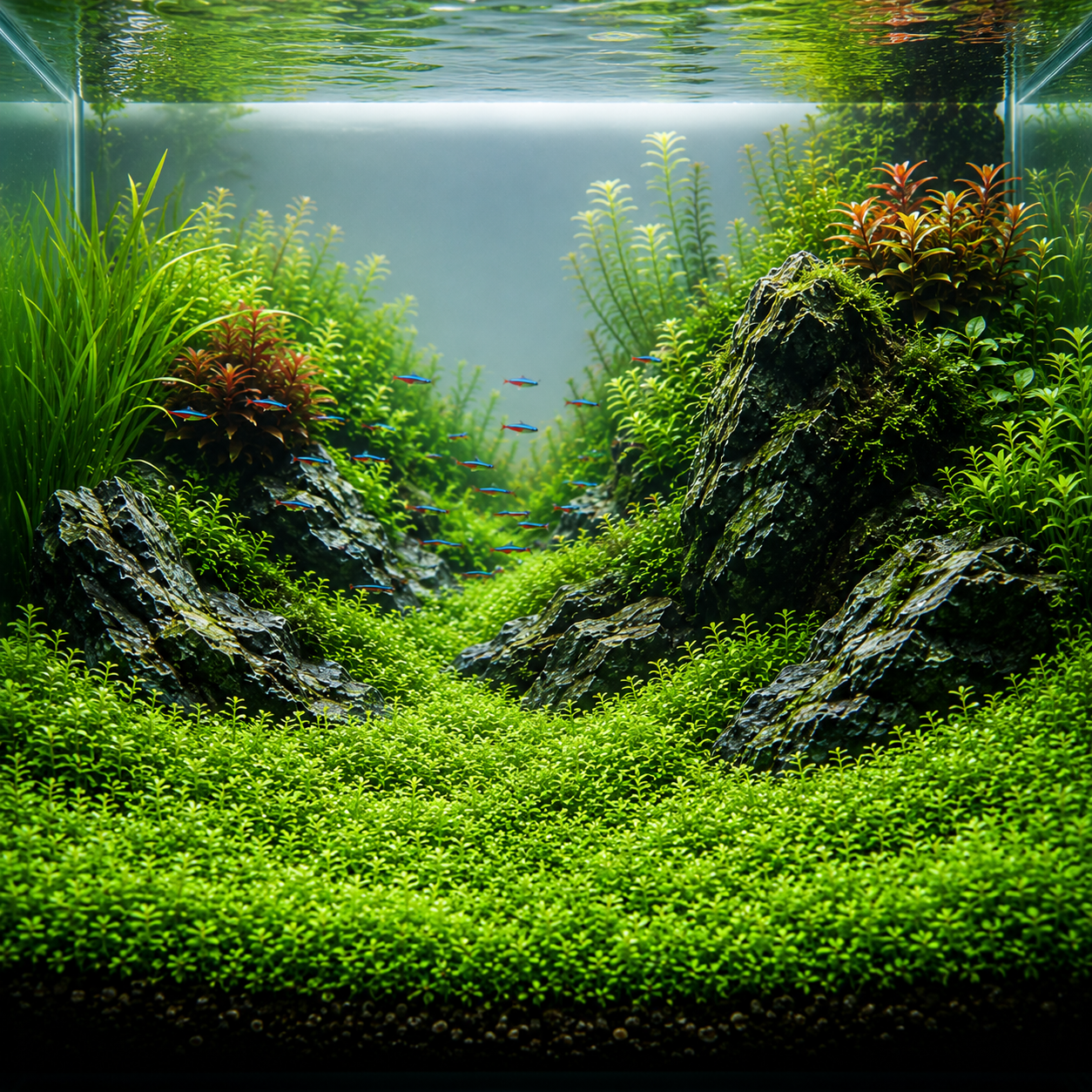
Few things in the planted aquarium hobby are more satisfying than a dense, wall-to-wall carpet of tiny plants covering the foreground substrate. Whether it is the precise jewel-like miniature leaves of HC Cuba, the round bright green rounds of Monte Carlo, or the fine grass blades of dwarf hairgrass, a healthy carpet transforms a planted tank from good to extraordinary.
But carpet plants are among the most demanding plants in the hobby to establish successfully. Here is what you actually need to know.
Why Carpet Plants Fail
Understanding failure modes helps you prevent them:
- Insufficient light: Carpet plants need the most light of any aquarium plant — they are on the substrate, furthest from the light source, and compete with overhead plants for photons
- No CO2: Most true carpet plants grow extremely slowly without CO2 injection and often melt entirely
- Wrong substrate: Carpet plants need something to root into — they will not establish on bare gravel or sand without root tabs
- Planted too deeply: Carpeting plants should have only their roots covered; burying the stem causes rot
- Algae outcompeting early growth: During the establishment phase (first 3–6 weeks), carpet plants are vulnerable to algae that colonise the substrate faster than the plants can cover it
Carpet Plant Options by Difficulty
Beginner-Accessible
Marsilea crenata (four-leaf clover)
- The most forgiving carpeting plant
- Grows in medium light without CO2 — the only true carpet plant that does
- Reaches 3–5 cm; spreads slowly by runners
- Best planted in small plugs spaced 2–3 cm apart
Monte Carlo (Micranthemum 'Monte Carlo')
- Round, bright green leaves; extremely photogenic
- Grows in medium light; grows much faster with CO2
- More forgiving than HC Cuba; can establish in low-tech tanks (slowly)
- Best planted in dense plugs trimmed into the substrate
Intermediate
Eleocharis acicularis 'Mini' (Dwarf hairgrass)
- Fine grass blades; natural appearance
- Spreads by runners once established
- Needs medium-high light and benefits from CO2
- Uproot and replant if algae takes hold — very important to maintain high light during establishment
Staurogyne repens
- Bushy, compact; slightly taller than true carpets (5–8 cm) but stays low
- Grows in medium light without CO2 (slowly)
- Good for low-tech hobbyists wanting some foreground structure
Advanced
HC Cuba (Hemianthus callitrichoides 'Cuba')
- The smallest carpeting plant in the hobby (1–2 mm leaves)
- Most demanding: requires high light (60–100 PAR), pressurised CO2 (30 ppm), and nutrient-rich substrate
- Creates the most refined, jewel-like carpet
- Fails completely without CO2; melts, goes brown, and is colonised by algae
Glossostigma elatinoides
- Classic carpet plant; slightly larger than HC Cuba
- Similar requirements to HC Cuba
- Grows in horizontal sheets; looks spectacular when fully established
The Dry-Start Method
For HC Cuba and difficult carpeting plants, the dry-start method (DSM) is the most reliable establishment technique:
- Set up the tank with substrate and hardscape but do not fill with water
- Plant carpet plants densely across the substrate
- Mist with dechlorinated water 2× daily to keep substrate moist
- Cover the tank with cling wrap to maintain high humidity
- Run lights on an 8-hour cycle
- After 4–6 weeks the carpet will be fully established on exposed soil
- Slowly flood the tank — raise the water level 2–3 cm per day over 1 week
The DSM bypasses the most difficult phase (early underwater establishment) entirely.
After Establishment: Trimming
Once carpeting plants cover the substrate:
- Trim horizontally with long curved scissors every 2–3 weeks
- Remove trimmings immediately — decomposing carpet clippings cause algae spikes
- Maintain a flat, even surface — do not allow the carpet to grow upward and become a tangled mass
Algae Management During Carpet Establishment
- Add 5–10 Amano shrimp immediately when flooding begins
- Add 3–5 otocinclus catfish once the tank is cycled
- Reduce photoperiod to 6–7 hours if algae appears
- Do not add fish until the carpet is fully established
Browse our carpeting plants, CO2 equipment, and aquasoil — available for delivery across Singapore.