
Carpeting Plants vs Moss Carpets: Which Foreground Style Is Easier?
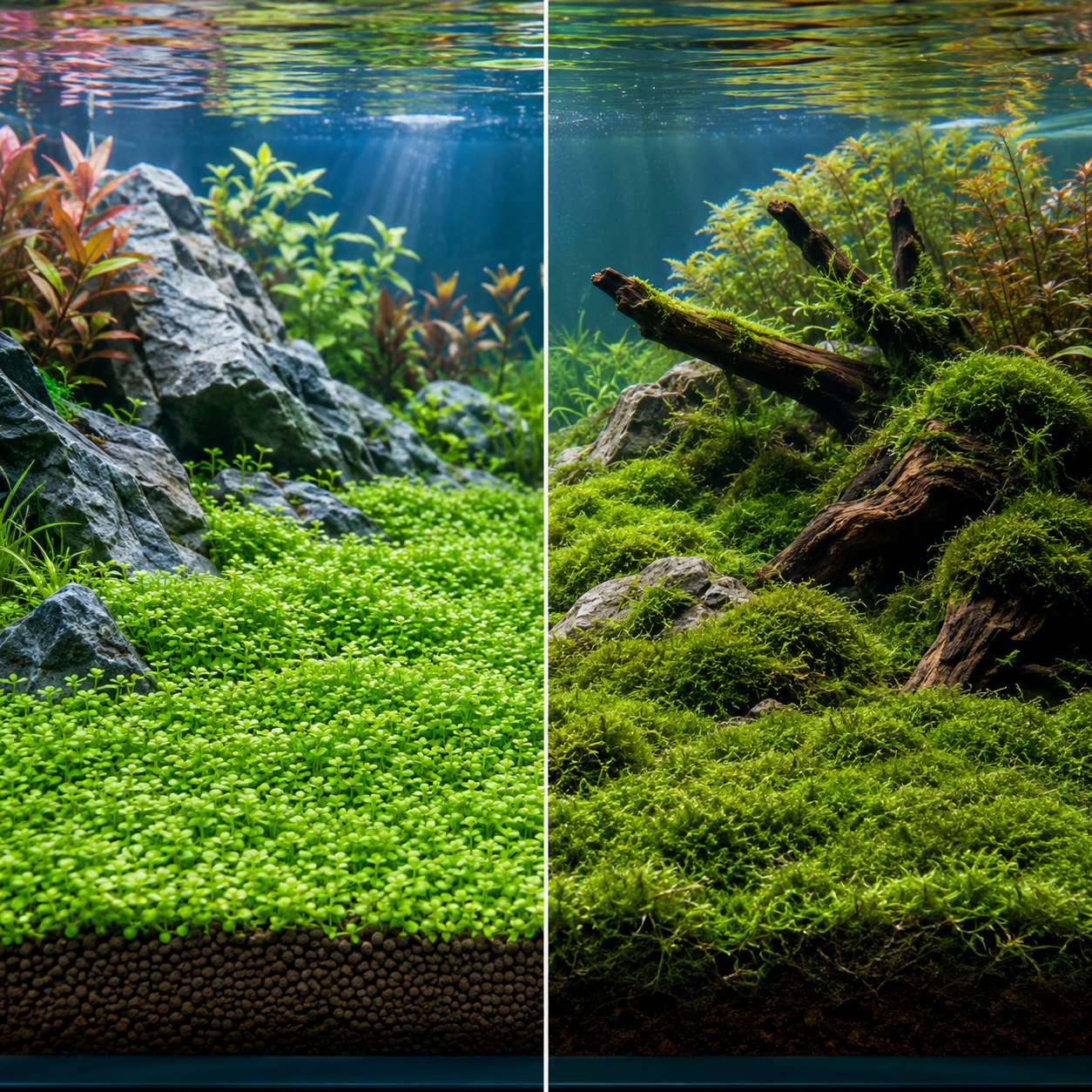
A dense green carpet covering the foreground of a planted tank is one of the most iconic images in aquascaping. But achieving it is harder with some plants than others. Carpeting plants like HC Cuba and monte carlo have very different requirements to moss carpets using java moss or fissidens. Here's a full comparison to help you decide.
Carpeting Plants
True carpeting plants grow horizontally across the substrate, forming a low, dense lawn effect. Popular options include:
- Hemianthus callitrichoides 'Cuba' (HC Cuba): The smallest carpeting plant, with tiny 1–2 mm round leaves. Requires CO2, strong light, and nutrient-rich aquasoil.
- Monte Carlo (Micranthemum 'Monte Carlo'): Slightly larger than HC Cuba with rounder leaves. Grows in medium light; CO2 is recommended but not always essential.
- Dwarf hairgrass (Eleocharis acicularis 'Mini'): Fine grass-like blades. Spreads by runners. Grows in medium–high light; CO2 helpful.
- Marsilea crenata: Small, four-leaf clover-like plant. One of the most forgiving carpeting species, tolerating lower light and no CO2.
Requirements for Carpeting Plants
| Plant | Light | CO2 | Difficulty |
|---|---|---|---|
| HC Cuba | High | Required | Hard |
| Monte Carlo | Medium | Recommended | Moderate |
| Dwarf hairgrass | Medium–high | Helpful | Moderate |
| Marsilea crenata | Low–medium | Not required | Easy |
Advantages
- Creates the most polished, professional-looking foreground
- Variety in texture — from grass to tiny round leaves
- Grows permanently rooted — stays in position once established
Disadvantages
- HC Cuba and most small-leaved carpeting plants need CO2 injection
- Can melt and fail if water parameters are incorrect
- Requires frequent fertilisation for healthy, dense growth
Moss Carpets
Moss carpets are created by growing java moss, fissidens, christmas moss, or similar species flat across the substrate using a mesh mat or pinned directly to the bottom.
Advantages
- No CO2 needed: Mosses thrive in low-tech setups
- Low light tolerance: Java moss grows in almost any lighting condition
- Easy to establish: Spread thinly across mesh, weight down, and it fills in over 4–6 weeks
- Excellent for shrimp and fry: Provides far more hiding cover than smooth carpeting plants
- Lower cost: Moss is generally cheaper to start than carpeting plants
Disadvantages
- Less precise appearance: Moss carpets have an organic, irregular look — not the manicured lawn of HC Cuba
- Can trap debris: Moss holds detritus in its matrix, requiring regular blowing out during water changes
- Growth management: Without trimming, moss grows upward and loses its carpet shape
Which Should You Choose?
Choose carpeting plants if:
- You have CO2 injection and strong lighting
- You want a clean, minimalist Iwagumi or Nature Aquarium aesthetic
- You are comfortable with more demanding plant care
Choose a moss carpet if:
- You have a low-tech setup without CO2
- You keep shrimp (moss provides far better habitat)
- You prefer an organic, natural-looking foreground
- You are new to aquascaping
For beginners in Singapore, monte carlo or marsilea crenata are the best carpeting plants to start with — forgiving, attractive, and widely available. Browse our plant collection to find your foreground species.