
Community Tank vs Species-Only Tank: Which Aquarium Setup Should You Choose?
One of the most important decisions when planning a new aquarium is whether to keep multiple species together or dedicate the tank to one. Both have distinct advantages depending on your goals, experience level, and the fish you want to keep.
What Is a Community Tank?
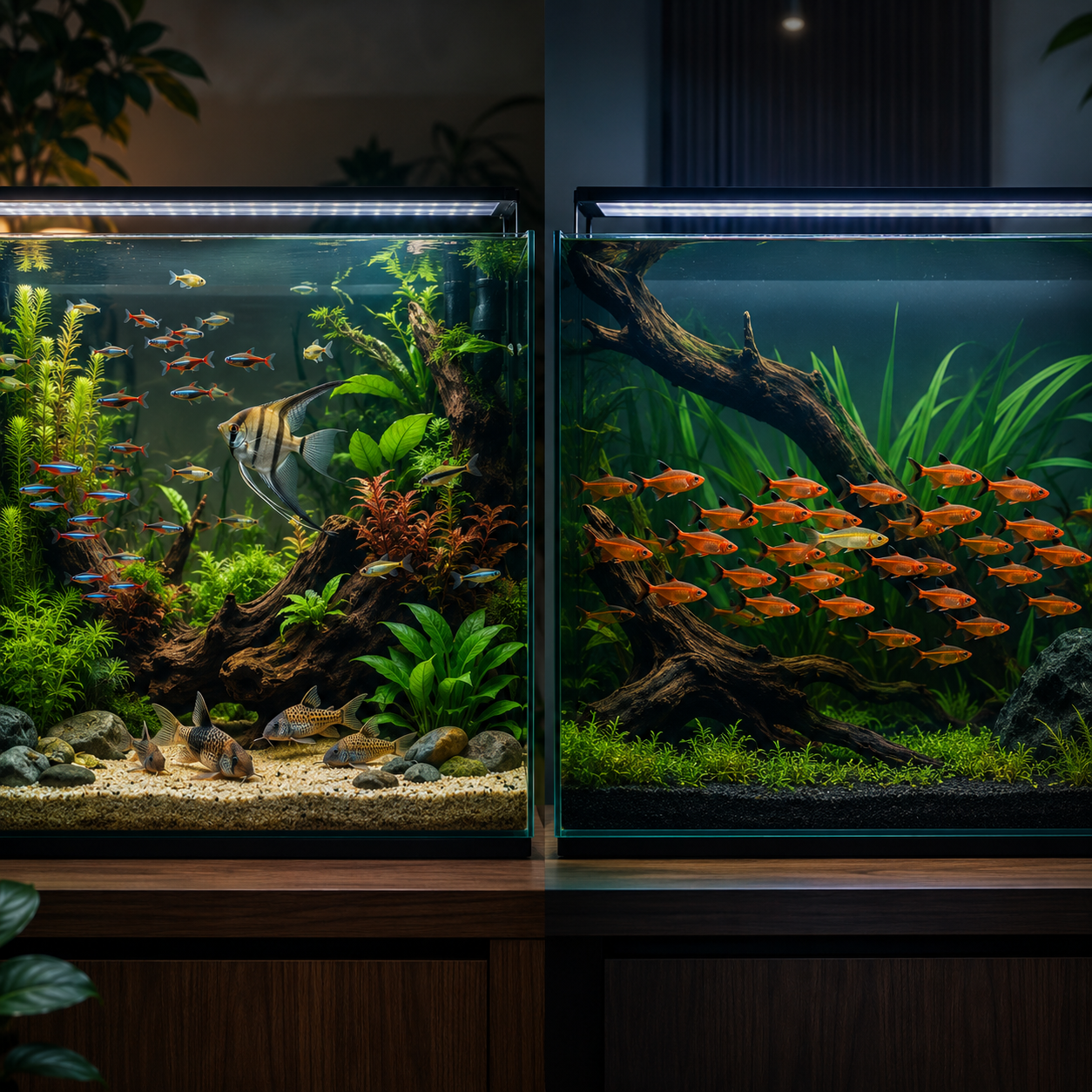
A community tank houses multiple compatible species together — for example, a school of harlequin rasboras, a group of corydoras, some amano shrimp, and an otocinclus. The goal is a harmonious, layered ecosystem with activity at every water level.
What Is a Species-Only Tank?
A species-only tank (also called a species tank) is dedicated entirely to one species — a betta tank, a discus colony, a crystal red shrimp setup, or a breeding tank for endler guppies. Every parameter decision is optimised for that single species.
Community Tank: Pros and Cons
Advantages
- Visually diverse — different colours, shapes, and swimming behaviours
- More interesting to observe — fish interact across multiple levels
- One tank serves many interests simultaneously
- Simulates natural ecosystem behaviour
Disadvantages
- Requires careful compatibility research before stocking
- Water parameters must be acceptable to all species — true species-optimised parameters are impossible
- Disease spreads to all species; treatment affects all species
- More complex to troubleshoot when problems arise
Species-Only Tank: Pros and Cons
Advantages
- Parameters can be perfectly dialled in for one species
- Breeding is far easier — no predation of fry or eggs by tankmates
- Simpler to medicate and troubleshoot
- Species behaviour is easier to observe without competition or distraction
- Premium species (discus, crystal red shrimp) look their best with no competing visual elements
Disadvantages
- Less visual diversity — can look sparse without thoughtful planting
- A single disease outbreak can wipe the entire tank
- Some species (schooling fish) need conspecifics but not necessarily a full community
When to Choose a Community Tank
- You want a living room display tank with maximum visual variety
- You are keeping hardy, widely compatible species (tetras, rasboras, corydoras)
- Tank size is 60 litres or larger
- Your priority is aesthetics over breeding productivity
When to Choose a Species-Only Tank
- You are keeping sensitive species (discus, dwarf puffer, wild bettas)
- Your goal is breeding and raising fry successfully
- You are keeping shrimp (most fish eat shrimp)
- You want to specialise deeply in one species
Hybrid Approach: Species Groups in a Community
Many experienced hobbyists run a "species group" community — for example, a tank with three distinct species, each occupying a different water level and ecological niche. This gives the visual diversity of a community tank with the compatibility certainty of limited species choices:
Example (100 litre):
- 20× Rummy nose tetra (mid-water)
- 8× Corydoras sterbai (bottom)
- 1 pair German blue ram (bottom/mid)
This is arguably the best of both worlds — visually stunning, ecologically balanced, and easy to maintain.
Browse our livestock collection to plan your setup.