

Concave Aquascape Guide: How to Build a Valley-Style Aquarium Layout
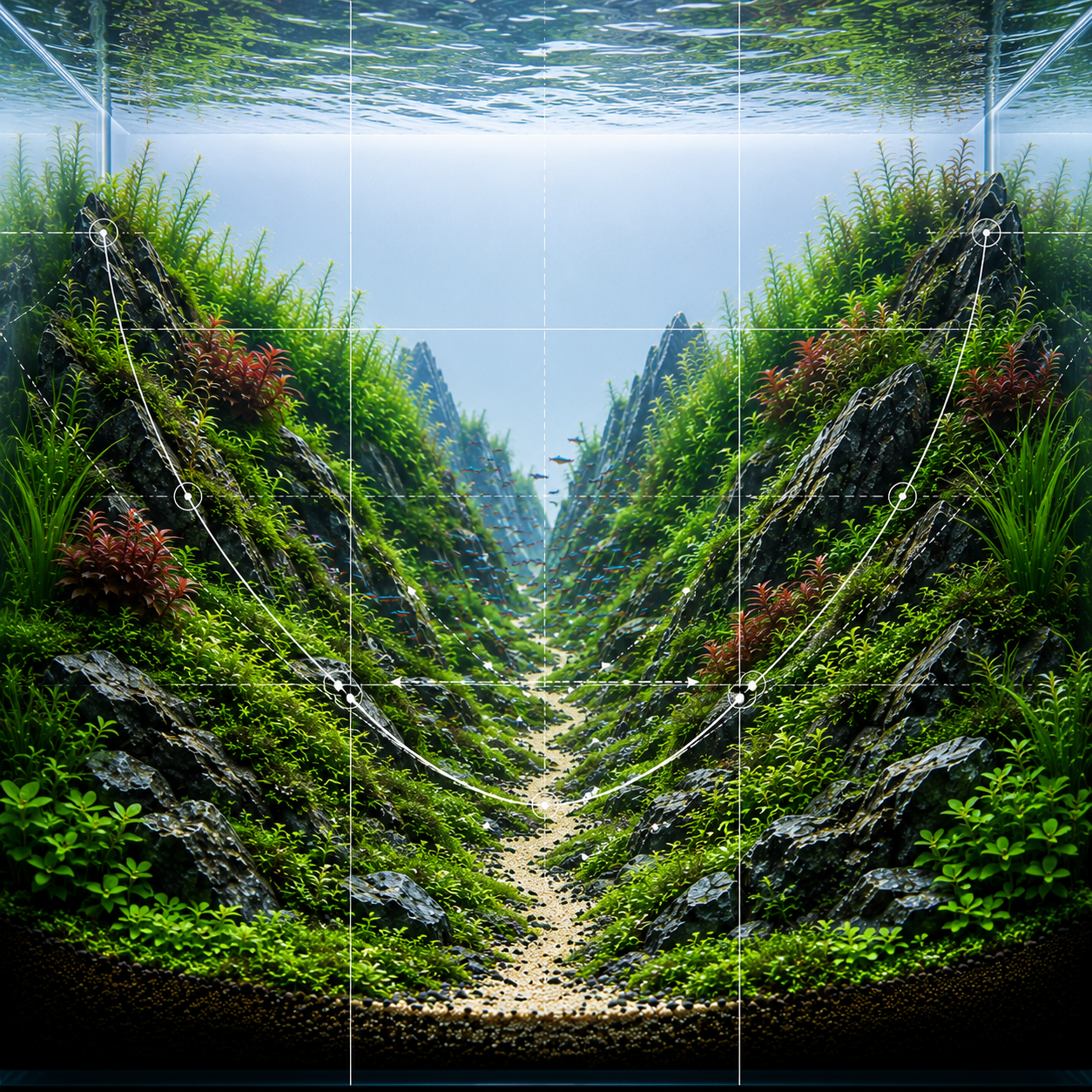
The concave layout is one of the most timeless aquascape compositions — tall planting or hardscape on both sides of the tank, with a lower, open valley running through the centre-foreground. It creates a natural clearing effect: the viewer's eye is drawn into the open central space, creating the illusion of looking into a forest clearing, mountain valley, or riverbed canyon.
What Is a Concave Layout?
In a concave aquascape:
- Both left and right sides are elevated — tall plants, high rocks, or both
- The centre is lower — creating a visual valley or clearing
- The foreground opens up in the centre — inviting the eye into the depth of the composition
- The centre path often contains a carpet or bare substrate — this is the "valley floor"
The name comes from the concave curve of the plant height profile when viewed from the front: high on the edges, low in the middle.
Why Concave Works So Well
The concave layout exploits multiple depth cues simultaneously:
- Framing: The tall sides frame the open centre like a picture frame, focusing attention on the depth
- Atmospheric perspective: A lighter, more open centre area with darker flanking plants reads as "distant" and "close"
- Natural analogy: Valleys, clearings, and canyons are instinctively readable natural spaces
Building a Concave Layout
Step 1: Establish Equal-Height Flanking Structures
The flanking structures should be roughly equal in height (within 10–15%) but not identical — exact symmetry looks artificial. One side typically has denser, more complex planting; the other is slightly lighter.
Options for flanking elevation:
- Dense background stem plants on both sides
- Rock formations that taper toward the centre
- Tall driftwood on each side
- A combination: rock formation on one side, dense planting on the other
Step 2: Create the Valley Floor
The valley floor runs through the centre of the tank from front to back. It should be visually clear and uncluttered:
- HC Cuba or Monte Carlo carpet: The most polished valley floor
- Fine white or dark sand: Natural biotope-style valley
- Very low crypts (C. parva): Subtle texture without obscuring the path
Step 3: Add Central Depth Elements
The valley is not completely empty — small accent elements placed along the central path create depth:
- A single small rock partially buried in the valley floor
- A small group of accent stones at the far back of the valley, creating forced perspective
- A branching piece of mini driftwood partially obscured by the flanking planting
Planting Plan (90 cm concave)
| Position | Plant | Height |
|---|---|---|
| Back left | Rotala wallichii | 35 cm |
| Back left | Rotala rotundifolia | 30 cm |
| Mid left | Java fern on driftwood | 20 cm |
| Back centre | Short accent rock | — |
| Mid right | Anubias barteri on rock | 18 cm |
| Back right | Ludwigia repens | 30 cm |
| Back right | Hygrophila polysperma | 35 cm |
| Foreground | HC Cuba carpet | 2 cm |
Fish for Concave Layouts
The open central path of a concave layout becomes a natural swimming lane for schooling fish:
- Rummy nose tetras or cardinal tetras: School back and forth through the central valley
- Discus or angelfish: Move through the central space with regal authority in a larger tank
- German blue rams: Claim the valley floor as their territory naturally
Browse our aquascape plants, rocks, and carpeting plants for concave layout materials in Singapore.