
Dutch Aquascape Guide: How to Build a Colourful Planted Aquarium Without Hardscape
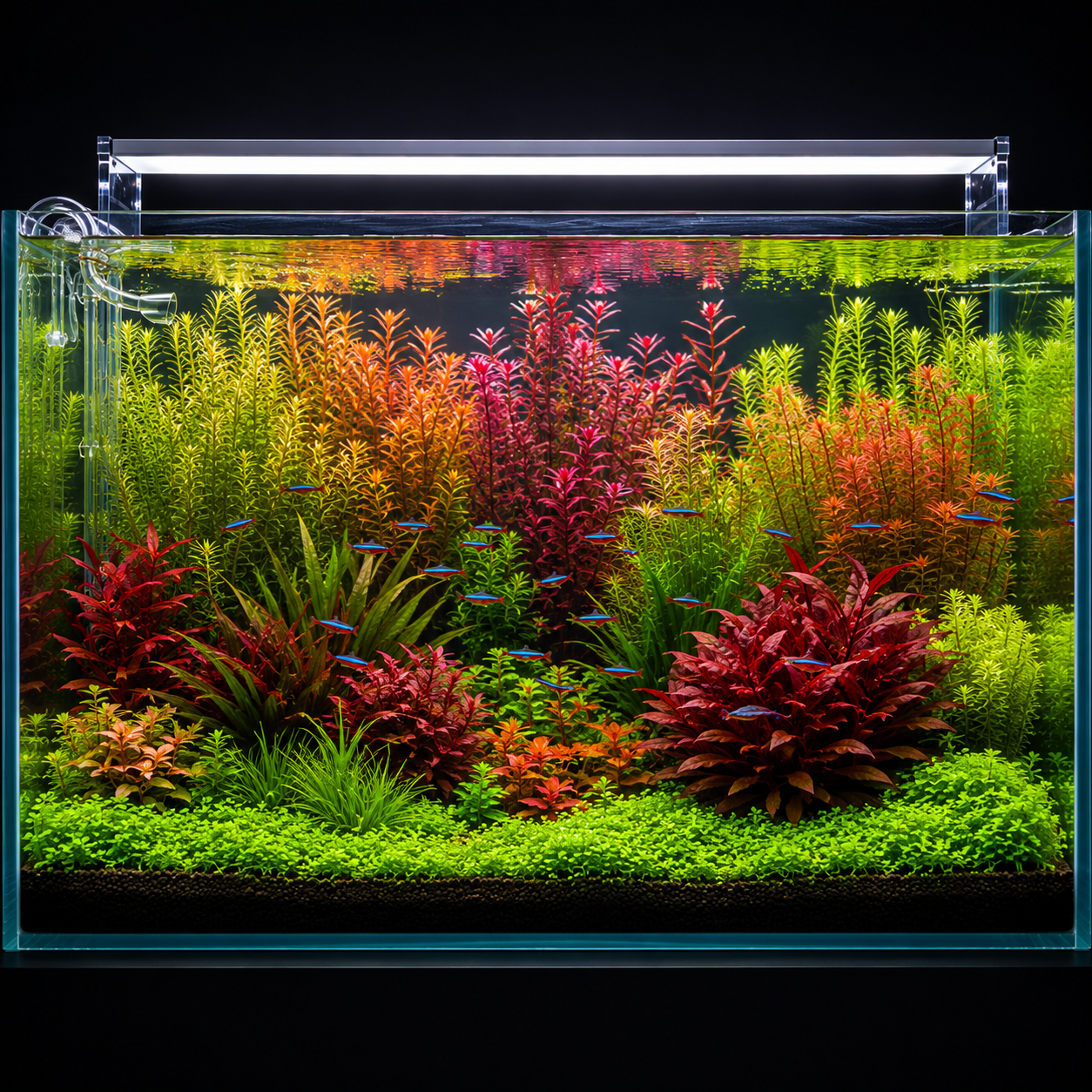
Dutch aquascaping predates Nature Aquarium style by several decades. Developed in the Netherlands from the 1930s onward, it is the original form of planted aquarium art — and it operates on entirely different principles to Japanese styles. Where Amano's work values negative space and stone arrangements, Dutch aquascaping celebrates maximum density, strict colour geometry, and the complete absence of visible hardscape.
Core Principles of Dutch Style
1. No Visible Hardscape
Dutch aquariums contain no visible rocks or driftwood. The entire composition is plant-based. Any wood used is purely structural — covered entirely by plants.
2. Street (Lane) Structure
The Dutch style uses "streets" — distinct vertical lanes of plants arranged from front to back. Each street is a single species, creating clear colour and texture boundaries. Streets alternate between taller and shorter species to create visual rhythm.
3. Colour Contrast Groups
Dutch planting uses high-contrast colour pairings:
- Red/orange stem plants against bright green
- Dark green against light green
- Fine-textured against broad-leaved
4. The Focal Point Group (Eye-catcher)
One group — typically the most striking red or orange plant — is positioned at the Golden Ratio and allowed to grow slightly taller than surrounding plants, acting as the composition's anchor.
Key Plants for Dutch Aquascaping
Red/Orange Focal Plants
- Ammannia gracilis: Narrow leaves with orange-red tips; classic Dutch focal plant
- Alternanthera reineckii 'Mini': Deep magenta; reliable red accent
- Ludwigia glandulosa: Deep red-purple; slower growing, excellent colour
- Rotala macrandra: Large-leaved, vivid pink-red; the showpiece of many Dutch tanks
Green Background/Body Plants
- Limnophila sessiliflora: Feathery, fast-growing bright green
- Hygrophila polysperma: Reliable bright green filler
- Cabomba caroliniana: Feathery green; strong visual contrast with red species
- Ceratophyllum demersum (hornwort): Fast grower; structural green mass
Midground Accent Plants
- Cryptocoryne species: Dark green rosettes; classic Dutch midground
- Echinodorus bleheri (Amazon sword): Large, dramatic rosette for focal midground
- Lobelia cardinalis: Light green spade-shaped leaves; striking in groups
Street Design Rules
Classic Dutch street arrangement for a 90 cm tank:
- Foreground (5–10 cm): Low carpeting species — Lilaeopsis brasiliensis or Glossostigma
- Street A (left): Tall red focal group — Rotala macrandra, 3–5 stems wide
- Street B: Bright green mid-height — Hygrophila polysperma
- Street C: Red accent — Alternanthera reineckii 'Mini'
- Street D: Feathery green — Limnophila sessiliflora
- Background (full width): Tall uniform green — Hygrophila corymbosa or Vallisneria
Technical Requirements
Dutch aquascaping is among the most technically demanding planted styles:
| Requirement | Level |
|---|---|
| CO2 | Required — pressurised, consistent |
| Lighting | High — 50–100+ PAR at midground depth |
| Fertilisation | Comprehensive macro + micro dosing, 3× weekly |
| Water changes | 50% weekly to manage nutrient accumulation |
| Trimming | Weekly for fast growers — Dutch tanks require constant maintenance |
Fish in Dutch Aquariums
Traditionally, Dutch aquariums used fish sparingly — the plants are the star. Classic choices:
- Cardinal tetras or neon tetras: Small, colourful; don't compete visually with red plant groups
- Rummy nose tetras: Classic Dutch companion fish
- Avoid: Large cichlids that uproot plants; bottom feeders that disturb planted substrate
Common Beginner Mistakes in Dutch Style
- Mixing too many species: True Dutch style uses a small number of species in large, disciplined groups. More than 8–10 species in a 90 cm tank becomes chaotic.
- Not trimming streets individually: Each street needs separate trimming to maintain distinct height differentiation.
- Insufficient light at the foreground: The foreground receives least light but needs to grow densest — this is where Dutch tanks most often fail.
Browse our stem plants, Dutch aquascape fertilisers, and CO2 equipment available in Singapore.