
Shi Qing Poh
Author
27 August 2026
9 min read
Forest Aquascape Guide: How to Create a Miniature Underwater Woodland
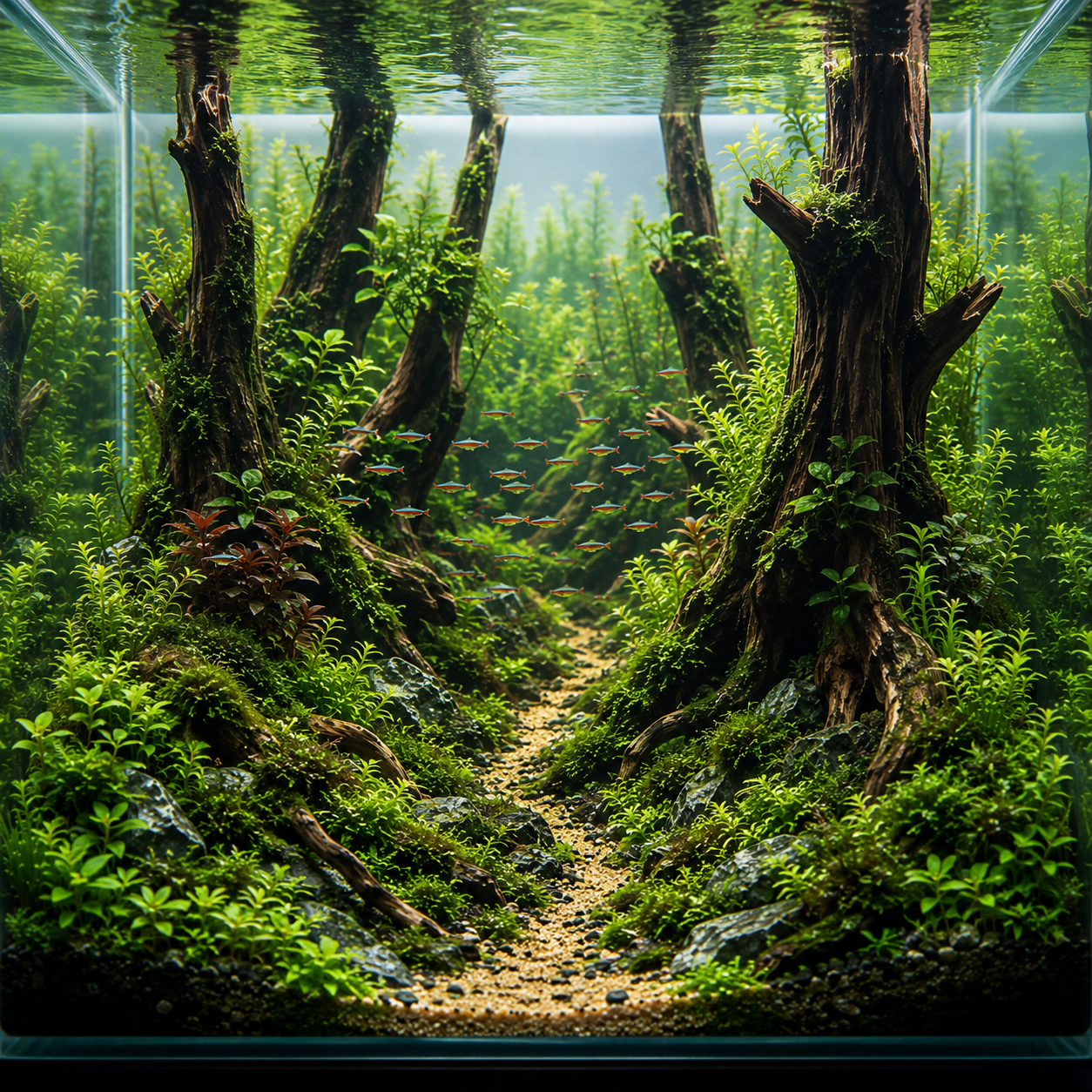
The forest aquascape is one of the most immersive freshwater setups you can build — a tank designed to look like a submerged woodland, with upright driftwood trunks rising from the substrate, moss and epiphytes clinging to bark-textured wood, and a soft ground cover below. When lit from above, the effect of light filtering through plant canopies and between wood trunks is genuinely remarkable.
What Defines a Forest Aquascape?
- Multiple vertical driftwood "trunks": The defining feature — 3, 5, or more pieces of upright wood creating a forest canopy effect
- Moss-covered wood: Java moss, weeping moss, or fissidens covering the trunks to simulate bark and lichen
- Ground cover: Carpet plants or mosses across the substrate — the "forest floor"
- Filtered, dappled light: Floating plants or plant canopies reduce harsh direct lighting to create forest atmosphere
- Minimal or organic hardscape: Rocks may be present as "forest boulders" but are secondary to the wood
Choosing Driftwood for Forest Aquascapes
Best Driftwood Types
- Spider wood (Azalea root): Delicate branching structure perfectly mimics tree trunks with natural branch-offs; the most popular forest driftwood
- Malaysian driftwood: Dense, heavy; smooth curved trunks; more "ancient fallen tree" aesthetic
- Mopani wood: Two-toned; interesting organic shapes; suitable for more rugged forest looks
- Branching birch or beech wood: Natural branching for a realistic deciduous woodland feel
Arrangement Principles
- Use odd numbers of trunks (3, 5, 7)
- Vary trunk height — tall pieces in the back, slightly shorter in the foreground
- Tilt trunks slightly (5–10°) away from perfectly vertical — no trees in nature grow perfectly straight
- Allow some trunks to nearly touch at their canopy tips for a more enclosed forest effect
- Position trunks at varying depths front-to-back to create layered perspective
Planting the Forest
On the Wood (The Canopy and Bark)
- Weeping moss: The defining forest moss — long hanging strands from upper branches
- Fissidens fontanus: Dense, feathery; creates a lichen-like coating on lower trunk sections
- Java fern (especially narrow leaf or trident): Epiphytic; attaches naturally to wood; adds leaf structure to upper branches
- Anubias nana petite: Very small; attached to lower trunk sections and root bases
Ground Cover (The Forest Floor)
- Java moss mat: The easiest and most natural-looking forest floor — irregular, organic
- Monte carlo: Rounder, brighter green carpet; more manicured forest floor
- Miniature crypts (C. parva): Slow-spreading rosettes; extremely natural appearance
Background Plants
In most forest aquascapes, the wood canopy is the background. If background fill is needed:
- Vallisneria nana: Ribbon-like leaves emerge from behind the trunks
- Rotala rotundifolia: Soft, fine texture peeks between trunk gaps
Lighting for Forest Atmospherics
Forest aquascapes benefit from directed, slightly warm lighting:
- Position lights to cast shadows between trunk vertical structures
- Use floating plants (frogbit) to dapple the light on the forest floor
- Warm white LED (3000–4000K) creates a golden morning-light forest atmosphere
- High cool-white light flattens the shadow play and reduces the forest atmosphere significantly
Fish for Forest Aquascapes
Fish that move through the wood structures naturally:
- Wild bettas (Betta imbellis, B. smaragdina): Navigate between trunks as they would in forest streams
- Chocolate gourami: Drift through the lower canopy in a moody blackwater forest setup
- Pencilfish: Float diagonally among the trunk bases
- Small, active tetras (ember, neon): School through the trunks in loose, fluid formations
Browse our spider wood, Malaysian driftwood, mosses, and forest-suitable plants available in Singapore.