
Complete Guide to Freshwater Shrimp Tanks for Beginners
Freshwater shrimp tanks are one of the most rewarding setups in the aquarium hobby. They are compact, relatively low-maintenance, extraordinarily interesting to observe, and — particularly for neocaridina species — very forgiving of beginner mistakes. This guide covers everything you need to know to set up and maintain a thriving shrimp tank in Singapore.
Neocaridina vs Caridina: Which to Start With?
Neocaridina Shrimp
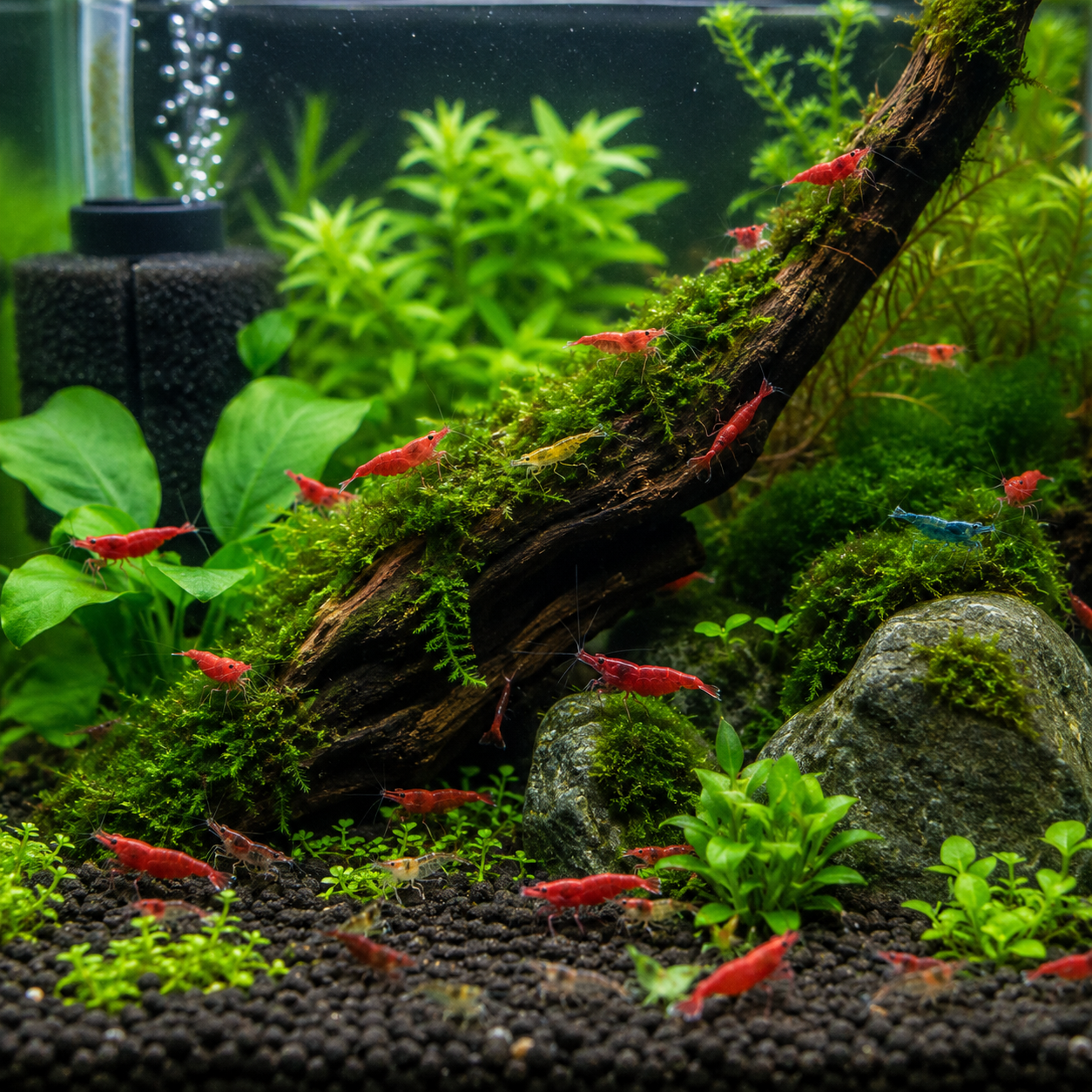
Neocaridina shrimp — cherry shrimp (red), blue dream (blue), yellow neocaridina, and many other colour variants — are the best choice for beginners.
Why beginners should start here:
- Tolerate Singapore tap water with minimal treatment
- Adapt to a wide pH range (6.5–8.0)
- Breed easily and visibly (berried females are a regular sight)
- Very forgiving of parameter fluctuations
- Available widely and affordably in Singapore
Optimal parameters for neocaridina:
- pH: 6.8–7.8
- TDS: 150–250 ppm
- GH: 6–12°
- KH: 2–6°
- Temperature: 22–26°C
Caridina Shrimp
Caridina shrimp — crystal red, crystal black, Taiwan bee, shadow panda — are intermediate to advanced. They require:
- RO water remineralised with caridina-specific remineraliser
- Very low pH (5.8–6.8) and TDS (80–150 ppm)
- More stable, controlled parameters
- Higher cost to source and maintain
Start with neocaridina. Upgrade to caridina once you understand shrimp keeping fundamentals.
Tank Size
- Minimum: 10 litres (nano setups are popular)
- Recommended: 20–40 litres for beginners — more water volume means more parameter stability
- More water = more buffer against mistakes
Filtration
Use a sponge filter exclusively for shrimp tanks.
- Intake strainers on power filters suck up small shrimp and juveniles
- Sponge filters provide gentle flow, no suction risk
- The sponge surface accumulates biofilm — a primary food source for shrimp
- Power sponge filters (air-driven or with a small submersible pump) are ideal for 20–40 litre shrimp tanks
Substrate
For neocaridina: Most substrates work — plain gravel, sand, or inert aquasoil
For caridina: Buffering aquasoil (ADA Amazonia, Tropica Soil, Benibachi Mitsui) is essential — it actively lowers and buffers pH at the caridina-optimal range
Plants
Shrimp thrive with plants. Essential shrimp-tank plants:
- Java moss: Provides biofilm grazing and juvenile hiding cover
- Bucephalandra: Thrives in soft water; accumulates biofilm on leaves
- Anubias nana petite: Hardy, biofilm-friendly, attached to driftwood
- Floating plants (frogbit, water sprite): Provide shade and cover; remove nitrates efficiently
- Christmas moss: Dense cover for moulting shrimp
Feeding
Shrimp are natural scavengers and require very little targeted feeding in a planted, mature tank:
- Frequency: Feed every 1–2 days; once a day is plenty in a planted tank
- Amount: A portion shrimp consume in 2–4 hours; remove leftovers
- Diet: Shrimp-specific wafers (Hikari Shrimp Cuisine, Shirakura), blanched vegetables (zucchini, spinach), algae wafers, snowflake food (dried legume skins)
Moulting
Shrimp must moult (shed their exoskeleton) to grow. During and immediately after moulting they are completely vulnerable:
- Do not touch or move recently moulted shrimp
- The empty white shell you see is normal — leave it; shrimp eat it for calcium
- Frequent failed moults (Moult Death Syndrome) indicate mineral deficiency — check GH and add calcium if needed
Population Growth
A healthy neocaridina colony will grow rapidly:
- Female shrimp berried (carrying eggs) approximately every 4–6 weeks
- 15–25 eggs per clutch
- Eggs develop for 4–5 weeks before hatching
- In 6 months, a colony of 10 can become 100
Manage population by adding fish (some nano fish eat small shrimp) or distributing excess shrimp.
Quick Setup Summary (20 litre neocaridina tank)
| Item | Recommendation |
|---|---|
| Tank | 20 litres, any shape |
| Filter | Air-driven sponge filter |
| Substrate | Inert aquasoil or plain gravel |
| Plants | Java moss, anubias nana petite, floating frogbit |
| Hardscape | Small driftwood piece, a few river pebbles |
| Starting shrimp | 10–15 neocaridina |
| Feeding | Every 1–2 days, small amount |
Browse our freshwater shrimp collection and shrimp accessories — available for delivery across Singapore.