

How to Choose a Centrepiece Fish Without Disrupting Your Community Tank
Every great community tank benefits from a centrepiece fish — a single, visually striking species that anchors the display and draws the eye. But a bad choice can result in aggression, fin-nipping, or a fish that terrorises everything else in the tank. Here's how to get it right.
What Is a Centrepiece Fish?
A centrepiece fish is typically:
- Larger or more visually distinctive than schooling tankmates
- Present as a single individual or a mated pair
- The focal point of the aquarium layout
- Compatible with the other species in the tank
Step 1: Match Size Carefully
A centrepiece fish should be noticeably larger than schooling fish — but not so large that it can eat them. Rule of thumb: the centrepiece fish should be no more than 2–3× the length of your smallest tankmates.
Safe pairings:
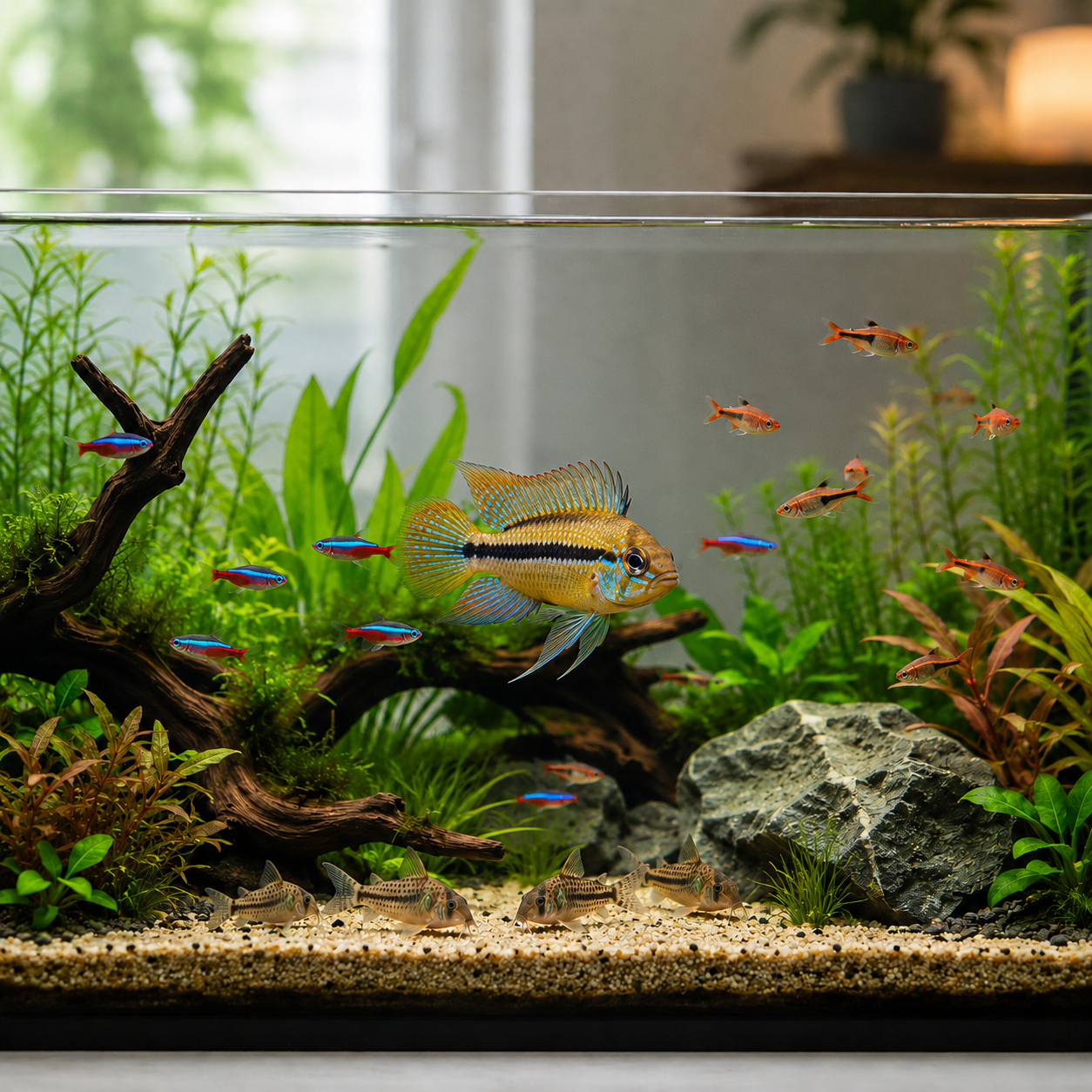
- German blue ram (5–7 cm) + cardinal tetras (5 cm)
- Bolivian ram (7–9 cm) + harlequin rasboras (4–5 cm)
- Pearl gourami (10–12 cm) + ember tetras (2 cm) ✓ (ember tetras too small to harass)
Risky pairings:
- Angelfish (15 cm+) + neon tetras (4 cm) — angelfish eat neons once large
- Oscar (30+ cm) + any small community fish — will eat everything
Step 2: Assess Temperament
Peaceful Centrepiece Options
| Fish | Size | Notes |
|---|---|---|
| German blue ram | 5–7 cm | Pairs best; can be territorial when breeding |
| Bolivian ram | 7–9 cm | Hardier and more peaceful than German blue ram |
| Pearl gourami | 10–12 cm | Elegant, peaceful labyrinth fish |
| Peacock gudgeon | 4–7 cm | Jewel-like, suitable for smaller tanks |
| Apistogramma | 5–8 cm | Stunning dwarf cichlid; forms bonded pairs |
Centrepiece Fish That Need Care
| Fish | Issue |
|---|---|
| Angelfish | Eats small fish; aggressive when spawning |
| Betta | Males cannot be kept with similar-looking fish |
| Discus | Requires expert water parameters |
| Flowerhorn | Highly aggressive; species-only tank required |
Step 3: Consider Breeding Behaviour
Many centrepiece cichlids and gouramis become significantly more aggressive when breeding. If you plan a permanent display community tank, either:
- Choose non-cichlid centrepiece fish (pearl gourami, peacock gudgeon)
- Provide dense planting to allow other fish to escape territorial males
- Be prepared to separate a breeding pair temporarily
Step 4: Match Water Parameters
Your centrepiece fish must share water parameter requirements with your existing community:
- German blue ram: prefers soft, warm, slightly acidic water (pH 6–7, 26–30°C)
- Pearl gourami: adaptable, suits most community parameters
- Bolivian ram: tolerates wider parameters than German blue ram
Recommended Centrepiece Combinations for Singapore
60 litre planted tank: 1 pair German blue ram + 12 cardinal tetras + 6 corydoras sterbai
100 litre planted tank: 1 pair pearl gourami + 15 rummy nose tetras + 6 corydoras + amano shrimp
150 litre planted tank: 1 pair angelfish + 20 cardinal tetras + 8 corydoras sterbai (note: add tetras after angelfish are established)
Browse our centrepiece livestock options available now in Singapore.