
How to Choose Fish Food for Tropical Freshwater Fish
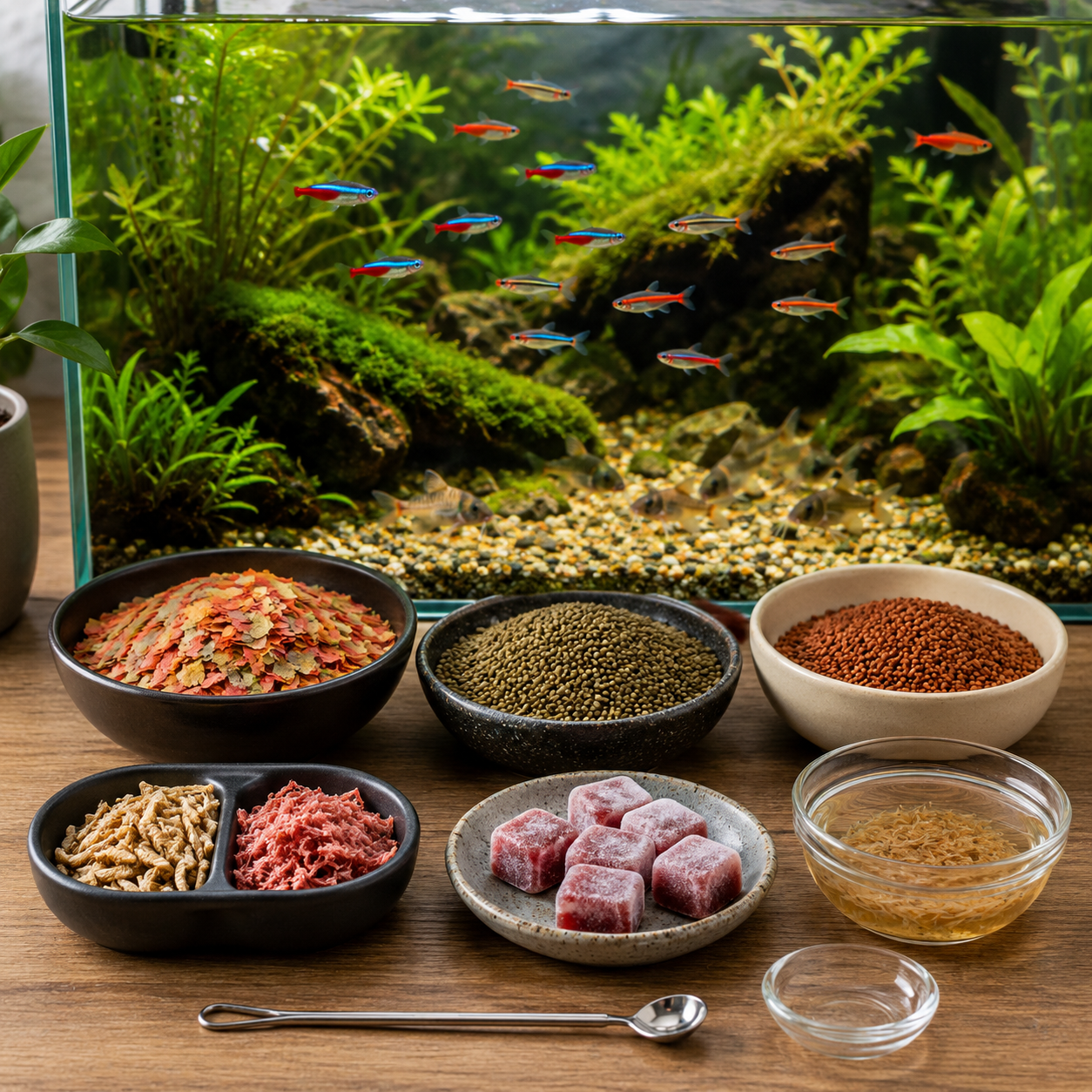
Feeding your fish correctly is one of the most important parts of their care — but the fish food aisle can be overwhelming. Flakes, pellets, wafers, frozen, live, freeze-dried: which do your fish actually need? Here's a straightforward guide to choosing fish food for tropical freshwater species.
Match Food to Fish Mouth Size
The single most important factor is particle size. Fish can only eat what fits in their mouth:
- Nano fish (chili rasboras, micro rasboras, small tetras): Need very fine powder or micro-pellets under 0.5 mm
- Small community fish (neon tetras, guppies, corydoras): Standard small flake or 0.5–1 mm micro-pellets
- Medium fish (angelfish, gouramis, barbs): Regular flake or 1–2 mm pellets
- Large fish (discus, cichlids, large plecos): Large pellets or discs (3–5 mm)
Match Food to Feeding Behaviour
Fish feed at different levels of the water column:
| Feeding layer | Fish examples | Best food type |
|---|---|---|
| Surface feeders | Bettas, hatchetfish, gouramis | Floating pellets or flake |
| Mid-water feeders | Tetras, rasboras, barbs | Slowly sinking flake or pellets |
| Bottom feeders | Corydoras, loaches, plecos | Sinking wafers and tablets |
If you feed only floating flake to a tank with corydoras, the corys will starve while your tetras overeat.
Flakes vs Pellets
Flakes
- Good for surface and mid-water feeders
- Easy to crush smaller for nano fish
- Dissolve quickly — remove uneaten food within 2–3 minutes
- Generally lower quality than equivalent pellets
- Can cloud water if overfed
Pellets
- Denser nutrition per gram
- Available in sinking, slow-sinking, and floating forms
- Easier to measure accurately (less overfeeding)
- Better for bottom feeders (sinking pellets)
- Preferred by most experienced hobbyists
Diet by Fish Type
Herbivores (algae eaters, some plecos, silver dollars)
Need spirulina-rich food, algae wafers, blanched vegetables (zucchini, cucumber). Protein-heavy food causes fatty liver over time.
Carnivores (bettas, most cichlids, puffer fish)
Need high-protein food: bloodworm, brine shrimp, daphnia, and meat-based pellets. Plant-based food provides insufficient nutrition.
Omnivores (tetras, guppies, most community fish)
Thrive on a varied diet: quality flake or pellets as a base, supplemented with frozen or freeze-dried treats 2–3× per week.
Frozen and Live Foods
Frozen foods (bloodworm, brine shrimp, daphnia, tubifex) are excellent nutritional supplements:
- Defrost in a small cup of tank water before feeding
- Feed 2–3× per week alongside dry food
- Stimulate breeding behaviour and improve colouration
Live foods (live brine shrimp, daphnia, black worms) offer the best nutrition but carry disease risk. Source from reputable suppliers.
How Much and How Often?
- Amount: Feed only what fish consume in 2–3 minutes, once or twice daily
- Fasting: A weekly fast day is beneficial for digestive health and water quality
- Overfeeding warning signs: Uneaten food on the substrate, cloudy water, rapid algae growth, elevated ammonia
Browse our fish food range — flakes, pellets, frozen food, and specialist diets available in Singapore.