
Island Aquascape Guide: Creating a Central Hardscape Layout with Open Swimming Space
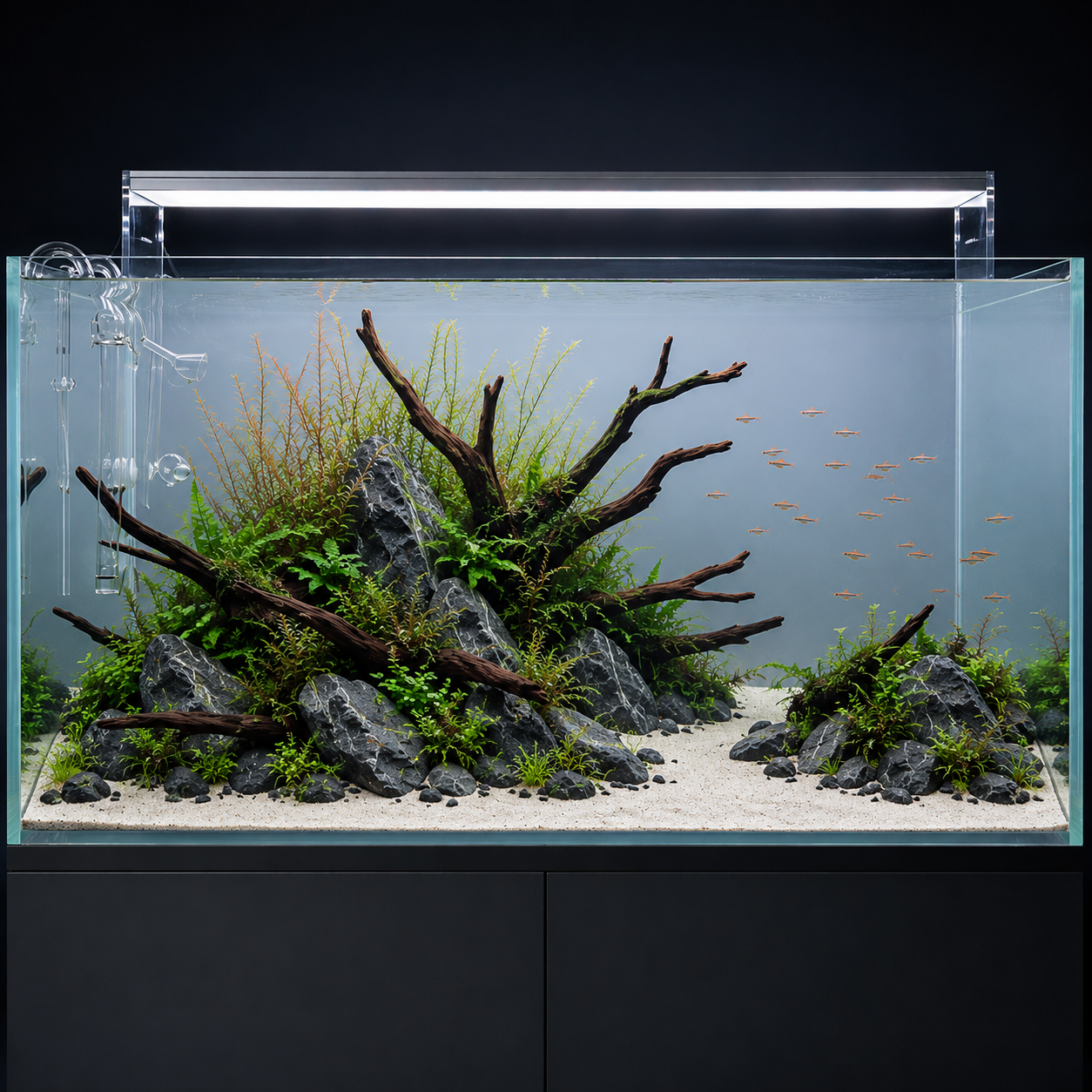
The island layout is one of the most visually accessible and practical aquascape compositions — a cluster of hardscape (rocks or driftwood) positioned in the centre-to-centre-back of the aquarium, surrounded by open substrate that provides swimming space and visual breathing room. It is approachable for beginners, adaptable to many tank sizes, and works beautifully in both Nature Aquarium and biotope-inspired styles.
What Is an Island Layout?
In an island layout:
- The primary hardscape cluster is positioned in the centre or slightly off-centre
- Open substrate (carpet or bare sand) surrounds it on both sides and in the foreground
- Plants are concentrated in and around the island — not spread across the full background
- The surrounding open space emphasises the island as a distinct focal element
The visual metaphor is clear: the hardscape cluster is an island emerging from an open plain or underwater clearing.
When to Choose an Island Layout
| Island layout excels when... | Consider other layouts when... |
|---|---|
| You want maximum open swimming space | You have very active fish that prefer planted cover |
| The tank is square or nearly square | Tank is very wide (>120 cm) — island looks isolated |
| You want a centrepiece rock or wood formation | You want full background planting |
| You keep schooling fish that need open midwater | Bottom-dwellers need substrate across the full base |
Building the Island: Step by Step
1. Plan the Island Position
Place the island's primary element at the centre-back of the tank — approximately two-thirds of the way from the front glass, one-third down from the top of the water column. For an off-centre island, position the primary stone at the Golden Ratio (approximately 60% from one side).
2. Build Upward
Island hardscape should have height — the tallest element should reach approximately 60–70% of the tank's water height. Build upward with stacked stones (binding with aquascaping putty if needed) or use a single dramatic piece of driftwood.
3. Plant the Island
Moss and epiphytes grow directly on the hardscape:
- Tie weeping moss or fissidens to upper surfaces
- Attach anubias nana petite and bucephalandra to rock faces
- Allow java fern to emerge from crevices
Small stem plants or crypts planted directly behind the island complete the back section.
4. Create the Open Foreground
The open foreground surrounding the island is its defining feature. Options:
- HC Cuba carpet: Most polished; requires CO2
- Monte Carlo: Easier; nearly as refined
- Bare sand (biotope style): Clean, natural; suits low-tech setups
- Fine gravel: Natural streambed appearance
Island Aquascape Planting Plan (60 litre)
| Element | Plant | Position |
|---|---|---|
| On island rocks | Weeping moss | Top and sides |
| On island rocks | Anubias nana petite | Front faces |
| On island rocks | Bucephalandra | Mid-height crevices |
| Behind island | 3× Rotala rotundifolia | Rear background |
| Foreground | Monte Carlo carpet | Full visible foreground |
Fish for Island Layouts
The open swimming space in an island layout is particularly suited to schooling fish:
- Rummy nose tetras (20+): School through the open midwater against the island backdrop
- Harlequin rasboras: Warm copper tone complements stone and wood
- Single pair German blue ram: Explore the island base as their territory
- Corydoras: Forage the open sandy foreground
Browse our rocks, driftwood, mosses, and carpeting plants for island aquascape materials available in Singapore.