
Low-Maintenance Aquarium Plants for Beginners: No CO2, No Fuss
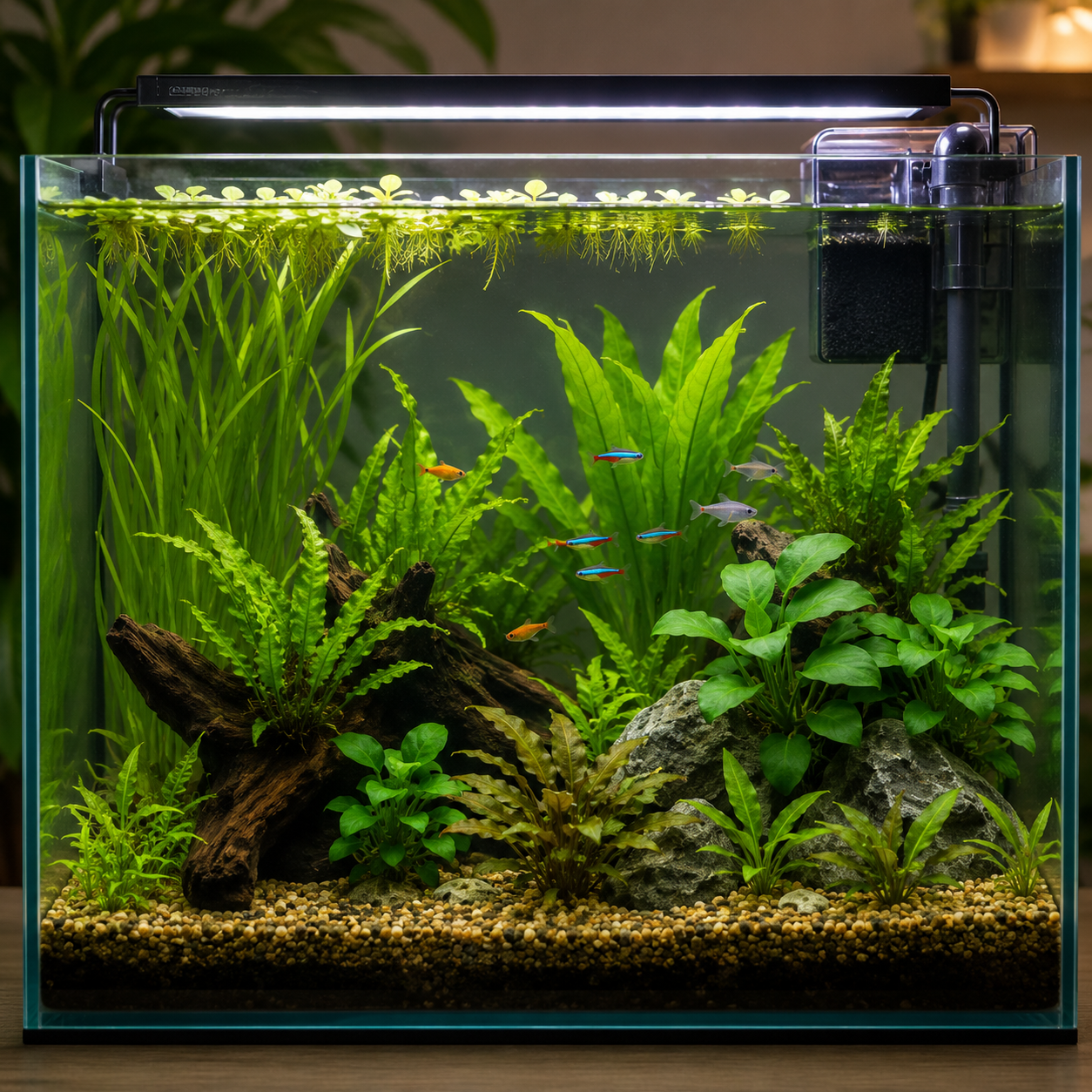
Live plants transform an aquarium. They provide shelter and comfort for fish, compete with algae for nutrients, produce oxygen, and consume ammonia and nitrate. A well-planted tank is biologically more stable, visually more dynamic, and genuinely more interesting than a bare or artificially decorated setup.
The good news: you do not need a pressurised CO₂ system, expensive specialist lights, or a horticultural background to keep live plants successfully. A wide range of aquatic plants thrive in low-light conditions with no additional CO₂ and minimal fertiliser.
This guide covers the best low-maintenance aquarium plants for beginners.
Why Keep Live Plants?
- Biological filtration: Plants absorb ammonia, nitrite, and nitrate directly — particularly useful in new or heavily stocked tanks
- Algae competition: Healthy plants starve algae of nutrients
- Oxygen production: During the photoperiod, plants produce oxygen and consume CO₂, benefiting fish
- Behavioural enrichment: Fish use plants for shelter, territory, and — in many species — spawning
- Aesthetics: Nothing matches the natural appearance of living plants
What Makes a Plant Beginner-Friendly?
- Grows well under standard LED lighting (no high-output specialist fixtures needed)
- Does not require injected CO₂
- Tolerates a range of water temperatures, including Singapore's ambient 27–30°C
- Adaptable to a range of pH and hardness
- Readily available at local fish shops
Best Low-Maintenance Plants
1. Java Fern (Microsorum pteropus)
Java fern is arguably the most beginner-proof aquarium plant. It grows attached to driftwood or rock (never planted in substrate — its rhizome must stay exposed or it will rot), tolerates low light, ignores most water parameter variations, and grows slowly and steadily.
Care requirements:
- Light: Low to medium
- CO₂: Not required
- Substrate: Not planted in substrate — attach to hardscape with fishing line or thread
- Temperature: 18–30°C — handles Singapore ambient temperatures without issue
- Fertiliser: Occasional liquid fertiliser (every 2–4 weeks)
Propagation: New plantlets grow on the edges of mature leaves. Simply detach and attach elsewhere.
2. Anubias (Anubias spp.)
Anubias species are among the most resilient plants in the hobby. They grow extremely slowly, tolerate very low light, and are nearly impossible to kill through neglect. Like java fern, they are rhizome plants attached to hardscape — never planted in substrate.
Care requirements:
- Light: Very low to medium
- CO₂: Not required
- Growth rate: Very slow (this is a feature — less trimming needed)
- Temperature: 22–28°C
- Fertiliser: Very infrequent; perhaps once a month
Common species:
- Anubias barteri — medium-sized, broad leaves
- Anubias nana — compact, suits smaller tanks
- Anubias coffeefolia — textured leaves with attractive patterning
Note: Anubias leaves are thick and tough — fish rarely damage them, and they are durable enough to withstand curious cichlids.
3. Java Moss (Taxiphyllum barbieri)
Java moss is extraordinarily versatile: attach it to driftwood and rocks for a naturalistic look, leave it floating as a carpet for surface-feeding fish, or attach it to mesh for a moss wall effect. It grows in almost any condition and requires no special care.
Care requirements:
- Light: Low to medium
- CO₂: Not required
- Growth rate: Moderate in good conditions
- Temperature: 15–30°C
- Fertiliser: Benefits from occasional liquid fertiliser but tolerates none
Uses: Spawning mops for egg-scattering fish; hiding places for fry; naturalistic hardscape coverage; shrimp habitat
4. Water Wisteria (Hygrophila difformis)
Water wisteria is a fast-growing stem plant that actively competes with algae for nutrients — one of the best choices for a new tank struggling with early algae outbreaks. It grows quickly under moderate light and requires only occasional trimming.
Care requirements:
- Light: Low to medium
- CO₂: Not required (grows faster with it, but not necessary)
- Planting: Stems planted in substrate
- Temperature: 24–30°C — ideal for Singapore conditions
- Fertiliser: Benefits from weekly liquid fertiliser
Fast growth tip: The trimmings can be replanted directly into the substrate to propagate more plants.
5. Amazon Sword (Echinodorus bleheri)
Amazon sword is a classic aquarium plant — large, dramatic, and relatively undemanding. It grows best when its roots have access to nutrients, so a nutrient-rich substrate or root tabs are helpful. Under moderate lighting it produces broad, attractive leaves that provide excellent cover for larger fish.
Care requirements:
- Light: Medium
- CO₂: Not required
- Substrate: Does best in nutrient-rich substrate or with root tabs
- Temperature: 22–28°C
- Note: Can grow quite large (30–50 cm) — best in tanks of 90 litres or more
6. Cryptocoryne (Cryptocoryne spp.)
Cryptocorynes (or "crypts") are popular, low-maintenance plants available in dozens of species ranging from compact 5 cm varieties to large background plants. They are slow-growing and shade-tolerant, making them ideal companions for anubias and java fern in low-light setups.
Care requirements:
- Light: Low to medium
- CO₂: Not required
- Substrate: Prefer nutrient-rich substrate or root tabs for best growth
- Temperature: 22–28°C
- Important: "Crypt melt" is a common initial response when crypts are moved to a new tank — leaves melt away, then regrow. Do not discard the plant; new leaves will emerge.
7. Hornwort (Ceratophyllum demersum)
Hornwort is one of the fastest-growing aquarium plants available. It can be floated or planted (though it does not form true roots), grows in almost any light, and is highly effective at absorbing ammonia and nitrate in new or heavily stocked tanks.
Best for: New tanks cycling with fish; tanks with high nitrate; providing surface cover for shy or air-breathing fish
Floating Plants
Do not overlook floating plants. They are extraordinarily effective at absorbing nitrate and ammonia, provide shade for fish that dislike bright light, and breed rapidly:
- Frogbit (Limnobium laevigatum): Round floating leaves, easy to manage
- Water lettuce (Pistia stratiotes): Rosette-forming, effective nitrate consumer
- Duckweed (Lemna minor): Very small, grows rapidly — some find it difficult to control, but fish and turtles enjoy eating it
Note: In Singapore, some floating plants are legally restricted for environmental reasons. Confirm that species are permitted for private aquarium use before purchasing.
Basic Plant Care Tips
- Do not bury rhizomes: Java fern, anubias, and similar rhizome plants rot if buried in substrate. Attach to hardscape.
- Use liquid fertiliser: Even low-tech plants benefit from occasional all-in-one liquid fertiliser to replace nutrients removed by water changes.
- Remove dead or yellowing leaves: Dead plant matter raises ammonia and promotes algae.
- Provide adequate lighting: Even low-light plants need some light — 6–8 hours of standard LED per day is sufficient.
- Start with fast growers: Fast-growing plants like water wisteria and hornwort help a new tank reach chemical balance faster by consuming excess nutrients.
Frequently Asked Questions
Do I need special soil for aquarium plants? Not for the plants listed here. Java fern, anubias, and java moss do not use substrate at all. Crypts, swords, and water wisteria benefit from nutrient-rich aqua soil or supplemental root tabs, but grow adequately in plain gravel with liquid fertiliser.
Why are my aquarium plants turning yellow? Yellowing often indicates nutrient deficiency — typically iron, potassium, or nitrogen. Dose an all-in-one liquid fertiliser weekly. Yellow, transparent leaves with holes often indicate potassium deficiency.
Can plants survive in a tank without a light? No — plants require light for photosynthesis. Even low-light plants need 6–8 hours of LED light per day. Natural light from a window is inconsistent and promotes algae.
Will plants survive Singapore's tap water? Yes. Singapore tap water, properly dechlorinated, supports all the plants listed here. The pH (approximately 7.0–8.0) and moderate hardness are within acceptable ranges for these species.
How do I stop plants from floating out of the substrate? Weigh down new plants temporarily with small plant weights (available at most fish shops) or anchor them by planting deeper. Rhizome plants like java fern should never be planted — tie them to hardscape with cotton thread or fishing line.