

Mountain Aquascape Guide: Creating Dramatic Rock Formations in a Freshwater Tank
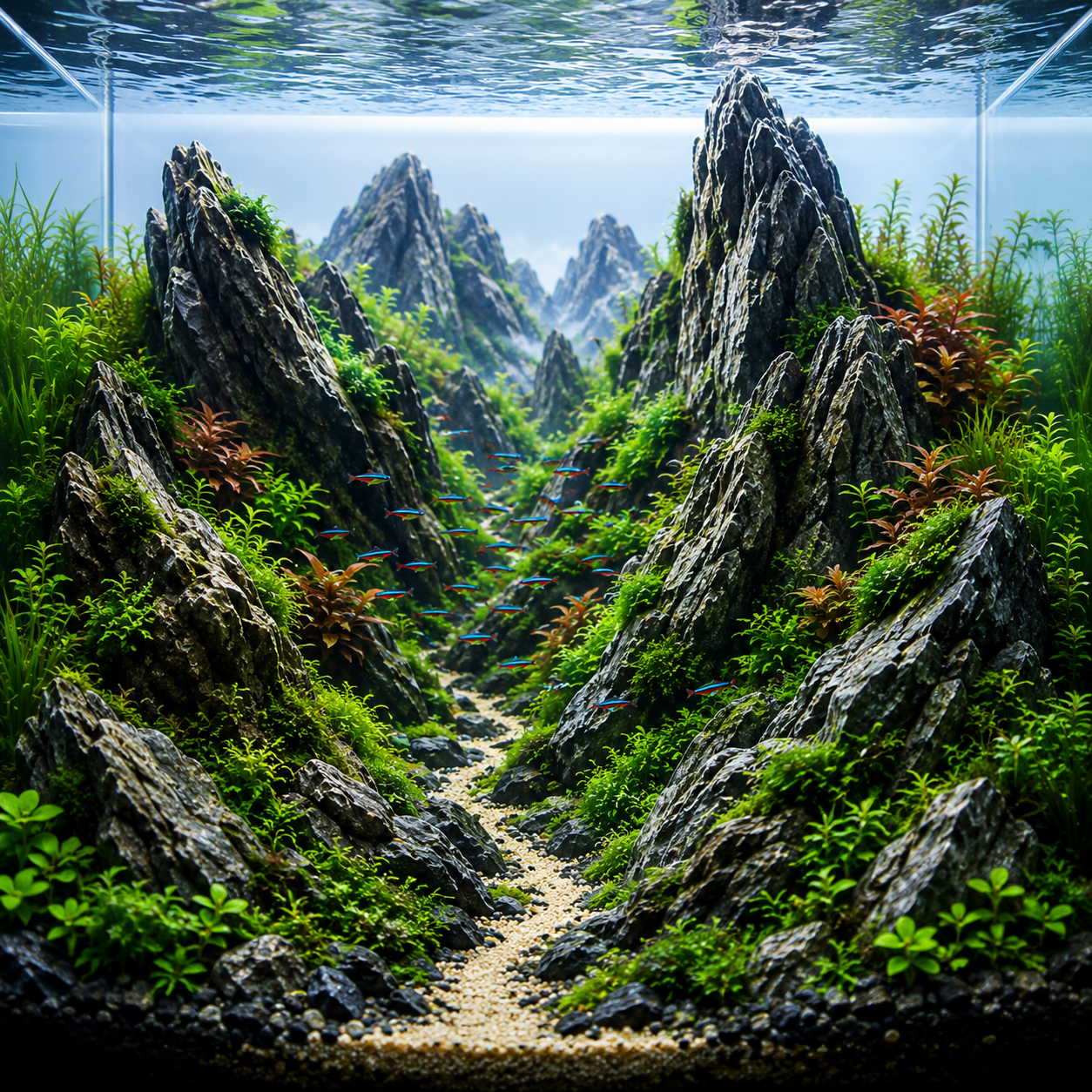
Mountain aquascapes are among the most visually dramatic freshwater setups — tall, stacked rock formations that create peaks, ridges, and elevated terrain, partially draped in moss and low plants, with fine sand valleys below. Done well, they genuinely resemble a miniature mountain landscape viewed through water.
Rock Selection for Mountain Aquascapes
The right rock makes or breaks a mountain aquascape. Key criteria:
Best Rock Types
- Seiryu stone: The most popular mountain aquascape rock — dramatic angular fracture faces, blue-grey colour, intricate natural texture. Note: raises pH and KH over time
- Ohko (Dragon stone): Intricate surface texture with natural pits and ridges; warm grey-brown colour; raises pH less than Seiryu
- Manten stone: Irregular angular surfaces; dark colour; excellent for dark, moody mountain layouts
- Frodo stone: Fine, layered structure; creates convincing geological strata appearance
Stone Grain Direction
All stones in a mountain aquascape must share the same grain direction — the natural lines and strata of the rock should all point the same way. Mixing grain directions destroys the illusion of natural geology.
Avoid
- Smooth river stones (no texture; look like pebbles, not mountains)
- Mixed rock types in the same layout
- Rocks that are far too large for the tank — oversized rocks look like boulders in a pond, not mountain peaks
Building Stable Rock Structures
Stacked rock formations must be structurally stable — a collapsing rock pile can crack tank glass.
Safety rules:
- Never stack rocks directly against the glass panels
- Use aquascaping epoxy putty to bond critical joints in tall formations
- Distribute weight by placing the largest, heaviest rocks on the substrate first
- Build on a foam platform under the substrate for very heavy formations
- Test stability by gently pressing the top of the formation before filling the tank
Layout Approaches
Single Peak (Convex)
One central mountain peak; lower terrain on both sides. Creates a focal point with the peak at the Golden Ratio position.
Dual Peak (with valley)
Two elevated formations with a valley between them — combines concave layout principles with mountain aesthetics. Very photogenic.
Ridge Line
A continuous elevated ridge running parallel to the back glass, with the valley along the foreground. Plants fill the ridge; sand or carpet occupies the valley floor.
Planting a Mountain Aquascape
Mountain layouts use minimal but precise planting:
- Moss on rock faces: Fissidens, mini christmas moss, or weeping moss glued or tied to rock surfaces — makes formations look aged and naturalised
- Short crypts or anubias in crevices: Small plants emerging from gaps between stones
- Carpet in the valley: HC Cuba, monte carlo, or fine-textured moss in the sand valley below the peaks
- No tall stem plants: Tall background stems compete with rock formations and obscure the peak silhouettes
Fish for Mountain Aquascapes
Fish that complement the rocky mountain aesthetic:
- Hillstream loaches: Cling to rock faces exactly as they would in a natural mountain stream; the most appropriate fish for a mountain layout
- Zebra danios: Active schoolers from fast-flowing hill streams; natural in rocky-stream biotopes
- Small, active rasboras: Dart through the rock formations energetically
- Single pair of apistogramma: Claim rock crevices as natural territory
Browse our Seiryu stone, Ohko stone, and aquascaping moss — mountain aquascape materials available in Singapore.