
Nature Aquarium Style Guide: How to Create a Balanced, Natural-Looking Aquascape
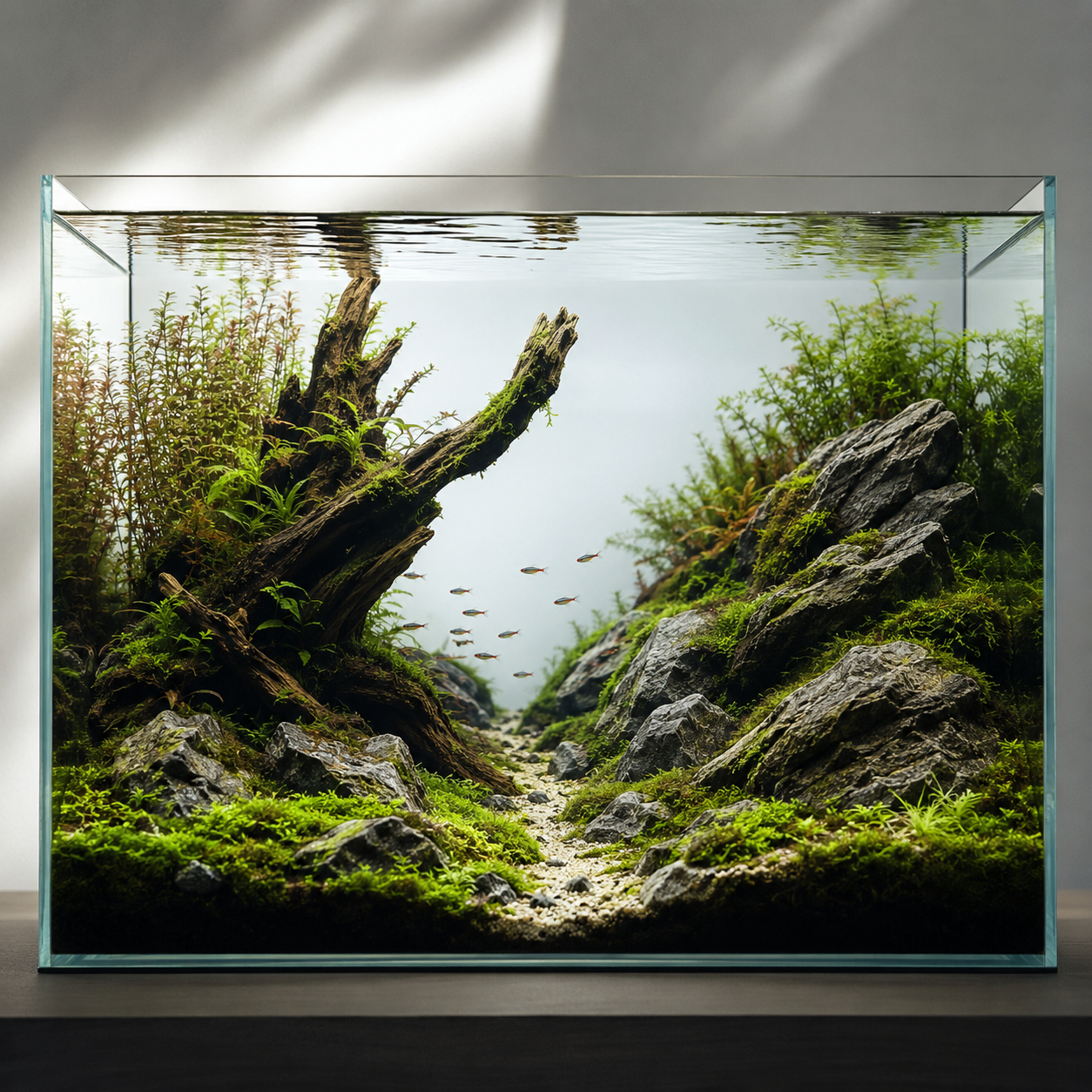
The Nature Aquarium style is the most influential aquascaping philosophy in the modern hobby. Pioneered by Japanese photographer and aquarist Takashi Amano through his company ADA (Aqua Design Amano), it applies Japanese aesthetic principles — wabi-sabi, ma (negative space), and naturalistic asymmetry — to the design of planted aquariums.
Unlike Dutch aquascaping, which values dense colour contrast, or Taiwanese aquascaping, which maximises visual impact, the Nature Aquarium aims to create a sense of peaceful natural landscape — as if you are looking through a window into a living forest floor, mountain valley, or streambed.
Core Principles
1. The Golden Ratio and the Rule of Thirds
Amano applied the Golden Ratio (1.618) to aquascape composition, placing the primary focal point — typically the main rock grouping or driftwood — at approximately one-third from the left or right, never in the centre. This asymmetric placement creates visual tension and the sense of natural, uncontrived composition.
2. Negative Space (Ma)
Negative space — areas of open substrate, cleared midground — is a defining feature of Nature Aquarium style. Empty space is not "unfilled"; it is an intentional compositional element that gives the eye a place to rest and makes the planted areas feel more dramatic by contrast.
3. Natural Texture and Material
Hardscape materials (Seiryu stone, Manten stone, African driftwood, spider wood) are chosen for their natural texture and weathered appearance. The goal is to evoke materials as they would appear in nature — mossy, worn, organic.
4. The Concave Layout (The Valley)
Many Nature Aquarium layouts use a concave structure: tall planting or hardscape at the sides, open midground in the centre. This creates a valley or clearing effect — one of the most timeless and photogenic aquascape compositions.
Essential Plants for Nature Aquarium Style
Foreground
- HC Cuba (Hemianthus callitrichoides): The defining foreground carpet of serious Nature Aquarium layouts — requires high light and CO2
- Eleocharis acicularis 'Mini': Fine hairgrass; slightly easier than HC Cuba
- Marsilea crenata: Four-leaf clover carpet; low-tech friendly
Midground
- Anubias nana petite: Tied to driftwood; adds dark textural contrast
- Bucephalandra: Jewel-like; attached to rocky hardscape
- Short crypts (Cryptocoryne parva): Low-growing rosette; fills gaps naturally
Background
- Rotala rotundifolia: Pink-tipped stem plant; soft texture behind hardscape
- Vallisneria nana: Ribbon-like leaves; graceful background movement
- Various moss on driftwood: Weeping moss, flame moss — creates the aged, natural wood appearance
Hardscape Arrangement: The Rule of Odd Numbers
Nature Aquarium hardscape is almost always arranged in odd numbers (1, 3, 5 stones) — even numbers feel artificially symmetrical. The largest stone is the primary focal point; smaller stones are satellite elements arranged to suggest a naturally occurring formation.
Seiryu stone arrangement for a 60 cm tank:
- 1 large primary stone (placed at Golden Ratio position, slightly angled)
- 2 medium secondary stones (flanking, facing inward toward the primary)
- 2–3 small accent stones (foreground, partially buried for a natural settled look)
Fish for Nature Aquarium
Fish choices are restrained and complement the natural theme:
- Rummy nose tetras (20–30): Classic companion; move in tight schools that animate the composition
- Cardinal tetras: Natural in their wild Amazon habitat that shares plants like HC Cuba
- Corydoras sterbai: Bottom activity; natural bottom-dweller for the composition
- Amano shrimp: Invisible cleanup crew; critical for algae management
Technical Requirements
| Requirement | Specification |
|---|---|
| CO2 | Pressurised system; 1–2 BPS for 60 cm |
| Lighting | 40–80 PAR at substrate; 8 hours daily |
| Substrate | ADA Amazonia or quality aquasoil |
| Filtration | Canister; 5–8× tank volume turnover |
| Water changes | 30% twice weekly for demanding layouts |
The Amano Approach to Algae
Amano's signature contribution to planted tank management was using Amano shrimp (named after him) as the primary algae control method — replacing chemical treatments with biology. A 60-litre planted tank typically needs 10–15 Amano shrimp to stay clean.
Browse our aquascaping plants, hardscape, and equipment — all Nature Aquarium essentials available in Singapore.