
Shi Qing Poh
Author
19 March 2026
7 min read
Open-Top vs Covered Aquarium: Pros, Cons, and Safety Considerations
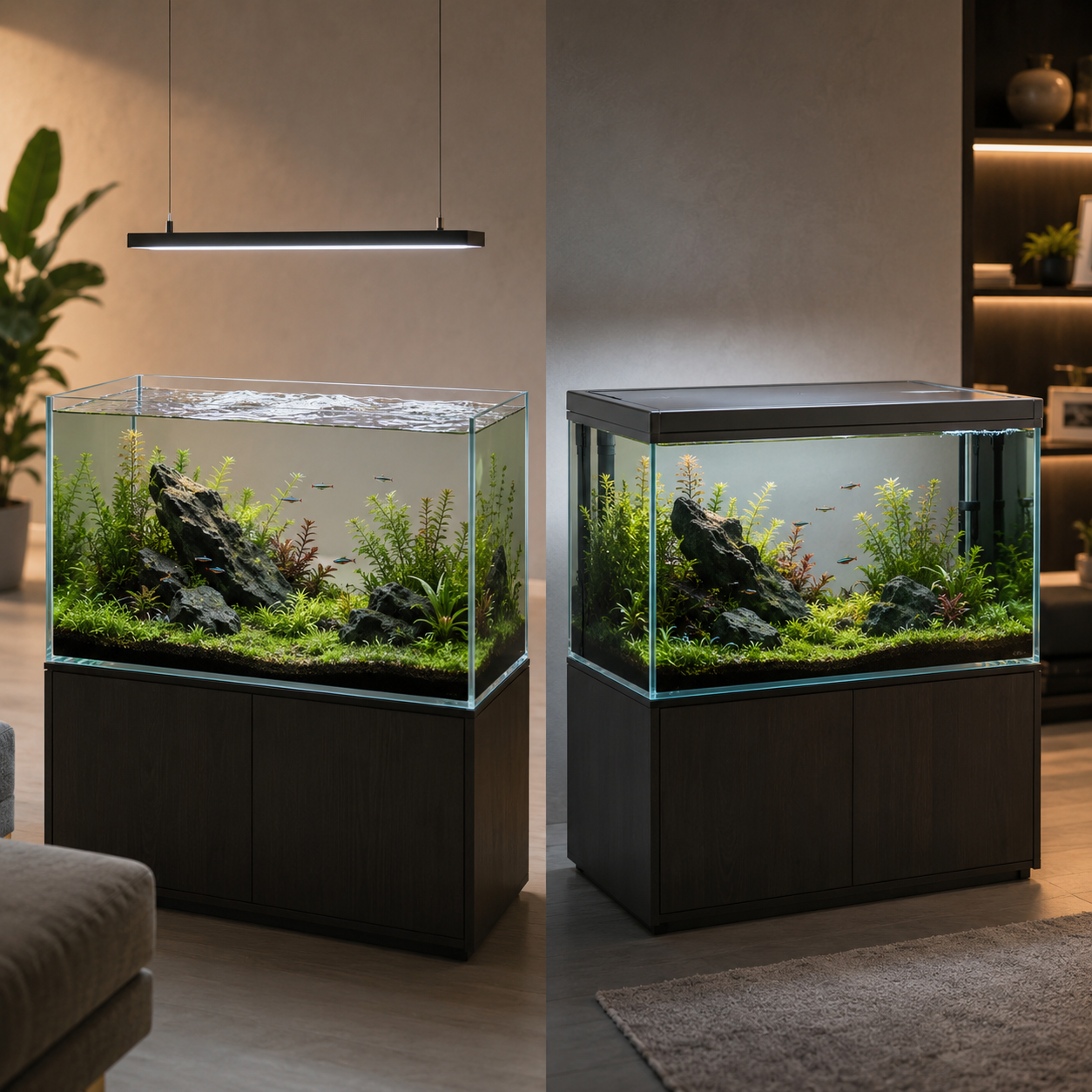
The choice between an open-top and a covered aquarium has real consequences for your fish, your plants, and your maintenance routine. Neither is universally better — the right choice depends on what you're keeping and what you value.
At a Glance
| Factor | Open-Top | Covered |
|---|---|---|
| Evaporation | High — daily top-ups needed | Minimal |
| Jumping risk | High for certain species | Minimised |
| Plant growth | Emersed plants possible | Limited to submerged growth |
| Aesthetics | Clean, magazine-style look | Traditional, enclosed look |
| Humidity impact | Raises room humidity | Contained |
| Maintenance | Easier top access | Lid removal needed |
| CO2 efficiency | Lower — CO2 escapes surface | Higher |
Open-Top Aquariums
Advantages
- Aesthetic appeal: Rimless open-top tanks have become the standard in modern aquascaping. The unobstructed view from above and the clean sight line make them visually superior.
- Plant flexibility: Emergent plants can grow above the waterline, creating a paludarium-like effect. Stem plants that reach the surface develop emersed leaves.
- Maintenance access: No lid to remove for water changes, plant trimming, or feeding.
- Light efficiency: No glass lid to reduce light intensity — some lids reduce PAR by 10–15%.
Disadvantages
- Evaporation: Singapore's heat means open-top tanks can lose 1–3 cm of water per week. A top-up routine is essential.
- Jumping risk: Many fish jump — especially when startled, during spawning, or at lights-off. Any open-top tank housing known jumpers needs a surface net or mesh cover.
- Increased humidity: Can raise room humidity around the tank significantly.
Covered Aquariums
Advantages
- Jumping prevention: A lid eliminates the most common cause of unexplained fish loss.
- Less evaporation: Water level stays stable for longer between top-ups.
- CO2 efficiency: For CO2-injected planted tanks, a lid significantly reduces CO2 loss through surface agitation and open air.
Disadvantages
- Reduced light: Glass lids can cut PAR by up to 15% unless kept spotlessly clean.
- Condensation: Lids collect condensation that drips back into the tank, carrying minerals that can raise hardness over time.
- Less flexibility for tall plants: Plants that reach the surface have nowhere to go.
Fish That Require a Cover
These species are known jumpers and must have a covered or netted tank:
- Bettas
- Killifish (all species)
- Hatchetfish
- Arapaima and large predators
- Archerfish
- Some loaches (kuhli loaches especially)
The Best Compromise: Mesh Covers
For open-top aquarium aesthetics with jumping protection, a black nylon mesh cover stretched across the top of the tank provides:
- Minimal visual obstruction
- Full light penetration
- Jumping protection
- Continued emersed plant growth through the mesh
This is the most popular choice among aquascapers who keep jumper-prone species.
Browse our aquarium accessories and hardware for covers, mesh, and rimless tanks available in Singapore.