

Rimless Aquarium vs Braced Aquarium: Which Look and Build Should You Choose?
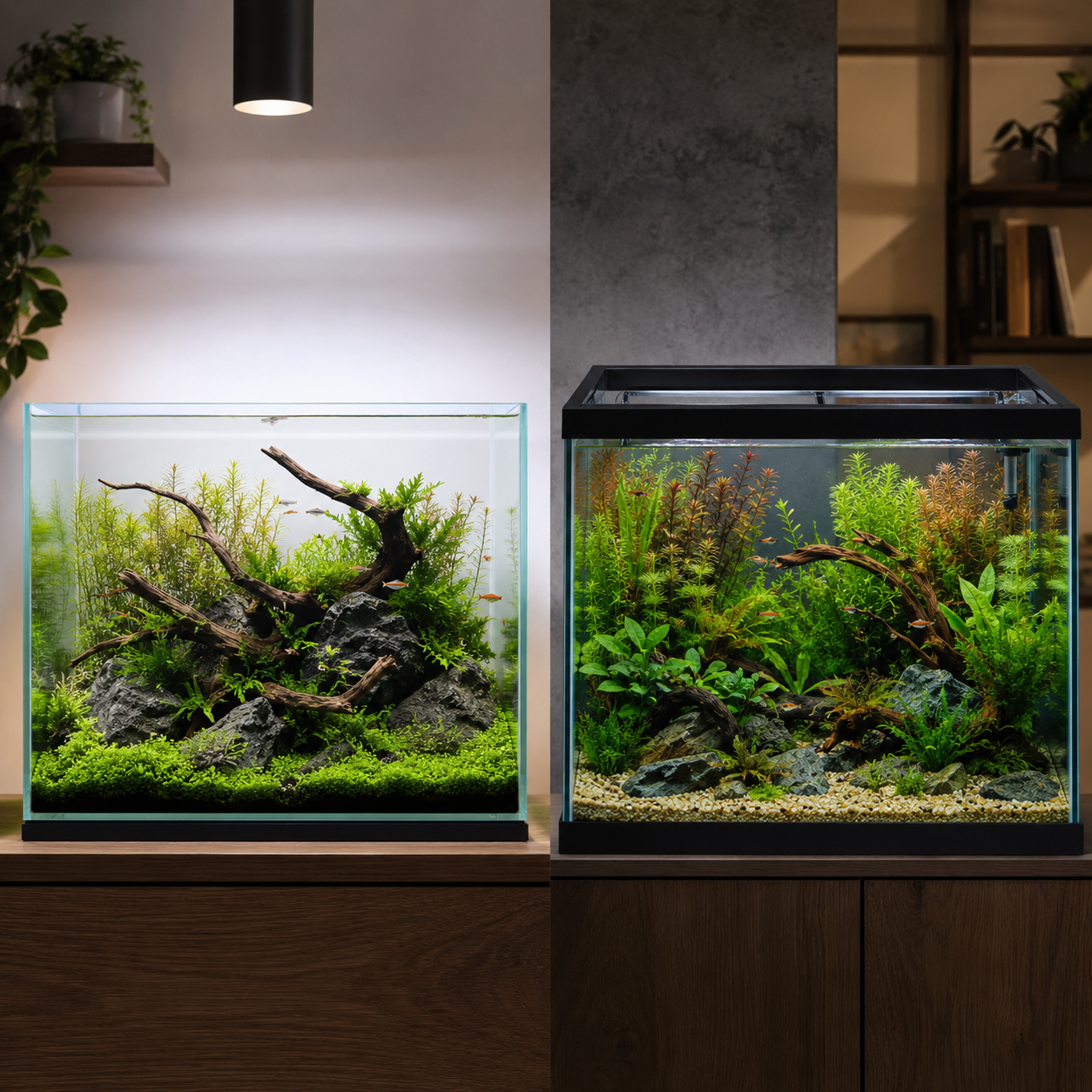
When choosing an aquarium, one of the most noticeable differences is whether it has a frame — a plastic brace running across the top opening — or is completely rimless with open glass edges. This is not purely aesthetic: it affects structural integrity, maintenance, livestock safety, and how the tank looks in your home.
Braced Aquariums
Braced (or framed) aquariums have a plastic frame around the top and sometimes the bottom rim. Cross-braces span the opening to prevent the glass panels from bowing outward under water pressure.
Advantages
- Greater structural safety: The cross-brace distributes water pressure and prevents bowing, especially in large tanks (120+ litres)
- Lower cost: Braced tanks are significantly cheaper to manufacture and buy
- More widely available: Standard braced tanks are sold everywhere
- Prevents jumping: The cross-brace partially covers the opening, reducing jumping risk
- Covers visible silicone: The frame conceals corner silicone seams
Disadvantages
- Visual bulk: The black plastic frame is visible from every angle and interrupts the clean line of sight into the tank
- Less compatible with modern aquascape aesthetics: In photography and display contexts, braced tanks look dated compared to rimless
- Access restriction: The cross-brace limits access to the water surface for maintenance and planting
Rimless Aquariums
Rimless aquariums have no frame. The glass panels are joined at the corners with clear silicone, and the top is completely open.
Advantages
- Clean aesthetics: The glass-to-water view is unobstructed from all angles. In photography and room display, rimless tanks look dramatically more polished.
- Full surface access: No brace to work around when trimming plants, doing water changes, or arranging hardscape.
- Modern standard in aquascaping: All serious aquascape display tanks are rimless.
- Visible corner silicone becomes a design element: Many rimless tanks use black or clear silicone as a deliberate detail.
Disadvantages
- More expensive: Thicker glass must be used to compensate for the missing brace, driving up cost
- Jumping risk: Fully open top means jumping fish can escape. A mesh cover is recommended for jumper-prone species.
- Evaporation: Open top tanks lose more water to evaporation — especially in Singapore's heat
- Size limitation: Very large tanks (240+ litres) are structurally challenging without some bracing
Which Should You Choose?
| Choose rimless if... | Choose braced if... |
|---|---|
| Aesthetics and photography matter | Budget is the primary concern |
| You want modern aquascape style | You keep jumping fish |
| Tank is under 200 litres | Tank is 200+ litres |
| You will use a mesh cover | You prefer a covered setup |
For Singapore hobbyists: Most aquascaping-focused tanks 60–120 litres are now rimless by default. For a first tank at a lower budget, a braced tank is perfectly functional and holds fish just as well.
Browse our aquarium hardware range for both rimless and braced options.