
Taiwanese Aquascape Style Guide: Dense Planting, Colour, and Display-Tank Impact
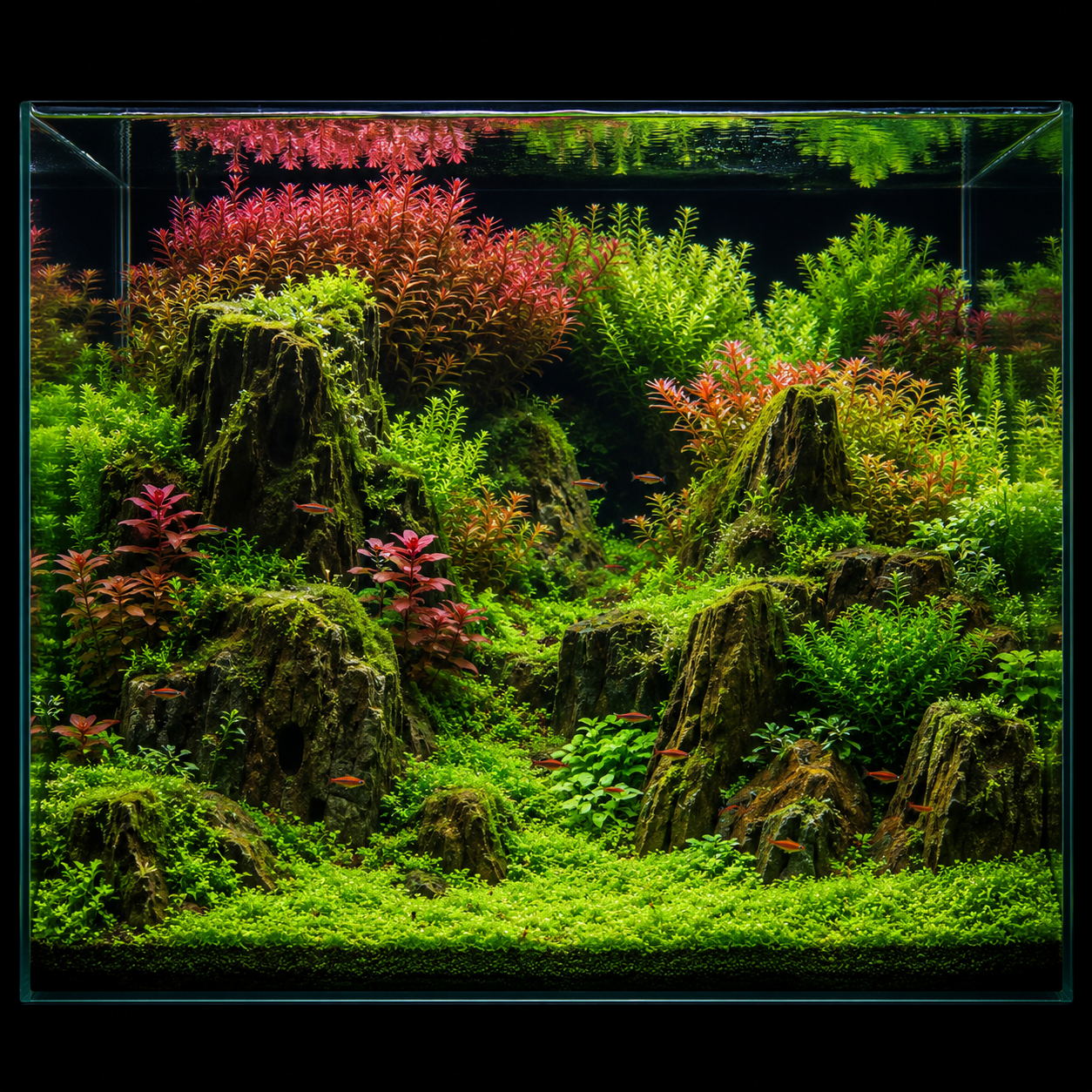
Among the major aquascaping styles, Taiwanese aquascaping stands apart for its unapologetic density, colour saturation, and theatrical visual impact. Where Japanese styles like Iwagumi and Nature Aquarium value minimalist restraint and the beauty of negative space, Taiwanese aquascapes fill every centimetre with lush, layered, colourful plant life.
What Defines Taiwanese Aquascaping?
Characteristics
- Maximum planting density: Very few or no areas of visible substrate — plants cover almost every surface
- Colour contrast: Vivid red, orange, pink, and purple stem plants against bright green midground and background
- Layered complexity: Multiple plant species at multiple heights create depth through visual layers
- Large display scale: Most impressive in tanks 90 cm or longer, though 60 cm versions exist
- High-tech requirement: CO2 injection and strong lighting are essential — the density and colour are not achievable in low-tech setups
- Regular trimming: Dense planting requires frequent, precise trimming to maintain the layered structure
Key Plant Choices
Background (Tall, Dense Stem Plants)
- Rotala H'ra or rotundifolia: Pink-orange tips under high light; classic Taiwanese background
- Ludwigia super red: Blood-red; provides the strongest colour contrast
- Rotala wallichii: Fine, hair-like deep red stems for feathery texture
- Myriophyllum mattogrossense: Feathery green counterpoint to red stems
- Hygrophila pinnatifida: Unusual sideways growth; textural interest
Midground
- Rotala green or Rotala 'Green': Bushy, compact green mass
- Staurogyne repens: Low-growing, compact; green texture
- Bucephalandra: Jewel-like accent at rockwork
- Anubias nana petite: Tied to driftwood or rocks; persistent dark green contrast
Foreground
- Monte Carlo: Dense, bright green carpet
- Hemianthus callitrichoides (HC Cuba): Finest-textured carpet; maximum density effect
- Dwarf hairgrass: Grass-like texture variation
Hardscape in Taiwanese Aquascaping
Unlike Nature Aquarium or Iwagumi where hardscape is the focal point, Taiwanese aquascaping uses hardscape as a supporting structure:
- Rocks: Seiryu stone or dragon stone create natural structure between plant masses; much of the rock may eventually be covered by moss or foreground plants
- Driftwood: Used to create internal structure and attach epiphyte midground plants
- Less prominent than Japanese styles: Plants take visual precedence over hardscape
Technical Requirements
| Requirement | Specification |
|---|---|
| Lighting | High output planted LED; 50–100+ PAR at substrate |
| CO2 | Pressurised CO2 system; 1–2 bubbles per second for 60 cm tank |
| Substrate | High-nutrient aquasoil (ADA Amazonia, Tropica Soil) |
| Fertilisation | Comprehensive liquid fertiliser (macro + micro) dosed 3× weekly |
| Filtration | Canister filter with flow rate 5–8× tank volume per hour |
| Water changes | 30–50% weekly to manage nutrient accumulation |
Trimming Methodology
Trimming is the most time-intensive aspect of Taiwanese aquascaping:
- Stem plants: Cut to maintain height differentiation between background and midground; replant trimmings immediately to fill gaps
- Carpet plants: Trim horizontally with long curved scissors to maintain a flat, even surface
- Trim weekly for fast growers (rotala, ludwigia) in a high-tech setup
Fish for Taiwanese Aquascapes
Fish are secondary to plants in this style but should complement the visual palette:
- Rummy nose tetras (30+): Classic companion; their red and white creates a living focal element against the green and red plant mass
- Cardinal tetras: Blue-red stripe complements warm plant colours
- Small corydoras: Active bottom presence; visual break from plants at the substrate level
Browse our planted tank collection — CO2 systems, high-output LEDs, aquasoil, and all plants featured above available in Singapore.