

Triangular Aquascape Layout Guide: How to Create Depth, Flow, and Visual Balance
The triangular layout is one of the most commonly used aquascape compositions for good reason: it is immediately readable, creates strong visual flow, provides a natural gradient from complex to open, and works at virtually any tank size. Understanding what makes a triangular aquascape succeed separates generic attempts from truly satisfying displays.
The Core Principle
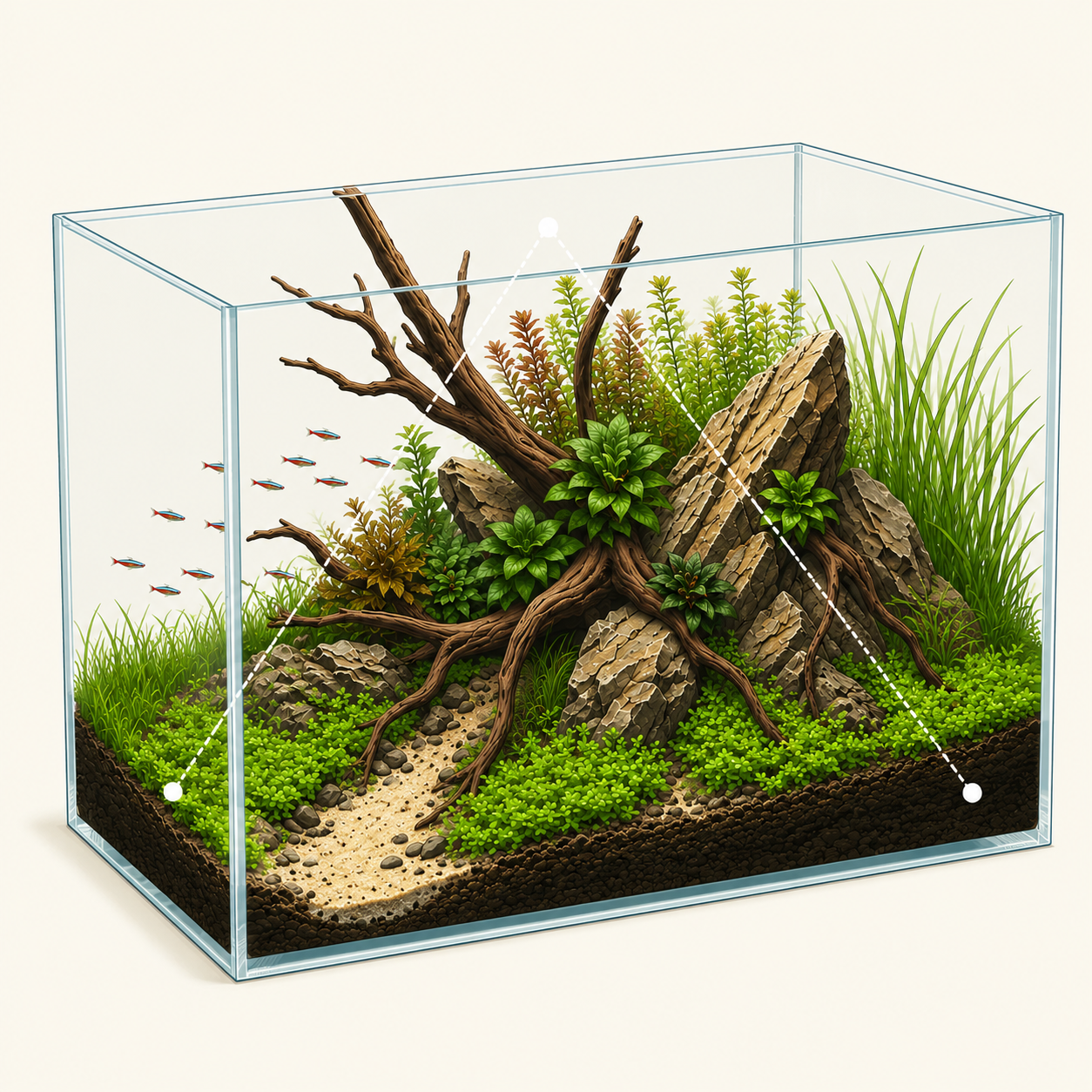
A triangular layout creates a visual diagonal: tall planting or hardscape in one back corner, sloping downward and forward to an open foreground on the opposite side. This diagonal creates movement — the eye follows the slope from the high point to the open space and back.
The resulting shape when viewed from the front is roughly triangular:
- Apex: Tall background plants or tall hardscape in one corner
- Base: Open foreground space on the opposite side
- Slope: A gradual transition from tall to low across the midground
Which Side Should Be Tall?
By convention, the taller side is often positioned on the left in photographs (following Western left-to-right reading direction). However, placement should be based on:
- Where the viewer sits: The viewer should look from the open side toward the tall side
- Room layout: If the tank is viewed from one specific angle, orient the tall side away from that viewpoint's open side
- Light source: In asymmetric lighting setups, tall plants may benefit from being closer to a supplemental light source
Building the Height Gradient
Tall Side (60–70% of tank height)
Options:
- Dense background stem plants (Rotala, Hygrophila, Vallisneria) growing to full height
- Tall driftwood with moss and epiphytes
- Stacked rock formation reaching upper midwater
Transitional Midground
The slope between tall and open sides uses decreasing-height elements:
- Midground plants (anubias, crypts, java fern)
- Medium-height rocks or driftwood pieces
- Progressively lower plant species as you move across the midground
Open Foreground
The low, open side of the triangle — typically the right foreground — provides breathing space:
- Carpet plant (HC Cuba, Monte Carlo, dwarf hairgrass) across the visible substrate
- No tall obstructions — this is deliberate negative space
Hardscape in Triangular Layouts
Hardscape (rocks, driftwood) reinforces the diagonal when placed to echo the slope:
- Primary driftwood piece: diagonal orientation from upper-left to lower-right (or reverse)
- Secondary rocks: positioned along the slope line, decreasing in size as you move to the open side
- Avoid placing equal-height elements on both sides — this creates a valley (concave) layout rather than a triangle
Common Mistakes
| Mistake | Fix |
|---|---|
| Both sides the same height | Commit to one tall side; keep the other consistently lower |
| Slope too abrupt | Add intermediate-height plants to smooth the gradient |
| Foreground too cluttered | Remove midground elements from the open side — protect the negative space |
| All plants same species | Vary texture and colour along the slope for visual interest |
Planting Plan (90 cm triangular tank)
| Zone | Plant | Height |
|---|---|---|
| Back left (apex) | Rotala rotundifolia | 35–40 cm |
| Back left | Vallisneria nana | 30–40 cm |
| Mid left | Java fern on driftwood | 20–25 cm |
| Mid left-centre | Anubias barteri | 15–20 cm |
| Mid-centre | Cryptocoryne wendtii | 10–15 cm |
| Right foreground | Monte Carlo carpet | 3–5 cm |
| Right open | Open substrate | 0 cm |
Browse our aquascape plants, hardscape, and aquasoil for triangular layout materials available in Singapore.