

Aquarium Snail Guide: Nerite, Mystery, Ramshorn, and Malaysian Trumpet Snails Compared
Snails in aquariums have a complicated reputation. To some hobbyists, they are welcome allies that clean algae and process detritus. To others, they are pest species that multiply uncontrollably and overwhelm a tank. The truth depends almost entirely on which species you are keeping and why.
This guide covers the most commonly kept freshwater aquarium snails — their benefits, limitations, breeding behaviour, and which type suits different tank setups.
Why Keep Aquarium Snails?
Snails offer several genuine benefits:
- Algae grazing: Many snail species consume green spot algae, diatoms, and biofilm from glass and hard surfaces that are difficult to reach with a scraper
- Detritus processing: Snails consume uneaten food, decomposing plant matter, and organic debris that would otherwise raise ammonia
- Substrate aeration: Burrowing species (Malaysian trumpet snails) prevent compaction and anaerobic pockets in fine substrate
- Visual interest: Many snail species are genuinely attractive — mystery snails in particular come in striking colours
- Biological indicator: A sudden die-off of snails often indicates water quality problems (particularly copper contamination) before fish are affected
Nerite Snails (Neritina spp.)
Best for: Algae control on glass and hardscape; tanks where population control is essential
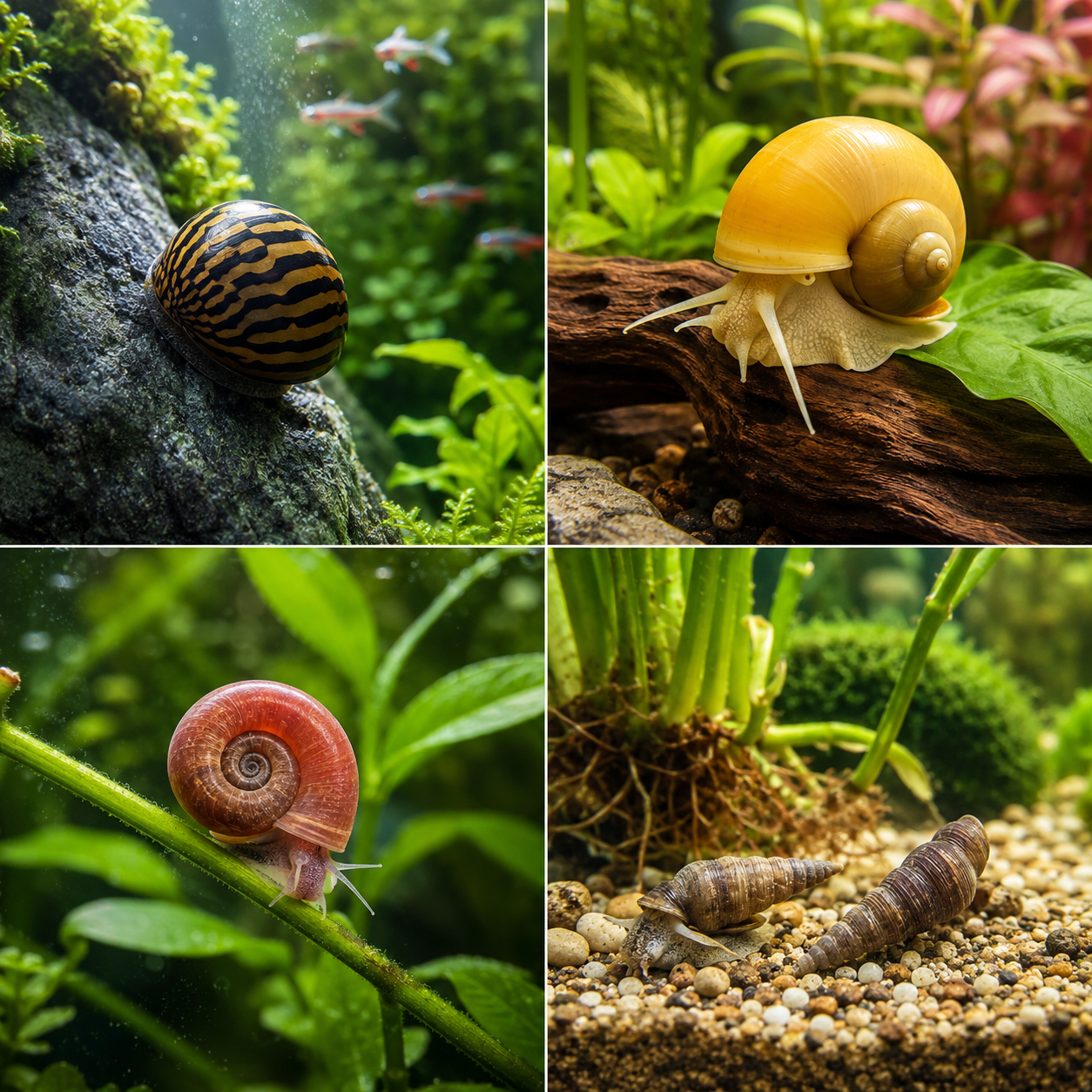
Nerite snails are widely regarded as the best algae-eating snails for freshwater aquariums. They are tireless grazers that methodically cover every hard surface — glass, smooth rock, driftwood, and equipment — consuming green spot algae, diatoms, and biofilm.
The key advantage of nerite snails: They do not reproduce in freshwater. Their eggs require brackish (partially salinated) water to hatch. This means nerite populations in a freshwater tank remain exactly the number you put in — no explosion, no pest problem.
Care requirements:
- Temperature: 22–28°C
- pH: 6.5–8.5 — very adaptable
- Hardness: Prefer moderately hard water; soft water can erode their shells over time (supplement with a small piece of cuttlebone)
- Tank size: Suitable from 20 litres
- Stocking: 1–2 per 20–30 litres for effective algae control
Available varieties:
- Zebra nerite (N. natalensis) — black and yellow stripes
- Tiger nerite — orange with black stripes; slightly smaller
- Horned nerite — small, patterned, with short spine-like protrusions
- Olive nerite — smooth, dark olive shell
Limitation: Nerite snails lay small white eggs on hard surfaces that are difficult to remove and mildly unsightly. The eggs will not hatch in freshwater, but they must be physically scraped off.
Mystery Snails (Pomacea bridgesii)
Best for: Tanks where visual interest is wanted from snails; general detritus cleanup; soft algae grazing
Mystery snails are large (up to 5 cm diameter), active, and available in an impressive range of colour morphs: gold, ivory/white, blue-grey, brown, jade, and purple. They are immediately visible in a tank and genuinely attractive.
What they eat: Soft algae, biofilm, decomposing plant matter, uneaten food. They are less effective on green spot algae (too hard for them) and do not eat healthy plant tissue in most cases.
Care requirements:
- Temperature: 18–28°C
- pH: 7.0–8.0 — prefer neutral to alkaline; acidic water erodes their shells
- Hardness: Prefer hard water; need adequate calcium for shell health
- Tank size: Suitable from 20 litres
- Important: They breathe air — they have a siphon they extend to the surface; ensure the tank lid has gaps for this, or an open top
Reproduction: Mystery snails breed in freshwater. Females deposit egg clutches above the waterline (on tank walls or under the lid) — these are pink/beige egg masses. This makes population management simple: remove egg clutches to prevent breeding, or leave them to hatch if you want more snails.
Limitation: They can consume very tender plant shoots, though they generally leave healthy, firm plant tissue alone.
Ramshorn Snails (Planorbella / Planorbarius spp.)
Best for: Feeding to puffer fish and other snail-eaters; planted tanks with decomposing matter to process; naturalistically planted setups
Ramshorn snails have a distinctive flat, spiral shell. They come in the natural brown-grey form and a selectively bred red variety (the red blood ramshorn, popular in planted tanks). They are active, breed readily, and consume algae, detritus, and decomposing plant matter effectively.
The ramshorn reputation problem: They breed prolifically in freshwater. A well-fed ramshorn population can explode to hundreds of individuals within months. For hobbyists who are not managing populations actively, this can become overwhelming.
Population control strategies:
- Manual removal of eggs (gelatinous clusters on surfaces)
- Introducing a predator: assassin snails, puffer fish, or loaches that eat snails
- Reducing overfeeding (excess food drives population explosions)
Care requirements:
- Temperature: 18–28°C
- pH: 7.0–8.0
- Very hardy and adaptable
Malaysian Trumpet Snails (Melanoides tuberculata)
Best for: Substrate maintenance in planted tanks with fine sand or soil; tanks with burrowing-sensitive livestock (corydoras benefit from clean, aerated substrate)
Malaysian trumpet snails (MTS) are small, elongated snails with a cone-shaped shell. They spend most of their time buried in substrate, burrowing through it, processing detritus and uneaten food, and aerating the substrate to prevent anaerobic pockets.
Benefits of MTS:
- Prevent substrate compaction and the anaerobic gas pockets that can poison fish
- Process organic matter in the substrate efficiently
- Largely invisible during the day (emerge at night to feed)
The MTS population question: Like ramshorn snails, MTS can multiply rapidly in a well-fed tank. They are livebearers — each female produces live young without mating. A few individuals introduced accidentally on plants can become hundreds.
Managing MTS populations: Reduce feeding, introduce assassin snails, or do occasional substrate vacuuming to thin the population. A moderate population (tens of snails) is entirely beneficial; an extreme overabundance indicates overfeeding.
Assassin Snails (Clea helena)
Best for: Controlling pest snail populations (ramshorn, MTS, pond snails)
Assassin snails are a specialist species that prey on other snails. They are attractively patterned with brown and yellow bands, grow to about 2.5 cm, and are effective predators of smaller snails.
Use case: If your tank has a ramshorn or MTS outbreak, introducing 4–6 assassin snails will gradually reduce the population. Once snails are eliminated, assassins will eat frozen meaty foods and fish scraps.
Important: Assassin snails do not threaten large snails (mystery snails) but will eat nerite and ramshorn snails.
Snail Compatibility with Fish and Shrimp
| Snail species | Safe with shrimp? | Safe with fish? |
|---|---|---|
| Nerite | Yes | Yes (most fish ignore them) |
| Mystery snail | Yes | Yes (most fish; cichlids may chip shells) |
| Ramshorn | Yes | Some fish eat them (loaches, puffers) |
| MTS | Yes | Loaches eat them; others ignore them |
| Assassin snail | Potentially risky with small shrimp | Yes |
For shrimp-specific guidance, see Cherry Shrimp Care Guide.
Frequently Asked Questions
Do aquarium snails need special food? Most aquarium snails thrive on naturally occurring algae, biofilm, and detritus in a well-established tank. Supplement with blanched vegetables (zucchini, cucumber, spinach) and algae wafers. Mystery snails in clean tanks benefit from calcium supplementation (cuttlebone).
Will snails eat my aquarium plants? Nerite snails do not eat healthy plants. Mystery snails rarely eat healthy plant tissue. Ramshorn snails may nibble at very delicate plants. None of the species listed here are significant plant eaters under normal conditions.
How do snails get into tanks without being deliberately added? Snail eggs are microscopic and often introduced on live plants purchased from fish shops. A single plant with snail eggs can introduce ramshorn or MTS to your tank. Rinse new plants thoroughly and consider a brief dip in diluted potassium permanganate solution before adding to your tank.
Can I keep multiple snail species together? Yes, in most cases. Nerite and mystery snails coexist peacefully. Assassin snails should not be kept with smaller snail species you want to preserve.
Are snails harmful to fish? No — healthy snails are harmless to fish. A dead or dying snail can release ammonia rapidly as it decomposes, so remove any snail that has been still and unresponsive for more than 24 hours.