
Cherry Shrimp Care Guide: A Beginner's Guide to Freshwater Shrimp Tanks
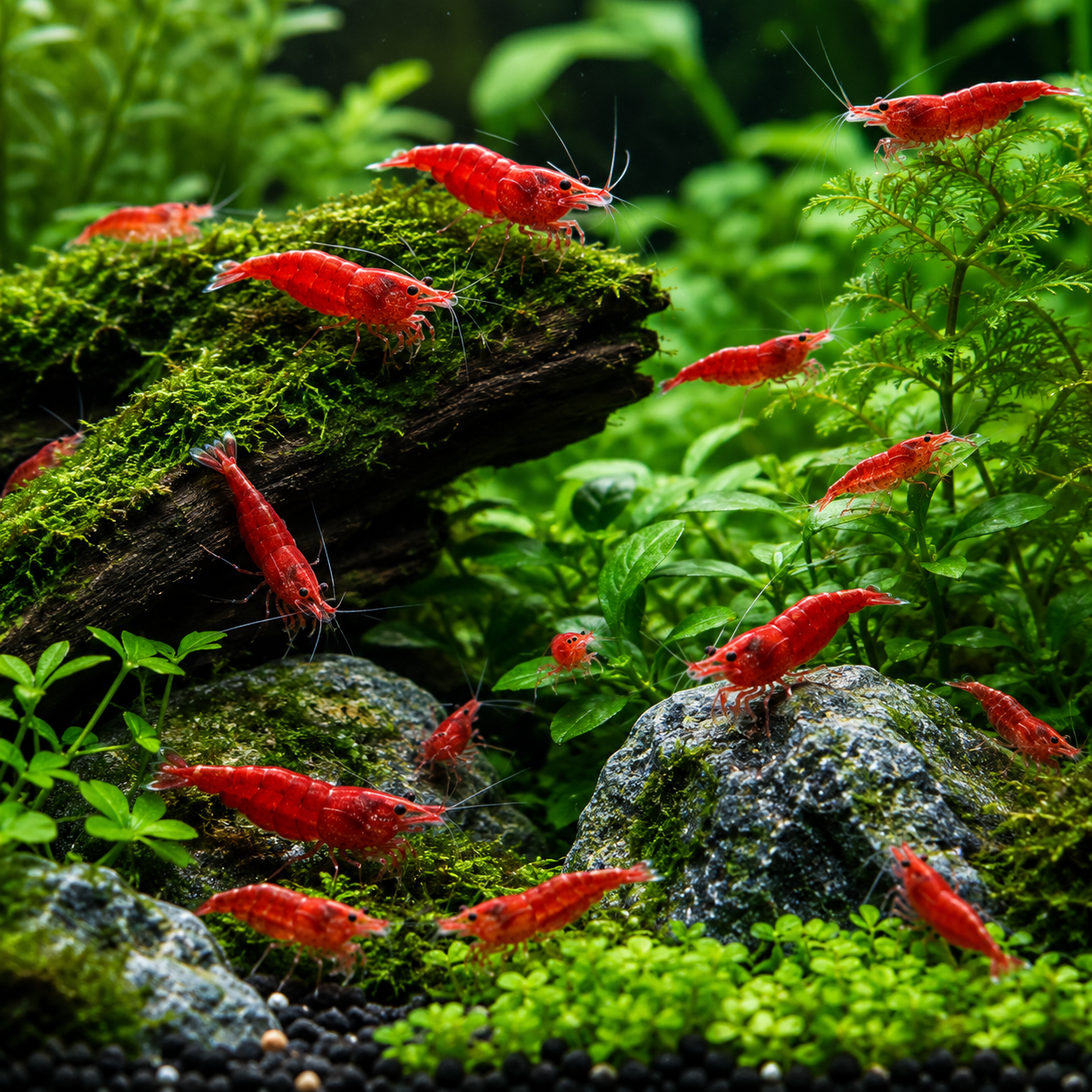
Cherry shrimp (Neocaridina davidi) are one of the best additions to a planted freshwater aquarium. They are endlessly active, fascinating to observe as they pick at every surface for algae and biofilm, and available in a stunning range of colours from the classic red to yellow, blue, orange, and black variants. They breed readily in the right conditions and establish thriving colonies in well-maintained tanks.
This guide covers everything needed to set up a successful cherry shrimp tank — from water parameters and tank setup to feeding, breeding, and compatible tankmates.
Quick Reference: Cherry Shrimp Care at a Glance
| Parameter | Ideal Range |
|---|---|
| Tank size (minimum) | 20 litres |
| Temperature | 18–26°C |
| pH | 6.5–7.5 |
| Hardness (GH) | 6–8 dGH |
| KH (carbonate hardness) | 2–4 dKH |
| TDS (total dissolved solids) | 150–250 ppm |
| Diet | Algae, biofilm, plant matter, shrimp-specific foods |
| Adult size | 2.5–4 cm (females larger) |
| Lifespan | 1–2 years |
Cherry Shrimp Colour Grades
Cherry shrimp are sold in grades based on colour intensity. Higher grades command higher prices:
| Grade | Description |
|---|---|
| Cherry / Regular | Pale red with clear patches; entry-level |
| Sakura | Solid red with minor clear areas |
| Fire Red | Deep, solid red with no clear areas |
| Painted Fire Red | Intense solid red on body and legs; highest grade |
For other colour varieties:
- Yellow neocaridina (Yellow Fire, Lemon Yellow) — bright yellow; easier to see against dark substrate
- Blue Velvet — deep blue; popular in planted tanks
- Orange Neocaridina (Sunkist) — vibrant orange
- Black Rose — dark black to charcoal
- Snowball — white/opaque
All neocaridina shrimp share the same care requirements and can interbreed — keep colour varieties separate to maintain colour purity.
Tank Size and Setup
Cherry shrimp can thrive in tanks as small as 20 litres, making them ideal for Singapore's HDB apartments where space is often at a premium. A 20–40 litre nano tank is the classic cherry shrimp setup.
Ideal setup features:
- Dense planting — essential for shrimp health. Live plants (java moss, anubias, java fern, floating plants) provide:
- Biofilm-covered surfaces for constant grazing
- Cover from potential predators
- Stable water chemistry
- Organic matter for foraging
- Fine substrate — light-coloured shrimp show better contrast against dark substrate; soil substrates are excellent for planted shrimp tanks; see Aquarium Substrate Guide
- Sponge filter — the ideal filtration for shrimp tanks; gentle flow, no risk of shrimp being sucked into the intake, and the sponge surface itself becomes a biofilm grazing station
- Hiding places — driftwood, mossy rocks, and ceramic shrimp tubes give shrimp places to hide during moulting (when they are vulnerable)
- Tight lid — shrimp are surprisingly good climbers and will exit the tank through any gap
For small planted tank ideas, see Nano Aquarium Guide.
Water Parameters: The Key to a Thriving Colony
Cherry shrimp are more sensitive to water chemistry than most fish. They are particularly affected by:
Ammonia and nitrite: Even trace amounts are lethal to shrimp. The tank must be fully cycled before any shrimp are added. See How to Cycle a Fish Tank.
Nitrate: Keep below 20 ppm through regular water changes. Nitrate above 20–30 ppm chronically stresses shrimp and reduces breeding success.
pH: 6.5–7.5. Neocaridina shrimp tolerate a range but thrive best at neutral pH. Extremes at either end cause stress and failed moults.
GH and KH: These are often overlooked but critical. Calcium and magnesium (measured by GH) are essential for successful moulting — shrimp pull minerals from the water to form new shells. Low GH leads to failed moults (the shrimp cannot shed its old shell and dies).
Singapore tap water context: Singapore's tap water, after dechlorination, typically has GH of 4–8 dGH and KH of 2–4 dKH — adequate for neocaridina shrimp. However, always test before adding shrimp. If GH is low, add a small amount of shrimp-specific mineral supplement.
Water changes: Perform 10–15% water changes weekly. Large, rapid water changes stress and can kill shrimp. Always match temperature and dechlorinate.
Feeding Cherry Shrimp
Cherry shrimp are primarily biofilm and algae grazers. In a well-established, heavily planted tank they spend most of their time picking at surfaces. Supplemental feeding enhances colour and breeding.
Recommended foods:
- Shrimp-specific wafers or pellets — spirulina-based options are excellent
- Blanched vegetables: zucchini, cucumber, spinach (2–3 times per week; remove after 24 hours)
- Dried or blanched Indian almond leaves — decomposing leaves develop biofilm that shrimp graze on intensely
- Bee pollen — occasional supplement; promotes breeding
- Snowflake food (soya husk) — classic shrimp food; soft and biofilm-growing
- Algae on surfaces — a well-cycled, planted tank produces natural biofilm that is the shrimp's best food source
Feeding frequency: Every 1–2 days for supplemental foods. Remove uneaten food after 24 hours to avoid fouling the water.
For general feeding guidance, see How Much and How Often Should You Feed Aquarium Fish?.
Cherry Shrimp Breeding
Cherry shrimp breed readily in good conditions — it is one of their most appealing characteristics. The colony grows gradually, providing a self-sustaining, expanding population.
Breeding process:
- Females moult and release pheromones — males in the tank react immediately and swim frantically searching for the female (this is called the "mating dance" or "shrimp waltz")
- The male locates the female and mates within hours of her moulting
- The female carries fertilised eggs under her tail (she is said to be "berried" — the eggs resemble a tiny cluster of berries)
- Eggs develop for 3–4 weeks; the female fans them regularly with her pleopods
- Miniature fully-formed shrimp emerge — exact copies of adults at about 2 mm
Maximising breeding success:
- Keep water parameters stable and nitrate low
- Ensure adequate GH and KH for successful moulting
- Dense java moss provides critical cover for tiny juvenile shrimp
- Keep a species-only or shrimp-safe community (no predatory fish)
- Feed varied, nutritious diet
Compatible Tankmates
Cherry shrimp are prey-sized animals. Most fish will eat them.
Safe fish tankmates:
- Otocinclus catfish — tiny, peaceful, and completely shrimp-safe
- Pygmy corydoras — generally safe; too small to eat adult shrimp
- Small rasboras (chilli rasbora, mosquito rasbora) — tiny and generally shrimp-safe
- Endler's livebearers — can occasionally eat very young shrimp but generally safe with adults
- Snails (nerite, mystery, trumpet) — safe and useful cleanup crew; see Aquarium Snail Guide
Avoid:
- Most fish over 3–4 cm that are active hunters or have large mouths
- Bettas (highly variable; many will hunt shrimp)
- Guppies (will eat juvenile shrimp and berried females are stressed by pursuit)
- Corydoras larger than pygmy species (may accidentally eat young shrimp)
- All cichlids
Common Problems
| Problem | Cause | Solution |
|---|---|---|
| Failed moults / "ring of death" | Low GH or sudden water chemistry change | Test and raise GH; perform smaller water changes |
| Shrimp dying after water change | Temperature shock or untreated chloramine | Match temperature carefully; ensure dechlorinator covers chloramine |
| Shrimp not breeding | Poor water quality, high nitrate, or unstable parameters | Test all parameters; perform consistent weekly water changes |
| Shrimp hiding constantly | Stress from predators, recent water change, or moulting cycle | Normal during moulting; check for tankmate issues |
Frequently Asked Questions
How many cherry shrimp can I keep in a 20-litre tank? Start with 10–20 shrimp in a 20-litre well-planted tank. They will breed and the colony will grow — a healthy 20-litre shrimp tank can eventually sustain 50–100 individuals.
Why are my cherry shrimp not breeding? The most common causes are: water parameters outside the ideal range (especially low GH), nitrate above 20 ppm, ammonia or nitrite present, or insufficient food and cover. Test all parameters and ensure the tank is fully cycled.
Can cherry shrimp live without a heater in Singapore? Yes — Singapore's ambient temperature (27–30°C) is at the warm end of cherry shrimp tolerance (optimal: 18–26°C). Cherry shrimp survive at Singapore's ambient temperature but breed less prolifically and have shorter lifespans at the higher end. If your home uses heavy air-conditioning (below 23°C), a heater may actually be needed.
Do cherry shrimp eat fish? No — cherry shrimp are completely harmless to fish. They may pick at dead or dying fish, but they do not attack or harm living fish.
How do I know if my cherry shrimp is healthy? Healthy cherry shrimp are active and constantly foraging; they have vivid, opaque colour; they moult regularly (shed shells are visible in the tank and are normal — do not remove them, as shrimp eat the shed shells for minerals); and berried females are visible in a colony with males present.