

Best Algae Eaters for Freshwater Aquariums: Fish, Snails, and Shrimp
One of the most practical ways to manage aquarium algae without constant manual scrubbing is to enlist the help of nature's own janitors. The right combination of algae-eating fish, snails, and shrimp can make a significant difference in how clean and balanced a tank looks — provided you choose species that actually eat the type of algae you have.
This guide covers the best algae eaters for freshwater aquariums, what each species actually eats, and how to keep them healthy.
Important Caveat First
Algae eaters are not a substitute for addressing the root cause of algae growth. If you have excessive light, high nutrients, or poor water circulation, algae eaters will be overwhelmed. They work best as a maintenance tool in a reasonably balanced tank, not as a cure for a severely overgrown one.
For a full explanation of algae causes and solutions, see: The Complete Aquarium Algae Guide.
Best Algae-Eating Fish
1. Otocinclus Catfish (Otocinclus spp.)
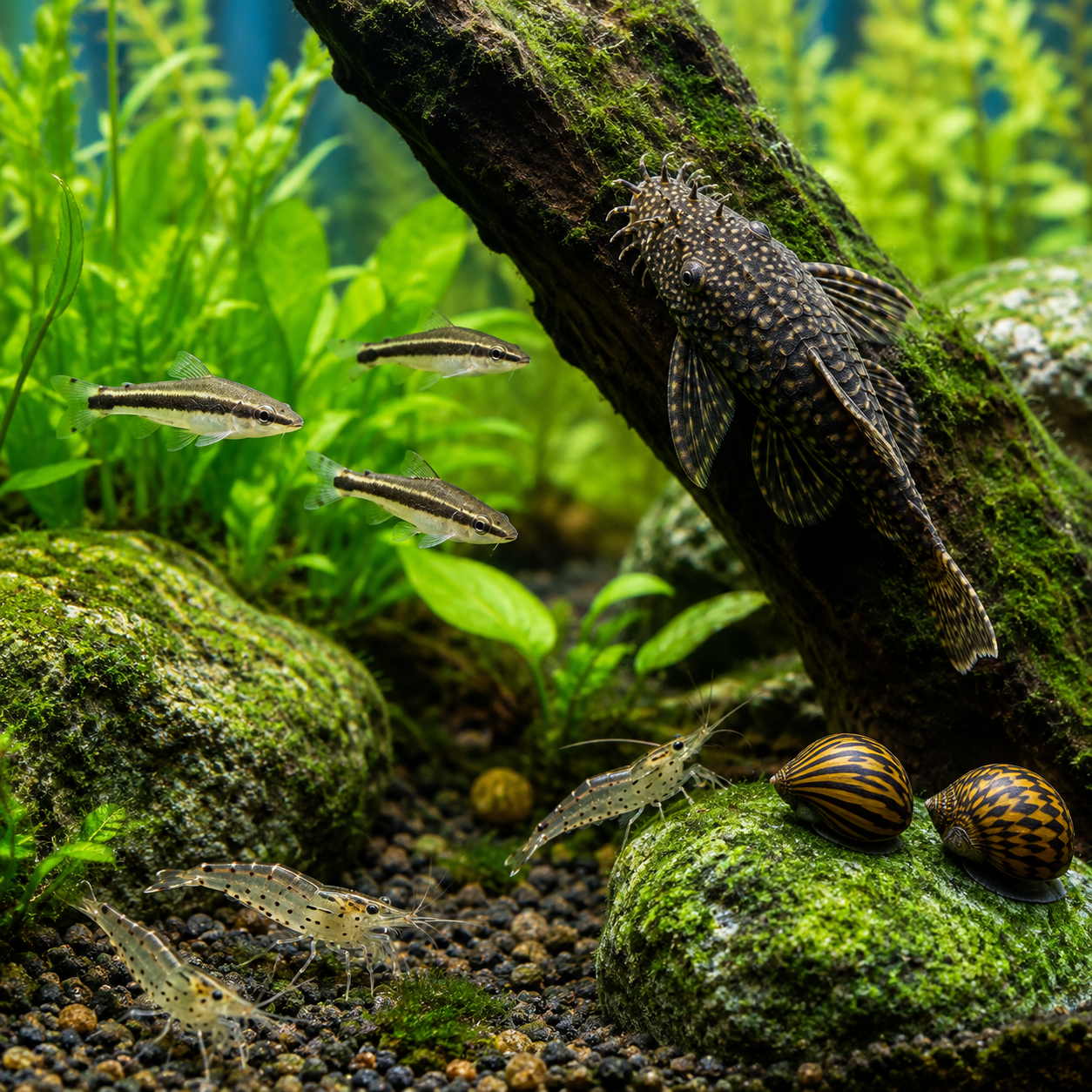
Otocinclus — or "otos" — are small, peaceful catfish that are among the most effective algae eaters available for community tanks. They specialise in soft algae: the thin green film and diatom (brown algae) coatings that appear on glass and plant leaves.
Tank requirements:
- Minimum tank: 40 litres
- Temperature: 22–27°C
- Group size: At least 4–6; they are social and decline in isolation
- pH: 6.0–7.5
What they eat: Soft green and brown algae (diatoms, green film). They will not touch black beard algae or staghorn.
Important notes: Otos are sensitive fish that often arrive in poor condition from importing stress. Quarantine before adding to the main tank. Once settled, they are hardy and long-lived (4–7 years).
2. Siamese Algae Eater (Crossocheilus oblongus)
The true Siamese algae eater (often confused with the Chinese algae eater and the flying fox — all three look similar) is one of the few fish that will graze on black beard algae. This makes it invaluable in planted tanks where BBA is a persistent problem.
Tank requirements:
- Minimum tank: 120 litres (they grow to 15 cm)
- Temperature: 24–27°C
- Keep in groups of 4+ to manage intraspecific aggression
- pH: 6.0–7.5
What they eat: Green algae, black beard algae, some hair algae, and biofilm.
Important notes: Verify species before purchasing — the true SAE (Crossocheilus oblongus) has a distinct horizontal black stripe from nose to tail including the tail fin. The false SAE (Epalzeorhynchos spp.) barely eats algae and becomes aggressive with age.
3. Bristlenose Plecos (Ancistrus spp.)
Bristlenose plecos are compact (12–15 cm as adults), hardy fish that graze continuously on surfaces. Unlike common plecos that grow to 50+ cm, bristlenoses are a practical option for medium-sized tanks. They rasp algae from driftwood, glass, and smooth rocks.
Tank requirements:
- Minimum tank: 100 litres
- Temperature: 23–27°C
- Provide driftwood — essential for their digestive health
- pH: 6.0–7.5
What they eat: Soft algae on glass and hardscape, biofilm, algae wafers, and softened vegetables (cucumber, zucchini).
Important notes: Supplement with sinking algae wafers and vegetable matter, especially in clean tanks where algae is sparse. They do not eat black beard algae.
4. Mollies (Poecilia sphenops)
Black mollies, in particular, are underrated algae grazers. They continuously pick at soft algae, biofilm, and green film on glass and hardscape. They also work as decent beginner community fish.
What they eat: Soft green algae, biofilm, some hair algae.
Notes: Not specialised algae eaters, but effective supplemental grazers in community tanks.
Best Algae-Eating Snails
1. Nerite Snails (Neritina spp.)
Nerite snails are widely considered the best algae-eating snails for freshwater aquariums. They are voracious grazers that cover every surface methodically — glass, hardscape, and slow-growing plant leaves. Crucially, they do not reproduce in freshwater (their larvae require brackish conditions), so populations stay under control.
What they eat: Green spot algae, diatoms, green film, biofilm on all hard surfaces.
Tank requirements:
- Minimum tank: 20 litres
- Temperature: 22–28°C
- Need calcium in the water for healthy shells (if using very soft water, add crushed coral)
One or two nerites per 20–30 litres is a reasonable stocking rate.
2. Mystery Snails (Pomacea bridgesii)
Mystery snails are large (up to 5 cm), active grazers that consume soft algae, biofilm, and decaying plant matter. They come in gold, ivory, blue, and other colour morphs. Unlike nerites, they do reproduce in freshwater, so manage egg clutches if you do not want a population explosion.
3. Malaysian Trumpet Snails (Melanoides tuberculata)
MTS live in the substrate and burrow through it, aerating it and consuming decaying matter. They eat some algae but are not primarily algae grazers. Their real value is substrate maintenance.
Best Algae-Eating Shrimp
1. Amano Shrimp (Caridina multidentata)
Amano shrimp are the most effective algae-eating shrimp available. Larger than cherry shrimp (up to 5 cm), they work methodically and will consume green hair algae, filamentous algae, and biofilm. A group of 6–10 Amanos in a 60-litre planted tank makes a noticeable difference.
What they eat: Hair algae, thread algae, green dust algae, biofilm, and decaying plant matter.
Tank requirements:
- Temperature: 22–26°C
- pH: 6.5–7.5
- Relatively peaceful — safe with most small community fish
- Note: They become prey for any fish larger than about 5 cm; plan tankmate selection carefully
2. Cherry Shrimp (Neocaridina davidi)
Cherry shrimp are smaller and less aggressive algae eaters than Amanos, but in large colonies they provide useful cleanup of biofilm, soft algae, and food debris. They are also easier to breed and establish as a colony.
Best for: Tanks without large or predatory fish; nano aquariums; planted tanks
Combining Algae Eaters Effectively
For a balanced community aquarium, a complementary algae-eating crew might look like:
- 4 otocinclus (soft film algae on glass and leaves)
- 2 nerite snails (green spot algae on glass)
- 6 Amano shrimp (hair algae and biofilm on substrate and hardscape)
This combination covers different types of algae across different surfaces without competition.
Frequently Asked Questions
Will algae eaters clean up a completely green tank? Not effectively. Algae eaters manage and maintain — they cannot clear a severely overgrown tank on their own. Address light and nutrient levels first, then use algae eaters for ongoing maintenance.
Can I keep algae eaters in a tank without algae? Yes, but supplement their diet. Otocinclus need algae wafers and blanched vegetables. Plecos require driftwood and supplemental feeding. Shrimp eat biofilm and food debris.
Do algae-eating fish eat plants? Otocinclus and nerite snails generally do not damage healthy live plants. Plecos may graze on thin-leaved plants when hungry. Amano shrimp may nibble on very delicate plants but generally prefer algae.
How many nerite snails should I keep? One nerite snail per 10–20 litres is a reasonable starting point. They will not overpopulate in freshwater.
Why is my algae eater not eating algae? Possibly because: (1) the tank is too clean and it is eating other food instead, (2) you are overfeeding other foods and it has no motivation, (3) it is the wrong species for the algae type present, or (4) it is stressed and not settled. Ensure species match the algae type in your tank.