
The Complete Aquarium Algae Guide: Types, Causes, and How to Control Them
Algae is an almost universal experience in the aquarium hobby. Walk into any fish room or browse any aquarium forum and you will find someone wrestling with green glass, brown film, or thick black beard. While a small amount of algae is perfectly normal — and even beneficial — excessive algae growth signals an imbalance in light, nutrients, or CO₂ that needs correcting.
This guide covers the most common types of aquarium algae, what causes each one, and exactly how to address them.
Is All Algae Bad?
No. Algae is a natural part of aquatic ecosystems, and a thin film on the back glass or some growth on driftwood is often a sign of a biologically active tank. Algae consumes nitrate and phosphate, competes with nuisance bacteria, and even provides a food source for certain fish and invertebrates.
The problem arises when algae grows faster than you can manage it — coating plant leaves, clouding glass, and making the tank look neglected.
The Three Root Causes of Problem Algae
Almost all algae problems trace back to an imbalance in one of three factors:
- Too much light (intensity, duration, or direct sunlight)
- Excess nutrients (phosphate, nitrate) from overfeeding or infrequent water changes
- Imbalance between CO₂, light, and nutrients in planted tanks
Identifying which factor is at play determines the solution.
Common Types of Aquarium Algae
1. Green Spot Algae (GSA)
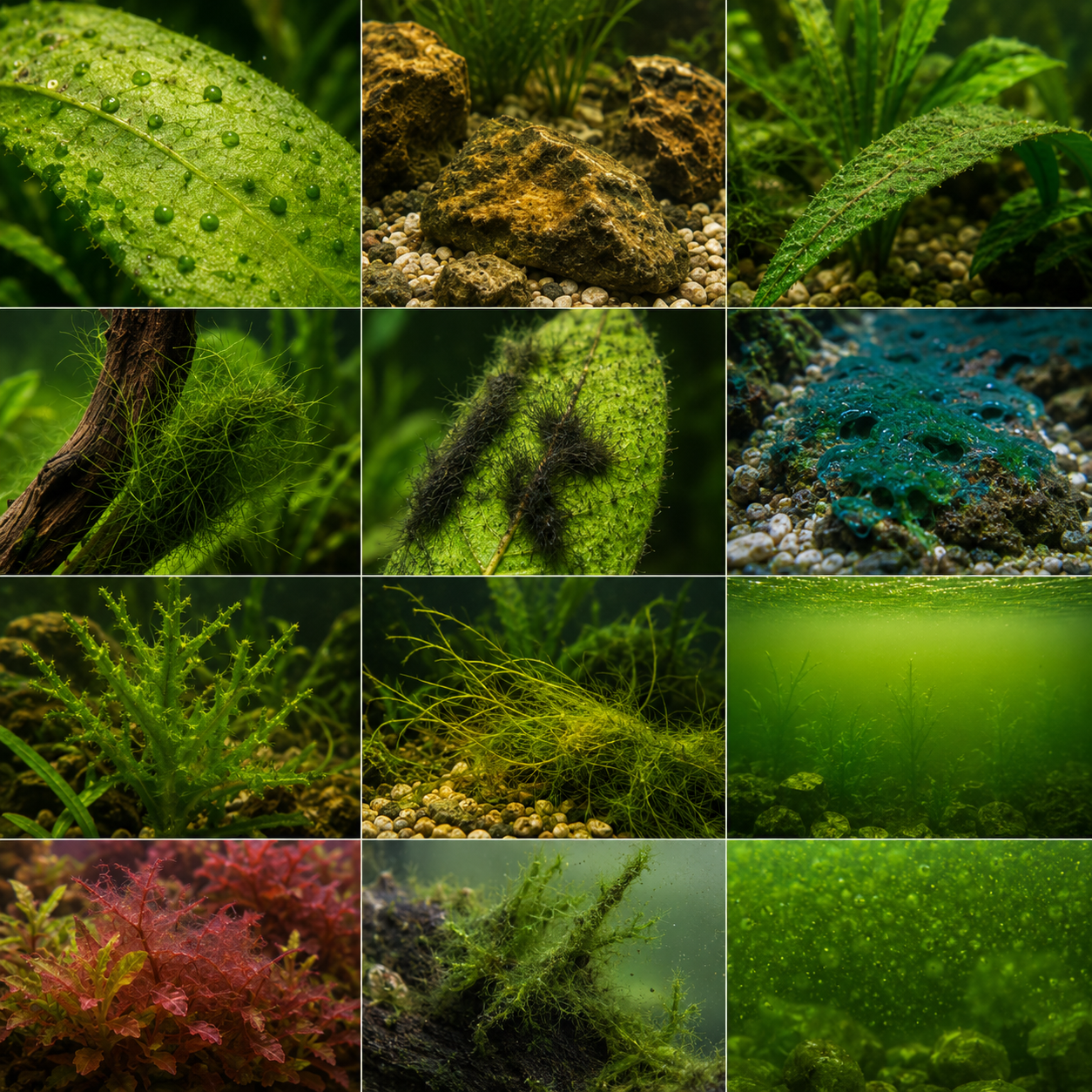
Appearance: Small, hard green circles on the glass and on slow-growing plant leaves.
Cause: Low phosphate, often combined with high light. Counterintuitively, GSA often indicates a phosphate deficiency rather than excess — phosphate competes with algae for growth and its absence paradoxically allows certain algae to thrive.
Solution:
- Raise phosphate levels slightly (if very low)
- Reduce light duration or intensity
- Add fast-growing plants to consume excess nutrients
- Remove manually with a razor blade or algae scraper
2. Staghorn Algae
Appearance: Grey or green branching filaments that look like deer antlers, attached firmly to hardscape and plant leaves.
Cause: Low CO₂, poor water flow, or decaying plant matter.
Solution:
- Improve water circulation
- Spot-treat with liquid carbon (glutaraldehyde-based products diluted in tank water)
- Trim affected plant leaves; remove algae-covered driftwood for treatment outside the tank
3. Black Beard Algae / Black Brush Algae (BBA)
Appearance: Dense, dark tufts (black, grey, or dark red) that attach tenaciously to driftwood, plant leaves, and filter intakes. One of the most difficult algae types to eradicate.
Cause: Fluctuating CO₂ levels, inconsistent lighting, or low flow areas where CO₂ is depleted.
Solution:
- Stabilise CO₂ injection (if running CO₂)
- Spot-dose affected areas with liquid carbon applied directly with a syringe while tank water is drained slightly
- Increase water flow to eliminate dead spots
- Certain fish such as Florida flag fish and some plecos graze on BBA
4. Green Water (Free-Floating Algae)
Appearance: The tank water turns entirely green, like pea soup, with no visible individual algae strands.
Cause: Excess light (particularly direct sunlight) combined with high nutrient levels. Microscopic algae are suspended throughout the water column.
Solution:
- Cover the tank with black plastic for 3–4 days (blackout treatment) — algae dies without light, fish and plants tolerate short blackouts
- Install a UV steriliser, which kills suspended algae cells as water passes through
- Move the tank out of direct sunlight
- Reduce lighting to 6–8 hours per day
5. Brown Algae (Diatoms)
Appearance: Soft brown or tan coating on glass, substrate, and decorations. Wipes off easily.
Cause: Common in new tanks with low light and silicate-rich water. Almost always disappears on its own once a tank matures.
Solution:
- Increase light levels slightly
- Add a nerite snail or otocinclus catfish to graze
- Wipe glass weekly; it will resolve itself in most cases within 2–6 weeks
6. Cladophora (Aegagropila linnaei) — Often Mistaken for Moss
Appearance: Dense, dark green tufts or mats, often found tangled around plants or filter intakes.
Cause: Poor water circulation and excess nutrients.
Solution:
- Manual removal is the most effective method
- Improve flow to eliminate dead spots
- Avoid introducing new plants from infected tanks without quarantine
Prevention: The Long-Term Strategy
Control Your Light
- Run lighting for no more than 8–10 hours per day in a planted tank; 6–8 hours for non-planted tanks
- Never position a tank in direct sunlight
- Use a timer — consistent photoperiods are far better than variable ones
Manage Nutrients
- Do not overfeed; remove uneaten food within 5 minutes
- Perform weekly water changes of 25–30%
- Stock appropriate algae eaters for your setup — see our guide: Best Algae Eaters for Freshwater Aquariums
Use Live Plants Strategically
Fast-growing plants like stem plants, floating plants, and water wisteria compete directly with algae for nutrients. A heavily planted tank is one of the most effective long-term algae management strategies available.
For plant recommendations, see: Low-Maintenance Aquarium Plants for Beginners.
Frequently Asked Questions
Will algae go away on its own? Brown diatoms in new tanks usually resolve themselves within weeks. Most other algae types will not disappear without addressing the underlying cause.
Is algae harmful to fish? In most cases, algae itself does not harm fish directly. However, green water algae can reduce oxygen at night through respiration, and extremely heavy algae growth can clog filter intakes and reduce flow.
Can I just add algaecide to kill algae? Algaecides are generally not recommended in planted or heavily stocked aquariums. They kill algae indiscriminately, including beneficial algae, and dying algae releases nutrients that can fuel the next outbreak. The underlying cause must be addressed.
What causes algae to grow on plant leaves specifically? Algae on plant leaves usually indicates slow-growing or struggling plants that cannot compete for nutrients, or localised low flow. Switch to faster-growing plants or address the flow issue.
Does a UV steriliser eliminate all algae? UV sterilisers are effective against suspended (free-floating) algae that passes through the unit. They do not affect attached algae on surfaces.