

Best Freshwater Fish for Beginners: Hardy, Peaceful, and Easy to Keep
Choosing the right fish for your first aquarium can feel daunting when you are standing in front of a wall of tanks. There are hundreds of species available, and not all of them are suited to beginner care. Some are sensitive to water quality, some are aggressive, and some grow far larger than their tank can accommodate.
This guide focuses on fish that are genuinely beginner-friendly: species that tolerate minor water chemistry fluctuations, get along well with others, and are widely available in Singapore.
What Makes a Fish Beginner-Friendly?
Before diving into specific species, it helps to understand the criteria:
- Hardiness: Tolerates a range of water parameters without stress
- Peaceful temperament: Safe to keep in a community tank
- Forgiving diet: Eats readily available flake or pellet food
- Manageable adult size: Stays small enough for reasonably sized home aquariums
- Availability: Commonly found at local fish shops
Top Beginner Freshwater Fish
1. Guppies (Poecilia reticulata)
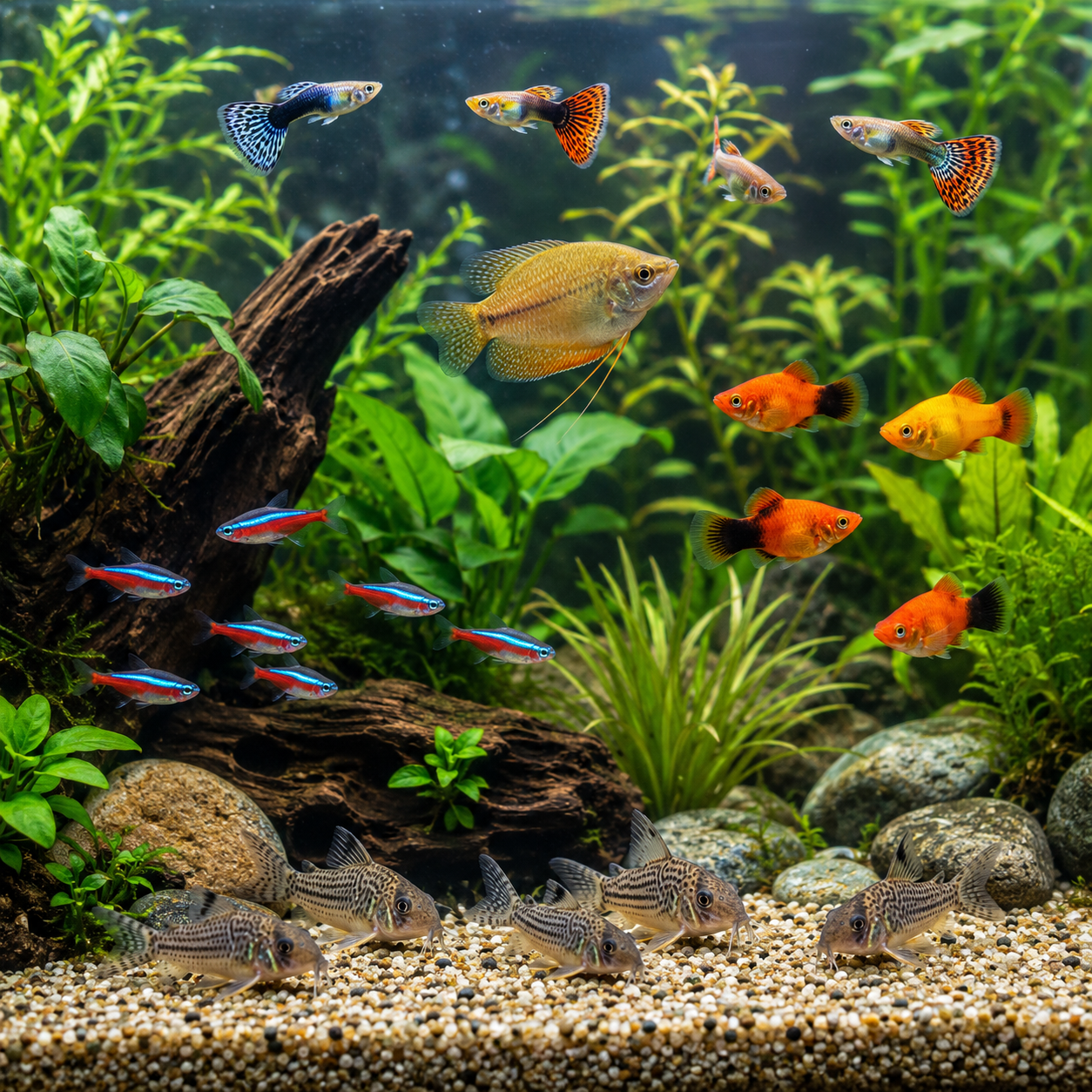
Guppies are arguably the most beginner-friendly fish in the hobby. They are colourful, active, inexpensive, and extraordinarily resilient. They thrive in temperatures between 24°C and 28°C — right in the middle of Singapore's ambient range.
Key facts:
- Adult size: 3–5 cm
- Temperament: Peaceful
- Diet: Accepts flake food readily
- Notes: Males are brightly coloured; females drabber but larger. They breed readily — be prepared for fry if you keep both sexes.
2. Neon Tetras (Paracheirodon innesi)
With their iconic electric blue and red stripe, neon tetras are a staple of beginner community tanks. They are best kept in schools of six or more, which also reduces individual stress.
Key facts:
- Adult size: 3–4 cm
- Temperament: Peaceful, schooling
- Diet: Small flake or micro pellets
- Notes: Prefer soft, slightly acidic water but adapt well to neutral pH
3. Corydoras Catfish (Corydoras spp.)
Corydoras are small, peaceful bottom-dwellers that serve a practical function: they scavenge uneaten food from the substrate, helping to keep the tank floor clean. They are social fish and should be kept in groups of at least four.
Key facts:
- Adult size: 3–7 cm depending on species
- Temperament: Very peaceful
- Diet: Sinking pellets, wafers, frozen bloodworms
- Notes: Prefer fine, soft substrate (sand or smooth gravel) to protect their barbels
4. Platies (Xiphophorus maculatus)
Platies are hardy livebearers that come in dozens of colour varieties. They are tolerant of a wide pH range and adapt readily to Singapore's tap water after dechlorination. Like guppies, they breed easily.
Key facts:
- Adult size: 5–7 cm
- Temperament: Peaceful
- Diet: Omnivorous; flake food with occasional vegetable matter
- Notes: Slightly alkaline water preferred but adaptable
5. Zebra Danios (Danio rerio)
Zebra danios are fast, active fish that are almost impossible to kill through minor water quality lapses — which makes them historically popular for cycling new tanks (though fishless cycling is always preferable). They thrive in groups and add constant movement to an aquarium.
Key facts:
- Adult size: 5–6 cm
- Temperament: Peaceful, active
- Diet: Flake food
- Notes: Tolerant of a wide temperature range; schooling fish
6. Mollies (Poecilia sphenops)
Mollies are hardy livebearers available in black, white, orange, and dalmatian patterns. They prefer slightly alkaline, moderately hard water — closer to Singapore's typical tap water chemistry than many other species.
Key facts:
- Adult size: 6–10 cm
- Temperament: Generally peaceful; males can be mildly nippy
- Diet: Omnivorous; benefits from algae in the diet
- Notes: Can tolerate some salinity; good for tanks with slightly elevated mineral content
7. Harlequin Rasboras (Trigonostigma heteromorpha)
Native to Southeast Asia, harlequin rasboras are ideally suited to tropical aquariums in Singapore. Their distinctive black triangular patch and coppery-pink body make them attractive in a school. They are extremely peaceful and undemanding.
Key facts:
- Adult size: 4–5 cm
- Temperament: Peaceful, schooling
- Diet: Flake food, micro pellets
- Notes: Prefer slightly soft, acidic to neutral water; widely available locally
8. Betta Fish (Betta splendens) — Solo Only
Bettas are stunning, personable fish that thrive in individual setups. A single male betta in a well-planted 15–30 litre tank makes an excellent beginner project. Never house two males together, and take care with community tanks — bettas can be aggressive toward similarly shaped or brightly coloured fish.
For a detailed setup guide, see: Betta Fish Tank Setup Guide.
Key facts:
- Adult size: 6–7 cm
- Temperament: Territorial; males must be kept alone or in specific community setups
- Diet: Carnivorous; prefers pellets formulated for bettas, supplemented with frozen or live food
Species to Avoid as a Beginner
Some commonly sold fish are poor choices for new hobbyists:
- Common goldfish: Require large tanks and cold water; not suited to tropical setups
- Oscars: Grow to 30+ cm and are aggressive; need very large tanks
- Red-tailed black sharks: Territorial and aggressive as they mature
- Discus: Require highly specific water chemistry and are sensitive to stress
- Flowerhorn: Large, aggressive, and unsuitable for community tanks
Building a Community Tank
A harmonious beginner community tank might look like:
- 6 neon tetras
- 6 harlequin rasboras
- 4–6 corydoras catfish
- 2–3 platies
This combination uses different water column zones (tetras and rasboras mid-water, corydoras bottom), stays peaceful, and looks striking. For more on combining species safely, see: Freshwater Community Tank Compatibility Guide.
Setting Up Your Tank First
Before purchasing any fish, make sure your tank is fully cycled and water parameters are stable. Refer to the Complete Freshwater Aquarium Setup Guide for the full preparation process.
Frequently Asked Questions
How many fish can I keep in a 60-litre tank? A rough guideline is 1 cm of adult fish per litre of water. For a 60-litre tank, that equates to about 60 cm of fish — so a school of six 4 cm tetras plus six 5 cm rasboras plus four 5 cm corydoras is approximately at capacity. Always err on the side of fewer fish in a new tank.
Can I mix guppies and bettas? Generally not recommended. Male bettas often attack guppies, particularly males with flowing fins. If you want to try it, a heavily planted tank with hiding spots can reduce aggression, but there is always risk.
What is the easiest fish to keep alive? Zebra danios and guppies are the most forgiving species for beginners. They tolerate a wider range of water conditions than most tropical fish.
Do I need a heater for these fish in Singapore? Most tropical fish kept in Singapore do not need continuous heating during the day. However, if air-conditioning runs overnight and drops ambient temperature below 24°C, a heater set to 26°C is advisable.
How long do freshwater aquarium fish live? Lifespan varies considerably. Guppies typically live 2–3 years. Corydoras can live 5–10 years with proper care. Research your specific species before purchasing.