
Betta Fish Tank Setup Guide: Everything You Need for a Happy, Healthy Betta
Betta fish — also known as Siamese fighting fish — are among the most beautiful and characterful fish in the freshwater hobby. Their flowing fins, vivid colours, and recognisable personalities make them endlessly appealing to beginners and experienced hobbyists alike.
Unfortunately, they are also among the most commonly mistreated fish in the trade, frequently sold in tiny cups or kept in unheated, unfiltered bowls. This guide explains exactly what a betta needs to thrive — and it is considerably more than most marketing materials suggest.
Why Bettas Need More Than a Bowl
In the wild, bettas inhabit slow-moving rice paddies, streams, and ponds across Southeast Asia — including Thailand, Cambodia, and neighbouring regions. These environments are not small: bettas roam territories of up to a square metre and more. A small, unfiltered bowl offers:
- No space for natural behaviour
- Rapid temperature swings (stressful and health-damaging)
- Rapid accumulation of ammonia with no biological filtration
- Boredom, which manifests as fin-biting and lethargy
A proper setup costs only marginally more than a bowl kit, and the difference in betta health and behaviour is dramatic.
Ideal Tank Size for a Betta
Minimum: 15–20 litres. This provides enough water volume to dilute waste, maintain temperature stability, and allow the betta to swim and establish a territory.
Recommended: 30–40 litres. At this volume, a fully planted betta tank is genuinely rewarding. Temperature stability improves, the nitrogen cycle establishes more easily, and there is room for substrate, hardscape, and plants.
For a community betta tank: 60 litres or more, to provide enough space to diffuse aggression.
Water Temperature
Bettas are tropical fish that require water between 24°C and 28°C, with 26°C being ideal.
In Singapore, daytime ambient temperatures usually keep tanks within this range. However:
- Air-conditioning at night can chill smaller tanks significantly
- Nano tanks (under 20 litres) are particularly susceptible to temperature fluctuations
A small adjustable heater set to 26°C is strongly recommended, particularly if your home uses air-conditioning regularly.
Filtration for a Betta Tank
Bettas need filtration for the same reason all fish do: to establish the nitrogen cycle and process toxic waste. However, there is an important consideration: bettas dislike strong water flow.
Strong currents push bettas around, stress them, and make swimming difficult for fish with long, flowing fins. The result is a stressed, exhausted betta with damaged fins.
Best filter options for bettas:
- Sponge filters: Gentle, effective, and easy to clean. The gentlest flow option available.
- Hang-on-back (HOB) filters: Effective but can produce strong flow. Baffle the output by attaching a sponge or foam block to the outflow.
- Small internal filters with adjustable flow: Many come with a flow reducer.
Aim for a gentle surface ripple rather than visible current across the tank.
Substrate
Bettas are not particularly substrate-specific. Options include:
- Fine gravel: Practical and widely available
- Sand: Natural appearance; corydoras (if in a community setup) prefer it
- Aqua soil: Excellent for planted betta tanks; releases nutrients for plants
Avoid very large, sharp gravel that can snag betta fins.
Plants and Decoration
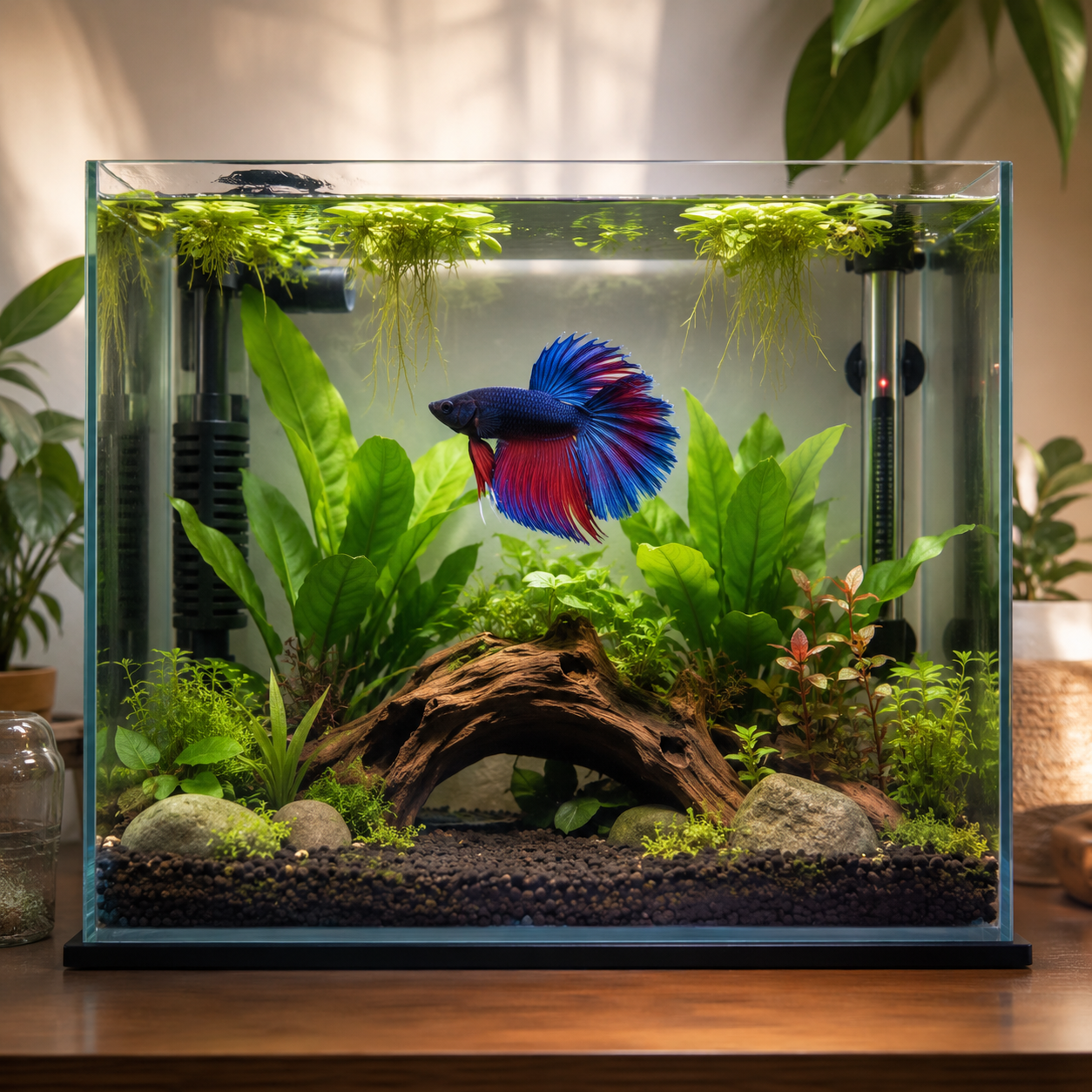
This is where a betta tank truly comes into its own. Bettas thrive in densely planted setups that mimic their natural habitat. Plants provide:
- Cover and territory: Bettas feel less exposed and stressed in a planted tank
- Resting spots: Bettas regularly rest on broad leaves near the surface; large anubias or amazon sword leaves are favourites
- Fin protection: Dense planting reduces fin-nipping behaviour in community setups
- Water quality: Live plants consume ammonia and nitrate
Best plants for betta tanks:
- Anubias (resting platforms; virtually indestructible)
- Java fern (shade-tolerant, textured cover)
- Java moss (natural ground cover; hides and enriches the tank floor)
- Amazon sword (broad leaves bettas love to rest on)
- Floating plants (provide shade and reduce light reflection, which some bettas find stressful)
For detailed care information on each species, see: Low-Maintenance Aquarium Plants for Beginners.
Lighting
Standard LED aquarium lighting works perfectly for a betta tank. Keep photoperiod to 8–10 hours per day. Bettas can appear stressed under constant intense light — floating plants and shade from broad-leaved plants help create areas of lower light intensity.
Cycling the Tank
Before adding your betta, cycle the tank to establish the nitrogen cycle. This takes approximately 4–6 weeks. An uncycled tank will produce ammonia spikes that damage betta gills and immunity, making fish susceptible to bacterial and fungal infections.
For the full process, see: How to Cycle a Fish Tank.
Betta Tankmates: What Works and What Does Not
Male bettas must never be housed together. Even a reflection can trigger displays. Two males in the same tank will fight until one or both are severely injured or dead.
Suitable community tankmates for a male betta (in a 60+ litre, well-planted tank):
- Corydoras catfish (peaceful, occupy a different water column level)
- Otocinclus catfish (tiny, peaceful algae eaters)
- Small rasboras (harlequin, chilli rasbora)
- Neon or ember tetras
- Nerite snails and mystery snails
- Amano or cherry shrimp (there is some risk — individual betta temperament varies)
Avoid:
- Other bettas (male or female in most setups)
- Guppies and fish with long, flowing fins (bettas attack them)
- Tiger barbs (fin nippers)
- Goldfish (different temperature requirements; also fin nippers)
Feeding Your Betta
Bettas are carnivores. Their upturned mouths are designed for surface feeding, and they evolved to eat insects, larvae, and small crustaceans.
Recommended diet:
- High-quality betta pellets (look for a protein source as the first ingredient)
- Frozen or live bloodworms (as a supplement, not a staple)
- Frozen or live brine shrimp
- Daphnia (good for digestion)
Feed once or twice daily, only what the betta can consume in 2–3 minutes. Remove uneaten food promptly.
Fast one day per week — this prevents constipation and bloating, which are common health issues in bettas.
Common Health Issues in Bettas
| Issue | Signs | Likely Cause |
|---|---|---|
| Fin rot | Fins appear ragged, darkening edges | Bacterial infection; poor water quality |
| Ich (white spot disease) | White spots on body and fins | Parasitic infection; temperature shock |
| Velvet | Gold or rust dust on body | Oodinium parasite |
| Bloat / dropsy | Swollen abdomen, pinecone-raised scales | Internal bacterial infection; constipation |
Most betta health issues trace back to poor water quality. Regular water changes and maintaining the nitrogen cycle prevent the majority of common diseases.
Frequently Asked Questions
Can a betta survive in a 5-litre tank? Survive, barely — but not thrive. A 5-litre tank provides minimal water volume to buffer ammonia and temperature. A minimum of 15 litres is necessary for any meaningful quality of life.
How often should I do water changes in a betta tank? For a cycled tank, a 25–30% water change weekly is sufficient. Always dechlorinate. For uncycled or very small tanks, twice-weekly changes may be necessary.
Do bettas need tank companions? No — bettas are solitary by nature and are often perfectly content alone in a well-planted tank. Community setups are possible but require careful planning and sufficient tank size.
Why is my betta making bubble nests? Bubble nesting is a sign of a healthy, content male betta. Males construct bubble nests at the water surface — a natural breeding behaviour. It is a positive indicator.
Can bettas and shrimp coexist? It depends heavily on individual betta temperament. Some bettas ignore shrimp entirely; others hunt them actively. Dense planting with plenty of hiding spots reduces risk. Introduce shrimp into an established, heavily planted tank with the betta already present rather than the other way around.