
Freshwater Community Tank Compatibility Guide: Building a Peaceful Aquarium
A community aquarium at its best is a living, balanced ecosystem — different fish occupying different zones of the water column, different body shapes and colours creating visual interest, and peaceful coexistence maintained without conflict. At its worst, it is a tank of stressed, injured, or dead fish, the result of incompatible species being housed together without research.
This guide covers the principles of community tank compatibility and provides practical stocking examples for beginners.
The Core Principles of Community Tank Compatibility
1. Match Water Parameter Requirements
This is non-negotiable. Every fish has a preferred range of temperature, pH, and water hardness. While many freshwater fish are adaptable, housing species with fundamentally different requirements together — for example, a cold-water goldfish with tropical fish — will result in chronic stress for at least one group.
For a Singapore tropical community tank, target:
- Temperature: 24–27°C
- pH: 6.5–7.5
- General hardness (GH): 4–12 dGH
2. Match Temperament
Fish temperament ranges from extremely peaceful to highly aggressive. Mixing a school of neon tetras with tiger barbs or a red-tailed black shark will result in constant fin-nipping and stress. Research each species before purchasing.
Temperament categories:
- Peaceful: Safe with virtually any non-predatory species of similar size
- Semi-aggressive: Generally peaceful but may bully smaller fish or defend territory
- Aggressive: May attack, chase, or injure tankmates; often best kept in species-only setups
3. Consider Adult Size
Many fish sold in shops are juveniles. A 3 cm oscar in a shop tank looks harmless — an adult oscar at 35 cm will eat anything it can fit in its mouth. Always research maximum adult size before purchasing.
4. Use the Water Column Effectively
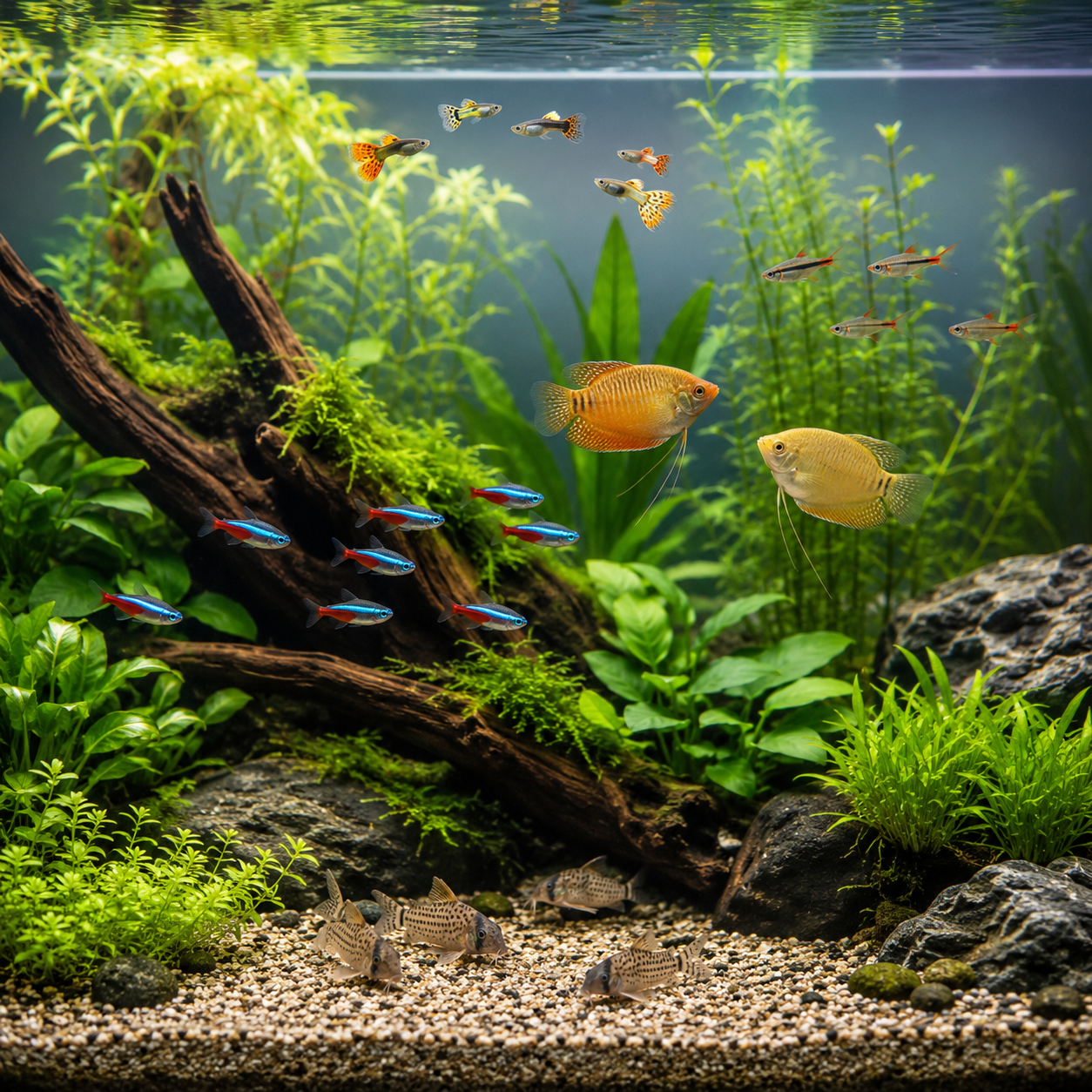
A well-stocked community tank uses all three water column zones:
| Zone | Examples |
|---|---|
| Top (surface) | Hatchetfish, some danios, betta |
| Middle | Tetras, rasboras, guppies, mollies, platies |
| Bottom | Corydoras, kuhli loaches, bristlenose plecos |
This reduces territorial competition and creates a more natural, visually balanced tank.
5. Avoid Competitive Species
Some fish are territorial about food or space, even if not overtly aggressive. Cichlids often claim territories around rock formations. Male bettas display to and chase each other through glass. Consider individual fish behaviour, not just species-level generalisations.
Peaceful Community Tank Stock Examples
Beginner Community (60 Litres)
A simple, forgiving starting point for a 60-litre tropical community tank:
- 8 harlequin rasboras (mid-water, schooling)
- 6 neon tetras (mid-water, schooling)
- 4 corydoras catfish (bottom-dwelling)
- 2 nerite snails (algae maintenance)
Why it works: All species prefer similar water parameters (pH 6.5–7.5, 24–27°C). None are aggressive. The rasboras and tetras occupy the same water column zone but are different enough in shape to reduce competition. Corydoras occupy the bottom without conflict.
Planted Community (90 Litres)
- 10 cardinal tetras (mid-water)
- 8 rummy-nose tetras (mid-water, schooling — prefer to stay grouped)
- 6 sterbai corydoras (bottom)
- 2 dwarf gouramis — males only, or one male and one female (mid-surface)
- 4 otocinclus catfish (algae cleaning)
- 6 Amano shrimp (cleanup crew)
Why it works: Cardinal tetras and rummy-nose tetras coexist peacefully. Corydoras and otos occupy different ecological niches. Dwarf gouramis are generally peaceful (do not house two males together without a very large tank). Amano shrimp work alongside fish in a planted setup.
Active Community (120 Litres)
- 12 zebra danios (fast, surface-area schooling fish)
- 8 black skirt tetras (mid-water)
- 6 bronze corydoras (bottom)
- 1 bristlenose pleco (bottom, algae grazer)
- 8 cherry shrimp (substrate cleanup)
Note on zebra danios: They are active and hardy, but their energy level can stress slower, shyer fish. Pair them with similarly active species.
Species Compatibility Notes
Dwarf Gouramis
Generally peaceful community fish, but two males in the same tank will often become territorial with each other, particularly in smaller tanks. One male per tank is safest. They can coexist peacefully with tetras, rasboras, and corydoras.
Bettas in Community Tanks
A single male betta can work in a 60+ litre planted community tank with the right tankmates: no fish with flowing fins, no fin-nippers, and species that occupy different water zones. See: Betta Fish Tank Setup Guide.
Cichlids
Most cichlids are poor candidates for peaceful community tanks. Exceptions include:
- Ram cichlids (Mikrogeophagus ramirezi): Small, generally peaceful with appropriate tankmates in 80+ litres
- Keyhole cichlids: Shy and peaceful Avoid aggressive species like Oscars, Jack Dempseys, or aggressive Central American cichlids in mixed community tanks.
Shrimp with Fish
Most fish large enough to fit shrimp in their mouths will eat them. Safe combinations:
- Cherry shrimp with otocinclus, small tetras, and corydoras
- Amano shrimp (larger) with most community fish Avoid shrimp with bettas (variable individual temperament), cichlids, and most fish over 6 cm.
Common Compatibility Mistakes
1. Housing aggressive fin-nippers with long-finned fish: Tiger barbs and male bettas do not coexist. Serpae tetras are semi-aggressive fin-nippers that will shred angelfish fins.
2. Housing predatory fish with prey-sized fish: An angelfish in a tank with neon tetras will eventually eat the tetras. Large cichlids eat smaller fish. Research both predatory potential and prey vulnerability.
3. Ignoring adult size: Buying a "small" fish that will outgrow a community tank is a common mistake. Common plecos are sold at 5 cm and grow to 50+ cm.
4. Overstocking: More fish means more waste, more competition, and more stress. Start with fewer fish than you think you can keep, and add gradually over months. For a maintenance schedule that supports healthy stocking, see: Aquarium Maintenance Schedule for Beginners.
Frequently Asked Questions
How many fish can I keep in a community tank? A guideline of 1 cm adult fish per litre of water is a rough starting point. A 60-litre tank could hold approximately 60 cm worth of fish — but this is a maximum, not a target. Err toward fewer fish in a new tank.
Can I mix fish from different continents? Yes, provided water parameter requirements overlap. Amazon fish (most tetras, corydoras) and Southeast Asian fish (rasboras, danios) share similar preferences for warm, slightly acidic to neutral water and coexist well.
Why do my fish keep chasing each other? Chasing can indicate territorial behaviour, spawning activity, or outright aggression. Observe which fish initiates and which is targeted. If the target cannot escape and shows signs of stress, the aggressor may need to be separated.
Do schooling fish need to be kept in schools? Yes. A lone neon tetra is a stressed neon tetra. Schools of at least six individuals are the minimum for most schooling species; the more the better. Inadequate group size causes chronic stress and reduced lifespan.
Can I keep different tetra species together? Generally yes — neon tetras, cardinal tetras, rummy-nose tetras, ember tetras, and black skirt tetras all coexist peacefully in a community setup. They will not school together as a mixed group but will swim in their respective schools without conflict.