
How to Cycle a Fish Tank: The Nitrogen Cycle Explained Step by Step
If you have ever wondered why so many beginners lose fish in the first few weeks, the answer is almost always the same: they skipped the nitrogen cycle. It is the most critical concept in freshwater fishkeeping, and yet it is routinely rushed or ignored entirely.
This guide explains what the nitrogen cycle is, why it matters, and exactly how to complete it before adding any fish to your aquarium.
What Is the Nitrogen Cycle?
The nitrogen cycle is the biological process by which toxic waste products are broken down into less harmful compounds through the action of beneficial bacteria.
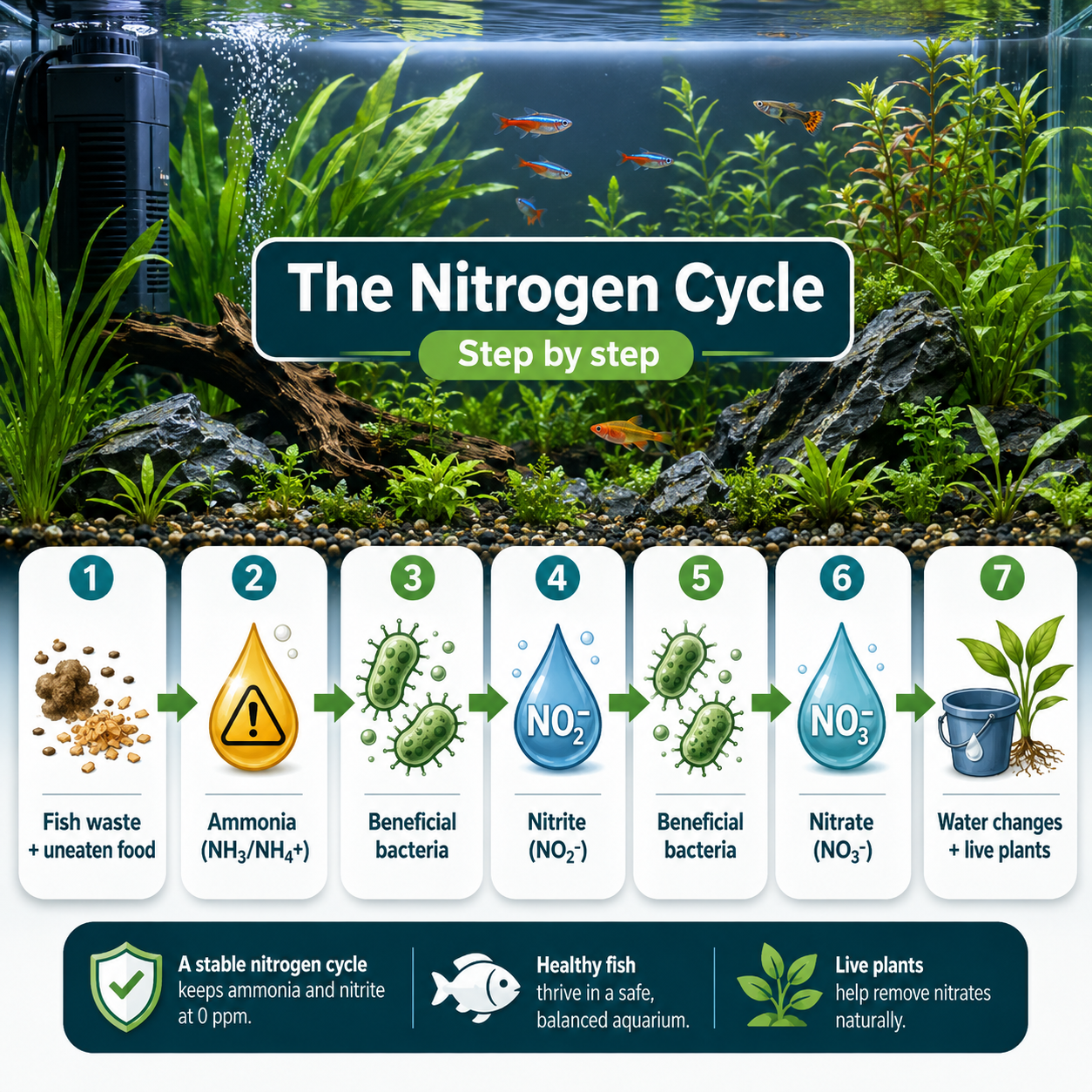
Here is the sequence:
- Fish produce waste (faeces, uneaten food, decomposing plant matter)
- Waste produces ammonia (NH₃) — highly toxic to fish even at low concentrations
- Nitrosomonas bacteria convert ammonia into nitrite (NO₂⁻) — also toxic
- Nitrobacter bacteria convert nitrite into nitrate (NO₃⁻) — far less toxic at low levels
- Nitrate is removed through regular water changes or consumed by live plants
The goal of cycling is to establish thriving colonies of those beneficial bacteria inside your filter media before fish are introduced.
Why Is an Uncycled Tank Dangerous?
Without established bacterial colonies, ammonia from even a few fish can spike to lethal levels within 24–48 hours. Fish in uncycled tanks often show symptoms of ammonia poisoning:
- Gasping at the water surface
- Red or inflamed gills
- Loss of appetite
- Lethargy
- Clamped fins
Ammonia as low as 0.25 ppm (parts per million) causes chronic stress and gill damage. At 2–3 ppm, it is acutely lethal for most species within hours.
Fishless Cycling vs. Fish-In Cycling
There are two primary methods:
Fishless Cycling (Recommended)
You add an ammonia source to the tank without any fish. The bacteria develop without causing animal suffering, and you can push ammonia to levels that would be lethal to fish — which actually accelerates bacterial growth.
Fish-In Cycling (Not Recommended)
Historically common, this involves adding a few "hardy" fish and doing very frequent water changes to keep ammonia below lethal levels while bacteria establish. It is stressful for the fish and requires daily monitoring. Fishless cycling is always preferable.
How to Do a Fishless Cycle: Step-by-Step
What You Need
- A fully set-up aquarium with filter running
- A liquid water test kit (measures ammonia, nitrite, nitrate, and pH)
- A pure ammonia source (household ammonia with no surfactants or perfumes, or pure ammonium chloride powder)
- Dechlorinator for tap water
- Patience — typically 4 to 6 weeks
Step 1: Fill and Dechlorinate the Tank
Fill your tank with tap water and add a quality dechlorinator. Singapore tap water contains chlorine and chloramine — chloramine is particularly important to neutralise, as it kills the beneficial bacteria you are trying to cultivate.
Step 2: Run the Filter
Switch on your filter. The bacteria will colonise primarily in the filter media — sponges, ceramic rings, and bio-media. Keep the filter running continuously throughout the cycling process.
Step 3: Add an Ammonia Source
Dose pure ammonia to reach approximately 2–4 ppm ammonia in the water column. Use your test kit to verify.
Dosing tip: Start conservatively. A few drops per 40 litres typically achieves 2–4 ppm, but strength varies between brands.
Step 4: Test Daily
Test ammonia, nitrite, and nitrate every day or every other day. Record your results.
What to look for:
- Week 1–2: Ammonia rises, then begins to fall as Nitrosomonas bacteria establish. Nitrite starts to appear.
- Week 2–3: Nitrite spikes high (sometimes very high — 5+ ppm). Ammonia continues dropping.
- Week 3–5: Nitrate begins to rise as Nitrobacter bacteria process nitrite. Nitrite falls.
- Cycle complete: Ammonia reads 0, nitrite reads 0, nitrate reads above 0.
Step 5: Redose Ammonia as It Drops
Once ammonia consistently drops to 0 within 24 hours of dosing, your Nitrosomonas colony is established. Continue dosing to keep feeding the bacteria.
Step 6: Confirm Completion
The cycle is complete when:
- You add ammonia to 2 ppm
- Within 24 hours, ammonia reads 0 ppm AND nitrite reads 0 ppm
- Nitrate is present (typically 20–80 ppm)
Step 7: Do a Large Water Change and Add Fish
Before adding fish, do a 50–70% water change to reduce nitrate to under 20 ppm. Then add your first fish slowly — no more than a few at a time.
How to Speed Up Cycling
Use an established filter sponge or media: If you know someone with a healthy, disease-free aquarium, ask for a piece of their used filter media. The existing bacteria colony dramatically accelerates cycling — sometimes completing it in 1–2 weeks.
Use bottled beneficial bacteria products: Commercial bacteria products can give cycling a head start. Results vary by brand, but they generally shorten the process.
Keep the temperature warm: Beneficial bacteria reproduce faster at 26–28°C. In Singapore this is rarely a problem, but if your tank runs cool, a heater helps.
Do not over-clean: Avoid cleaning filter media during cycling. The bacteria you want are colonising precisely those surfaces.
Troubleshooting Common Cycling Problems
Ammonia is not dropping after 2 weeks:
- Check that dechlorinator has fully neutralised chloramine (use a product labelled for chloramine)
- Confirm filter is running continuously
- Water temperature below 22°C slows bacterial growth significantly
Nitrite won't drop:
- This phase can be the longest. Nitrite spikes can be persistent. Continue testing and wait — Nitrobacter colonisation typically lags behind Nitrosomonas.
pH keeps dropping:
- The cycling process is acidic. If pH drops below 6.0, bacterial activity slows sharply. Add a small amount of sodium bicarbonate (baking soda) to buffer it to approximately 7.0.
Maintaining the Nitrogen Cycle Long-Term
Once established, the bacterial colony requires maintenance:
- Always dechlorinate water before water changes (chlorine kills beneficial bacteria)
- Never clean all filter media at once — rinse media in old tank water, not tap water
- Avoid antibiotics in the main tank unless absolutely necessary — they kill beneficial bacteria
- Do not overstock — sudden large increases in bioload can overwhelm the filter
For an ongoing maintenance schedule, see: Aquarium Maintenance Schedule for Beginners.
Frequently Asked Questions
How long does cycling a fish tank take? A fishless cycle typically takes 4–6 weeks from start to finish. With seeding from established media, it can complete in 1–2 weeks.
Can I add fish after 1 week? Almost certainly not. At one week, ammonia may be dropping but nitrite has likely not yet spiked and resolved. Adding fish at this stage risks ammonia and nitrite poisoning.
What happens if I have cloudy water during cycling? A white or grey bacterial bloom (cloudy water) is common in weeks 1–2 of cycling. It is caused by a bacterial population explosion and clears on its own. It is harmless and actually indicates active biological processes. See our guide: Cloudy Aquarium Water — Causes and Fixes.
Does a cycled tank ever need to be recycled? Yes — if the filter is cleaned with chlorinated tap water, if the tank is left without an ammonia source for weeks, or after heavy antibiotic treatment. Always add new fish gradually even in an established tank to avoid mini-cycles.
Can I cycle a tank with plants? Yes. Live plants consume ammonia and nitrate, which can make test readings harder to interpret, but plants actually help stabilise the tank and support the bacterial colony.