

Aquarium Maintenance Schedule for Beginners: Weekly, Monthly, and Seasonal Tasks
One of the most overlooked aspects of fishkeeping is the maintenance routine. Many beginners focus intensely on setup and stocking, then discover that the hobby requires ongoing, systematic care to stay enjoyable rather than stressful.
The good news: a well-established aquarium is not particularly demanding. Most of the work concentrates in a 15–30 minute weekly session. The key is consistency — irregular maintenance leads to accumulating problems that are harder to resolve than if they had been managed steadily.
This guide provides a practical aquarium maintenance schedule broken down by daily, weekly, monthly, and every-few-months tasks.
Daily Tasks (2–5 Minutes)
1. Observe Your Fish
The most important daily task costs nothing and requires no equipment. Spend two minutes watching your fish before or after feeding. Look for:
- Fish that are absent from their usual spots (hiding excessively can indicate illness or aggression)
- Unusual swimming behaviour — spinning, floating, sinking, darting erratically
- Visible signs of disease: white spots (ich), fin deterioration, swelling, colour changes
- Any fish that have died overnight (remove immediately — a decomposing fish can crash water quality within hours)
Early detection of problems is the single most effective strategy in aquarium health management.
2. Feed Appropriately
Feed once or twice daily, only what fish can consume in 2–3 minutes. Remove uneaten food after this time.
Overfeeding is the most common cause of:
- Elevated ammonia and nitrite
- Cloudy water
- Excessive algae growth
- Fat, unhealthy fish with shortened lifespans
3. Check Equipment
Confirm that the filter is running (listen for the hum and check for water movement), heater is functioning (verify temperature with a thermometer), and lights are on schedule.
Weekly Tasks (15–30 Minutes)
1. Water Change (25–30%)
Weekly partial water changes are the single most effective maintenance action available. They:
- Remove accumulated nitrate before it reaches harmful levels
- Replenish minerals and trace elements that fish require
- Dilute dissolved organic compounds that accumulate between changes
- Reset pH drift in tanks with heavy biological load
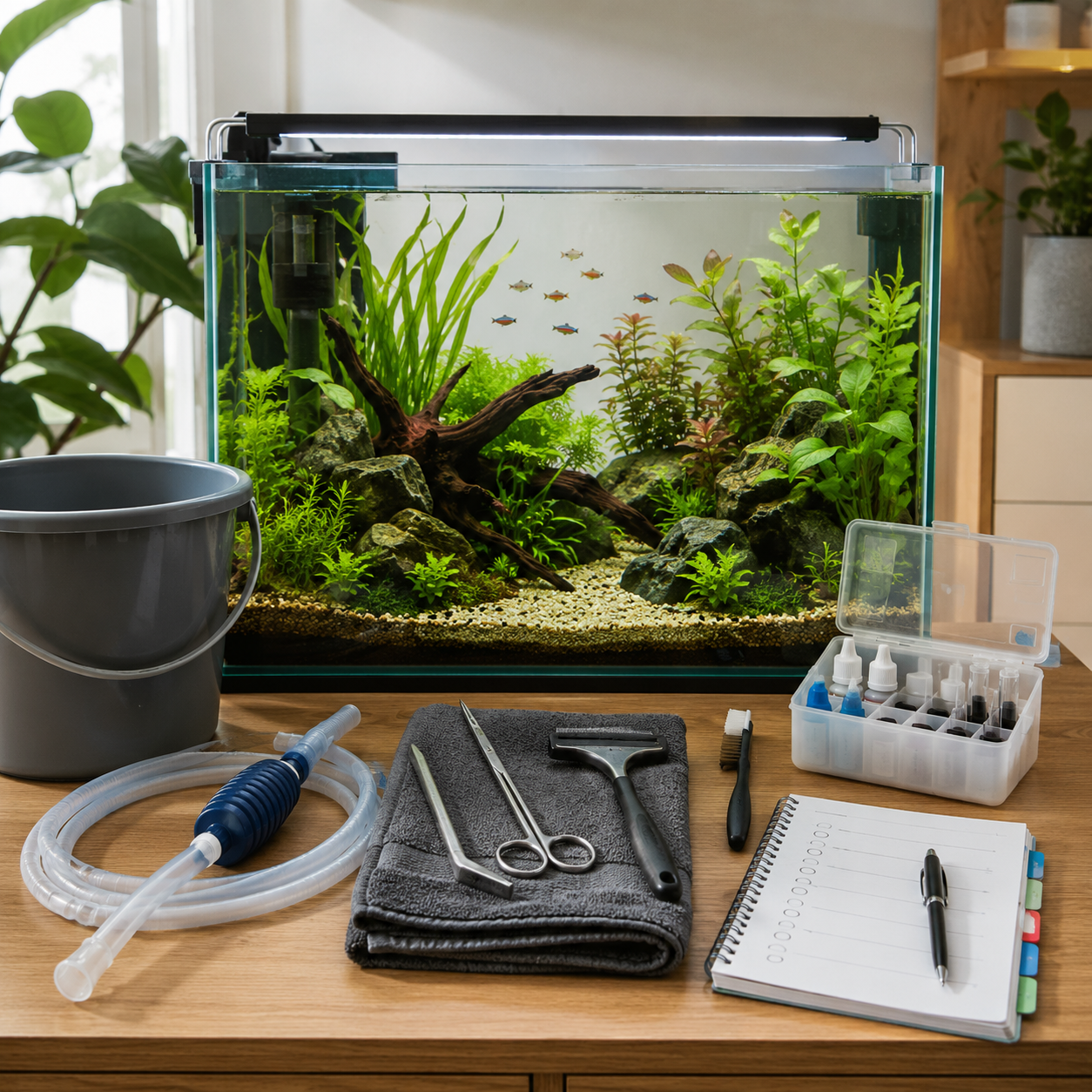
How to do a water change:
- Turn off the heater (running a heater out of water can damage or destroy it)
- Use a gravel vacuum (siphon) to remove 25–30% of tank volume while simultaneously vacuuming the substrate
- Fill a clean bucket with tap water
- Add dechlorinator to the bucket (Singapore tap water contains chlorine and chloramine — always neutralise before adding to the tank)
- Match temperature as closely as possible before adding (pour slowly to avoid temperature shock)
- Restart the heater once water level is restored
2. Clean the Glass
Wipe algae from the viewing panels using an algae magnet or scraper. Do this before the water change so disturbed algae can be siphoned out. Internal glass scrubbing tools are useful for corners and bottom edges.
3. Trim Plants
Remove dead or yellowing leaves (they decompose and raise ammonia). Trim fast-growing stem plants before they shade lower plants. Replant healthy trimmings if you want to fill in gaps.
4. Test Water Parameters
For a new tank (first 3 months), test weekly:
- Ammonia (target: 0 ppm)
- Nitrite (target: 0 ppm)
- Nitrate (target: under 20 ppm in a fish tank; up to 40 ppm may be acceptable in planted tanks)
- pH (target: 6.5–7.5 for most tropical community fish)
For an established tank (3+ months), testing every 2–4 weeks is sufficient unless problems are suspected.
Singapore tap water note: Singapore's treated water has pH approximately 7.5–8.5 coming out of the tap, but it typically stabilises in an established tank. If pH is drifting significantly, investigate biological load and buffering capacity.
Monthly Tasks (30–45 Minutes)
1. Clean the Filter (Partial Maintenance)
Filters require periodic cleaning to prevent clogging, but must never be sterilised or fully cleaned:
- Remove mechanical filter media (sponges, filter floss, pre-filters) and rinse in old tank water taken from the water change bucket — never in tap water (chlorine kills beneficial bacteria)
- Replace filter floss or filter wool if it is fully clogged and cannot be cleaned effectively
- Do not clean biological media (ceramic rings, bio-balls) unless completely necessary; the bacterial colony lives here
- Do not clean all media at once — stagger maintenance over multiple weeks to preserve the bacterial colony
2. Clean Equipment
- Wipe down the outside of the filter housing
- Check heater for calcium deposits (a soft toothbrush removes them)
- Inspect airline tubing, air stones, and powerhead intakes for blockages
- Clean filter intake tubes if visibly clogged with algae or detritus
3. Check Livestock Health in Detail
Beyond daily observation, take a closer look monthly:
- Are fish growing at expected rates?
- Are there any signs of breeding behaviour that need management?
- Do fin conditions look healthy (no rot, tears, or clamping)?
- Are bottom-dwellers present and active (corydoras and plecos can be easy to overlook)?
4. Dose Fertilisers (If Planted Tank)
Liquid all-in-one fertilisers for planted tanks are typically dosed weekly, but monthly is a good time to assess plant health more carefully:
- Yellow leaves may indicate nitrogen or iron deficiency
- Stunted growth may indicate potassium deficiency
- Adjust dosing based on plant response
Every 3–6 Months
1. Deep Substrate Clean
Regular water changes with a gravel vacuum maintain the upper substrate, but detritus accumulates in deeper layers over time. Every few months, perform a more thorough substrate vacuum — particularly in corners and under hardscape.
2. Replace Activated Carbon (If Used)
Activated carbon becomes saturated after approximately 4 weeks of use. Replace it monthly if you are using it for tannin removal, or remove it if it has no ongoing purpose (it is not a substitute for the nitrogen cycle).
3. Inspect and Replace Lighting
LED lights typically last years, but check that the output has not visibly degraded. Fluorescent tubes (if still in use) should be replaced annually even if they still light up — output degrades before the tube physically fails.
4. Assess Stocking
Is the tank balanced? Are any fish showing signs of stress from overcrowding? Has any fish outgrown the tank? Reassess your stocking every few months, particularly in the first year of a setup.
For guidance on compatible community setups, see: Freshwater Community Tank Compatibility Guide.
Troubleshooting Common Maintenance Issues
| Problem | Likely Cause | Solution |
|---|---|---|
| Algae growing on glass weekly | Too much light or nutrients | Reduce photoperiod; increase water change frequency |
| Nitrate rising despite water changes | Overfeeding or overstocking | Reduce feeding; review stocking |
| pH dropping steadily | High CO₂, high bioload, low buffering | Increase water change frequency; add crushed coral |
| Filter losing flow | Clogged mechanical media | Rinse sponges in old tank water |
| Fish dying after water change | Temperature shock or untreated chloramine | Match temperature; ensure dechlorinator covers chloramine |
Building the Habit
Consistency matters more than perfection. A moderately thorough weekly water change every week is far better than an extremely thorough water change once a month. Fish and beneficial bacteria both benefit from stability — dramatic swings in water chemistry cause more harm than gradual accumulation of nitrate.
Keep a simple log of water test results, maintenance dates, and any observations about fish behaviour. Patterns in the data often reveal problems before they become serious.
For more foundational guidance, see:
- The Complete Freshwater Aquarium Setup Guide
- How to Cycle a Fish Tank
- Cloudy Aquarium Water — Causes and Fixes
Frequently Asked Questions
How often should I do water changes? For most freshwater tanks, 25–30% weekly is the standard recommendation. Very lightly stocked tanks with many live plants may manage with bi-weekly changes; very heavily stocked tanks may need twice-weekly changes.
Can I skip a water change? Occasionally skipping one water change in a well-established, lightly stocked tank is unlikely to cause immediate harm. Making it a habit, however, leads to nitrate accumulation, reduced water quality, and increased disease susceptibility.
Do I need to turn off the filter during a water change? Not necessarily — many hobbyists leave the filter running during water changes. However, if the water level drops below the filter's intake, turn it off to avoid running it dry.
How do I know if my filter is working properly? Check for: steady water flow from the output, no unusual noise (grinding or rattling indicates a blockage or worn impeller), and visible surface agitation indicating gas exchange.
Why are my water tests showing 0 nitrate even in an established tank? If nitrate consistently reads zero in a tank with fish, one of the following is happening: very heavy plant growth consuming all nitrate, a test kit that has expired or been improperly stored, or denitrifying bacteria in the substrate consuming nitrate (beneficial but uncommon in standard home setups).