
Goldfish Tank Setup Guide: Why Bowls Are Not Enough
Goldfish have suffered more from misinformation than almost any other pet animal. For generations, they have been sold with the implication that a small bowl, a handful of flake food, and minimal attention is all they need. The reality is the opposite: goldfish are large, long-lived fish that produce extraordinary amounts of waste and need more space and filtration than most tropical fish of equivalent size.
This guide explains what goldfish actually require, debunks the bowl myth, and provides a practical setup guide for keeping goldfish in conditions where they genuinely thrive.
Quick Reference: Goldfish Care at a Glance
| Parameter | Fancy Goldfish | Common / Comet Goldfish |
|---|---|---|
| Tank size (minimum) | 100 litres for 2 fish | 200+ litres or pond |
| Temperature | 15–22°C (cool water) | 10–24°C |
| pH | 7.0–8.0 | 7.0–8.0 |
| Hardness (GH) | 8–20 dGH | 8–20 dGH |
| Adult size | 15–20 cm | 25–40 cm |
| Diet | Omnivore | Omnivore |
| Lifespan | 10–20 years | 15–30 years |
The Bowl Myth: Why It Harms Goldfish
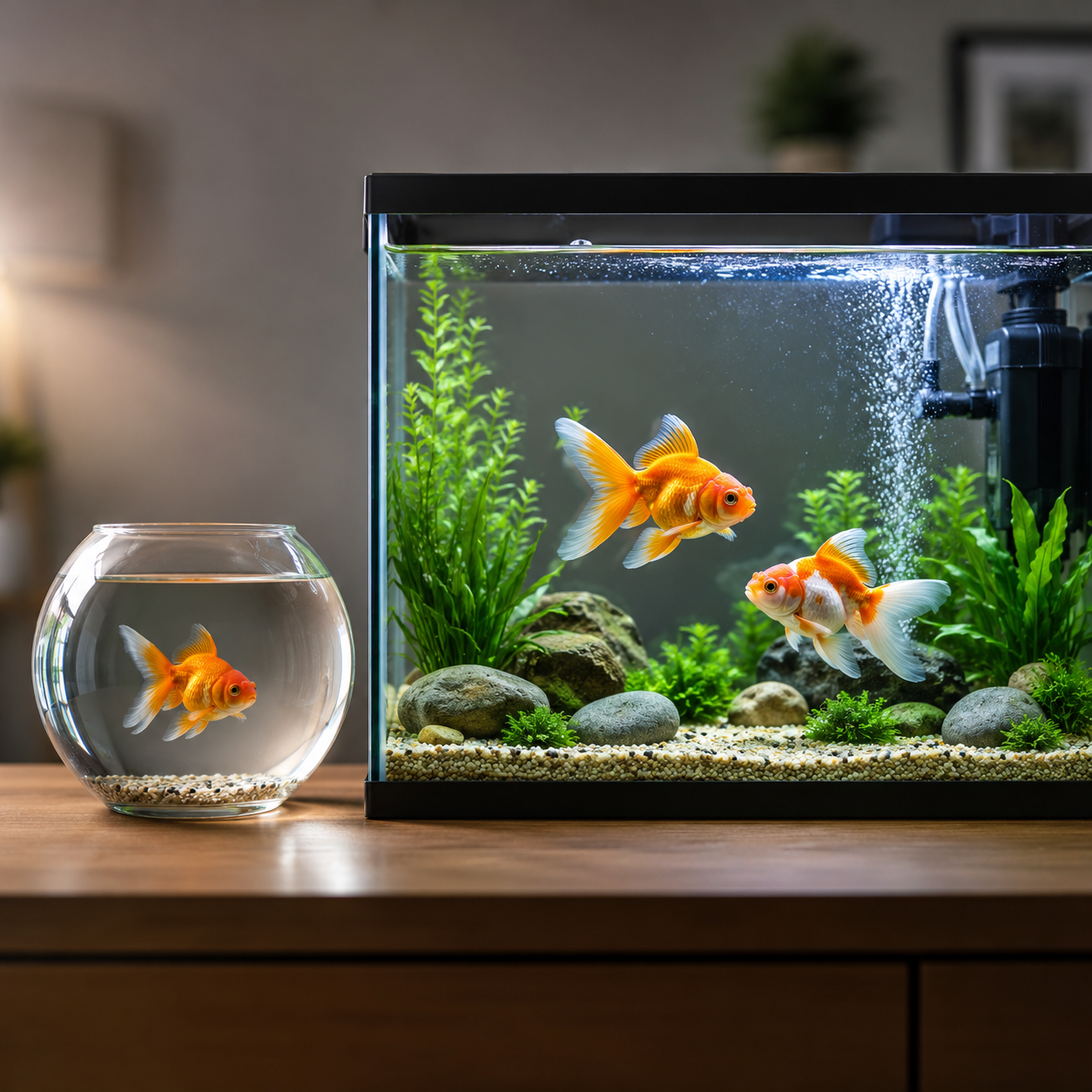
Goldfish kept in bowls face several serious problems:
1. No filtration — ammonia accumulates rapidly. Goldfish produce more ammonia per body weight than virtually any other commonly kept freshwater fish. Without a working nitrogen cycle and biological filtration, ammonia builds to toxic levels within days. Many "mystery" goldfish deaths in bowls are simply ammonia poisoning.
2. Oxygen depletion. A bowl has minimal surface area relative to volume. Combined with no surface agitation from a filter, oxygen exchange is poor. Goldfish at the surface gasping is a common sign of oxygen depletion, not hunger.
3. Temperature instability. Small water volumes heat and cool rapidly. Singapore's climate (27–31°C ambient) is actually too warm for goldfish — they prefer cooler water, and a small, unfiltered bowl in a warm Singapore home quickly exceeds healthy goldfish temperatures.
4. Stunting. Goldfish do not stay small because they grow to fit their container — this is a myth. They grow stunted due to poor nutrition, ammonia damage, and stress — but internal organs continue growing normally, leading to organ failure and shortened lifespan.
Goldfish Types: Fancy vs. Common
Common and Comet Goldfish
The traditional single-tailed goldfish sold as feeder fish or fairground prizes. These grow to 25–40 cm and are fast, active swimmers. They require pond-scale volumes and are genuinely unsuitable for indoor home aquariums as adults.
Fancy Goldfish
Selectively bred double-tailed varieties with rounder bodies and various ornamental features. They grow to 15–20 cm and are slower swimmers. They are more suitable for indoor aquariums — but still require proper filtration and adequate space.
Common fancy goldfish varieties:
- Oranda — rounded body with a distinctive fleshy hood (wen) on the head
- Ryukin — high-backed body with flowing double tail
- Telescope (black moor) — protruding eyes; needs smooth decor to avoid eye injury
- Ranchu — round body without dorsal fin; the "lionhead" of goldfish; see Ranchu Goldfish Care Guide
- Pearlscale — spherical body with distinctive dome-shaped scales
- Butterfly telescope — butterfly-shaped tail viewed from above
Tank Size Requirements
Fancy goldfish:
- Minimum: 100 litres for the first fish, plus 30–40 litres per additional fish
- Two fancy goldfish comfortably need 100–120 litres
- Filtration rated at 3–4 times tank volume per hour (goldfish need heavy filtration)
Common/comet goldfish:
- Minimum: 200 litres for a single fish; these are genuinely pond fish
- Most experienced goldfish keepers will not house common goldfish indoors at all
Water Parameters: Cool Water Is Critical
Goldfish are cold-water fish — they do not belong in tropical tanks.
- Temperature: 15–22°C for fancy goldfish; 10–24°C for common goldfish
- pH: 7.0–8.0
- Ammonia/Nitrite: 0 ppm
- Nitrate: Below 20–40 ppm with frequent water changes
Singapore challenge: Ambient temperature in Singapore (27–31°C) exceeds the ideal range for goldfish. Goldfish kept at temperatures above 24°C experience:
- Metabolic stress and increased disease susceptibility
- Reduced oxygen levels (warmer water holds less dissolved oxygen)
- Shortened lifespan
Solutions for Singapore goldfish keepers:
- Chiller — the most effective solution; a small aquarium chiller can maintain water at 22°C regardless of ambient temperature
- Heavy aeration and fans to reduce temperature by evaporative cooling (partial solution; reduces temperature by 2–4°C)
- Air-conditioned room where ambient temperature stays around 22–24°C
For general tank setup guidance, see The Complete Freshwater Aquarium Setup Guide.
Filtration: The Most Critical Equipment
Goldfish produce far more waste than typical aquarium fish. Adequate filtration is the single most important factor in goldfish keeping success.
Recommended filtration:
- Canister filter — the preferred choice for goldfish tanks; high biological capacity
- Hang-on-back (HOB) filter — adequate if rated for at least 2–3 times the tank volume per hour
- Sponge filter — suitable only as a supplementary filter for goldfish tanks
Aim for filtration rated at 3–5x tank volume per hour. For a 120-litre goldfish tank, use a filter rated at 400–600 litres per hour.
For a full comparison of filter types, see Aquarium Filter Guide.
Feeding Goldfish
Goldfish are omnivores and constant grazers. They do not have stomachs — food passes through their digestive system relatively quickly.
Recommended diet:
- Goldfish-specific pellets or flakes — sinking pellets are preferred; floating pellets cause goldfish to swallow air, leading to swim bladder issues
- Blanched vegetables: peas (de-shelled), zucchini, spinach, cucumber
- Frozen brine shrimp and bloodworms — protein supplements
- Algae wafers — beneficial
Feeding frequency: Two to three times daily in small amounts. Only feed what is consumed within 2–3 minutes.
Important: Overfeeding is extremely common with goldfish and rapidly degrades water quality. Their production of waste is already high — excess uneaten food amplifies this dramatically.
Substrate, Decor, and Plants
Substrate: Fine smooth sand or bare-bottom tanks are the most practical choices for goldfish. Goldfish sift substrate constantly looking for food — coarse gravel can be ingested and cause impaction; fine sand passes harmlessly.
Decor: Keep it simple and smooth. Goldfish with protruding eyes (telescopes, black moors) are particularly vulnerable to eye injury from sharp decor.
Plants: Goldfish eat and uproot most aquatic plants. Robust options include:
- Java fern (attached to hardscape — they nibble but do not destroy it easily)
- Anubias (similar — durable and bitter-tasting, so less appealing to goldfish)
- Fast-growing stem plants as "sacrificial" nutrition supplements
Frequently Asked Questions
How long do goldfish really live? Fancy goldfish with proper care live 10–20 years. Common goldfish in a pond can live 20–30 years. The typical 6-month bowl lifespan most people experience reflects the conditions, not the fish.
Can I keep goldfish with tropical fish? Generally no. The temperature requirements are incompatible — goldfish need cooler water, while tropical fish need warmth. There are a few exceptions (zebra danios, weather loaches, rosy barbs tolerate cooler temperatures) but most tropical community fish cannot coexist with goldfish.
Do goldfish really have a 3-second memory? This is a myth. Goldfish have demonstrated memory retention of weeks to months in laboratory studies. They can learn to associate stimuli with feeding, navigate obstacles, and recognise individuals.
Can I keep goldfish in a Singapore outdoor pond? Yes — but the tropical climate is challenging. Outdoor ponds in Singapore reach 30°C+ and need shade, good surface agitation for oxygen, and disease monitoring. Goldfish bred and acclimatised in tropical conditions (readily available in Singapore) cope better than cold-water imports.
What is the minimum tank size for two fancy goldfish? A minimum of 100–120 litres for two fancy goldfish, with a filter rated at 400–600 litres per hour. Do not purchase goldfish without having this setup in place and cycled first.