
Aquarium Filter Guide: Sponge, Hang-On-Back, Canister, and Internal Filters Compared
The filter is the single most important piece of equipment in an aquarium. Without effective filtration, toxic ammonia accumulates, fish suffer, and the tank becomes difficult to maintain. With the right filter running properly, the biological processes that protect your fish happen automatically and consistently.
But not all filters are the same. Different filter types have different strengths, and the best choice depends on your tank size, livestock, and budget. This guide explains how the most common filter types work and when each is the right choice.
How Aquarium Filtration Works
A filter performs up to three types of filtration:
Mechanical filtration: Physically removes particles (fish waste, uneaten food, plant debris) from the water by passing it through a medium that traps solids. Sponge, filter wool, and floss are common mechanical media.
Biological filtration: Provides surface area for colonies of beneficial bacteria (Nitrosomonas and Nitrobacter) that convert toxic ammonia into nitrite and then nitrate. This is the nitrogen cycle — the most critical function of any filter. Ceramic rings, bio-balls, and sponge are common biological media.
Chemical filtration: Uses activated carbon or other chemical media to remove dissolved compounds, tannins, medications, and odours from the water. Optional — most tanks do not require permanent chemical filtration.
For the nitrogen cycle fundamentals, see How to Cycle a Fish Tank.
Filter Flow Rate
A useful rule of thumb: choose a filter that turns over the tank volume 4–10 times per hour. A 60-litre tank needs a filter rated for 240–600 litres per hour.
- Heavily stocked tanks and large fish (goldfish, oscars, cichlids) need the higher end
- Shrimp tanks and betta tanks benefit from lower flow (4–6x)
- Planted community tanks: 6–8x
Sponge Filters
Best for: Shrimp tanks, betta tanks, breeding tanks, nano tanks, quarantine tanks, hospital tanks
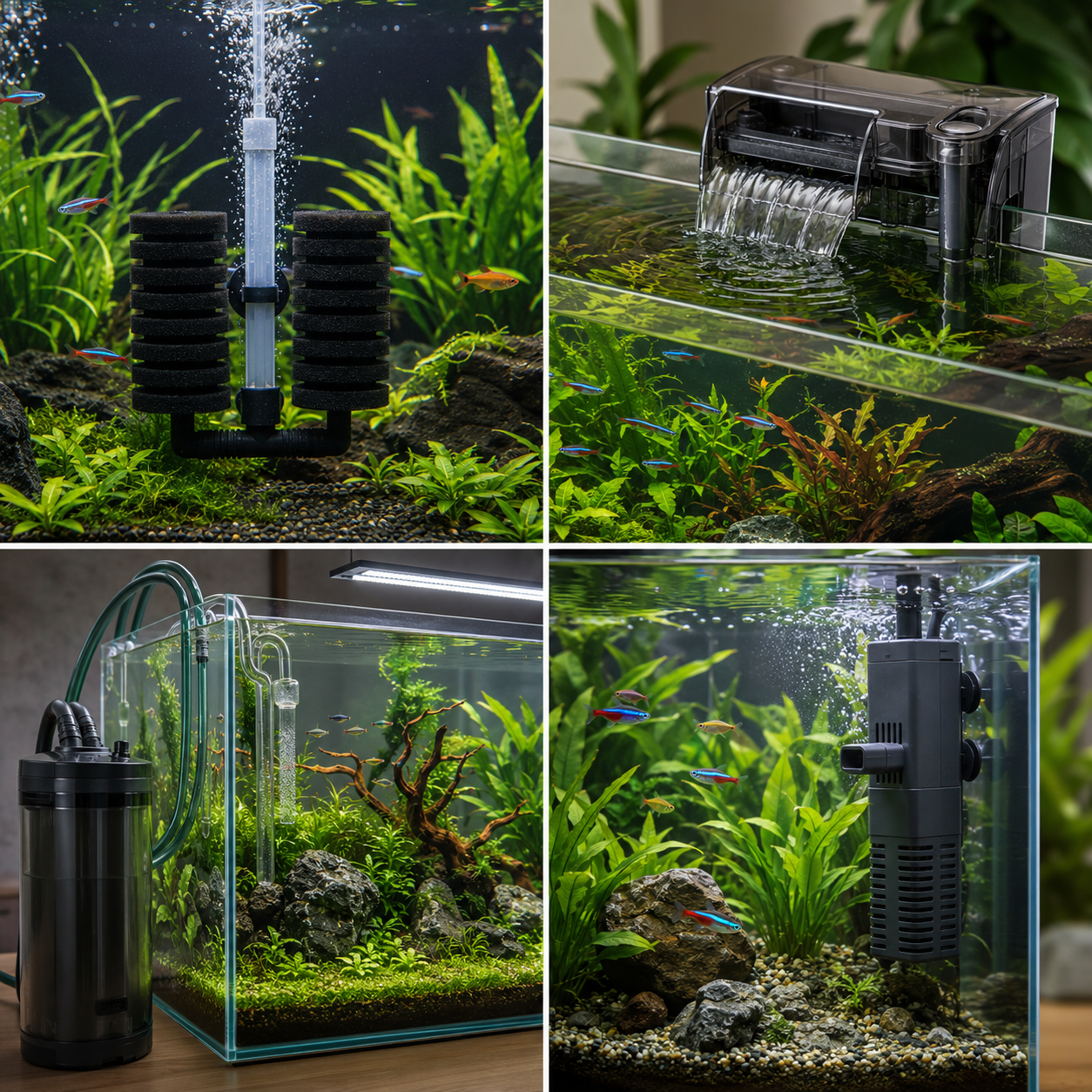
How they work: An air pump pushes bubbles through a sponge connected to an uplift tube. Water is pulled through the sponge, which provides both mechanical and biological filtration. The sponge surface accumulates beneficial bacteria over time.
Advantages:
- Very gentle flow — safe for shrimp, fry, bettas, and other flow-sensitive livestock
- No intake risk — small fish and shrimp cannot be sucked in
- Simple maintenance — squeeze sponge in old tank water monthly
- Low cost — among the most affordable filters available
- Reliable — minimal parts to fail
- Sponge surface becomes an additional grazing surface for shrimp
Disadvantages:
- Air pump required separately (adds bubbling noise)
- Not suitable for heavily stocked or large tanks — insufficient mechanical filtration capacity
- Can look bulky in a display tank
- Limited flow control
Recommended for: Shrimp-only tanks, betta tanks, quarantine/hospital tanks, breeding tanks, tanks under 40 litres
For quarantine setup guidance, see How to Quarantine New Aquarium Fish.
Hang-On-Back (HOB) Filters
Best for: Beginner community tanks; 40–120 litre tanks; versatile all-purpose filtration
How they work: The filter hangs on the back rim of the tank. A submersible impeller pulls water up a tube and through filter media (sponge, carbon cartridge, bio-media) before returning it to the tank over a waterfall-style spillway.
Advantages:
- Easy to set up and maintain — media access from the top
- Good mechanical and biological filtration capacity
- Multiple media chambers in better models allow customisation
- Provides surface agitation from the outflow
- Widely available in Singapore fish shops at affordable prices
Disadvantages:
- Can produce strong flow — may need baffling for bettas and sensitive species
- The outflow creates noise (splashing) if the tank water level drops below the spillway
- Limited biological media capacity compared to canister filters
- Filter cartridges from some manufacturers encourage replacement of the entire cartridge (which removes biological media — avoid; replace only the carbon insert if used, and never discard the sponge)
Recommended for: Beginner and intermediate community tanks, 40–120 litres, species that tolerate moderate flow
Canister Filters
Best for: Large tanks; heavily stocked tanks; tanks with high bioload (goldfish, oscars, cichlids, discus); planted aquariums where flow customisation is important
How they work: A sealed canister sits below or beside the tank. An impeller draws water through inlet tubing down into the canister, where it passes through multiple stages of filter media (mechanical, biological, chemical) before being returned to the tank through outlet tubing.
Advantages:
- Highest filtration capacity of any common filter type
- Multiple media chambers allow customisation (different combinations of mechanical, biological, and chemical media)
- Hidden from view (stored below the tank or in a cabinet)
- Very quiet when properly set up
- Flow rate is adjustable on most models
- Suitable for tanks from 80 litres to very large setups
Disadvantages:
- Most expensive filter type
- More complex to set up (priming required)
- Monthly maintenance involves removing the canister for cleaning — more involved than HOB
- Risk of flooding if connections fail or are incorrectly assembled
- May need an outlet spray bar to diffuse flow for sensitive species
Recommended for: 80+ litre tanks; goldfish tanks; planted aquariums; heavily stocked community tanks; discus and oscar setups
For goldfish filtration needs, see Goldfish Tank Setup Guide.
Internal Filters
Best for: Budget setups; small to medium tanks where HOB is impractical; secondary/supplementary filtration
How they work: A compact submersible filter sits inside the tank, drawing water through integrated sponge media with an impeller.
Advantages:
- Very affordable
- Simple to set up and maintain
- No risk of siphoning accidents (fully internal)
- Can be positioned at different depths
Disadvantages:
- Takes up internal tank space
- Usually less powerful than HOB or canister options
- Visible inside the tank
- Limited biological media capacity
- Outflow can be difficult to direct without creating dead spots
Recommended for: 20–60 litre setups on a budget; tanks where HOB or canister is not practical; supplementary filtration in larger tanks
Undergravel Filters (Legacy)
Undergravel filters — plates beneath the substrate connected to uplift tubes — were common in the 1980s and 1990s. They are largely obsolete today: maintenance is difficult, they clog with detritus, and they are incompatible with planted substrates. Not recommended for new setups.
Filter Media: What Goes Inside
| Media type | Function | Notes |
|---|---|---|
| Coarse sponge | Mechanical (large particles) | First stage; rinse monthly in old tank water |
| Fine sponge / filter floss | Mechanical (fine particles) | Replace when clogged; never use tap water to rinse |
| Ceramic rings / bio-balls | Biological | Never replace entirely; houses beneficial bacteria |
| Activated carbon | Chemical (dissolved compounds, tannins) | Replace every 4 weeks; not required in all setups |
| Purigen / chemical resins | Chemical (advanced polishing) | Regenerable; useful for planted tanks and discus setups |
Critical rule: Never clean all biological media at once, and never rinse any filter media in chlorinated tap water. Both kill the beneficial bacteria colony and trigger a mini-cycle.
Frequently Asked Questions
How do I choose the right filter for my tank? Start with tank volume and livestock type. Shrimp and bettas: sponge filter. 40–80 litre community tank: HOB filter. 80+ litre tank or high-bioload fish: canister filter. Budget is a secondary consideration.
How often should I clean my filter? Mechanical media (sponge, filter floss): monthly, in old tank water. Biological media (ceramic rings): every few months, gently, in old tank water — only if visibly blocked. Never sterilise biological media.
Can I use two filters in one tank? Absolutely — two filters in a tank provide redundancy (if one fails, the other maintains the cycle) and additional filtration capacity. This is common practice in heavily stocked or sensitive setups.
What is the best filter for a betta tank? A sponge filter is ideal — gentle flow, safe for the betta's fins, and provides reliable biological filtration. A baffled HOB filter is also suitable.
Do I need a filter if I have lots of live plants? Yes. Plants consume nitrate and some ammonia, but they do not replace the mechanical function of a filter and their impact on ammonia is slower than beneficial bacteria. A lightly planted tank without a filter will have dangerous water quality.