
Tetra Fish Guide: The Best Tetras for Peaceful Community Aquariums
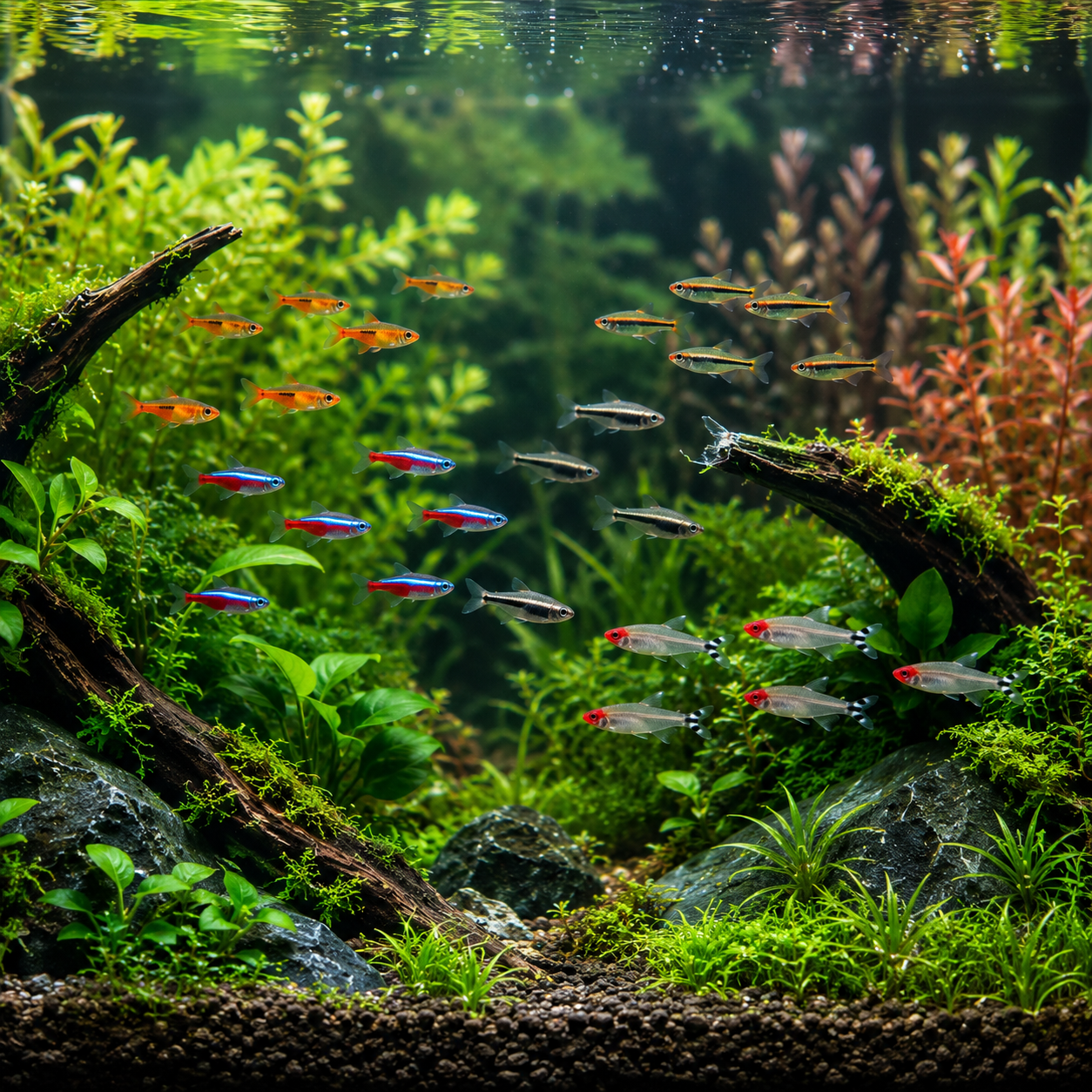
Tetras are the quintessential community aquarium fish. Small, peaceful, schooling, and available in stunning colours and patterns, they form the visual backbone of planted community setups around the world. There are hundreds of tetra species, but a handful have become consistent favourites — reliable, widely available, and genuinely beautiful in a school.
This guide covers the most popular and recommended tetra species for freshwater community aquariums, with care notes for each.
What Makes Tetras Good Community Fish?
- Small size — most tetras stay under 5 cm; they fit comfortably in 40–90 litre tanks
- Peaceful temperament — with a few exceptions (serpae tetras), tetras do not bully or harass tankmates
- Schooling behaviour — a large school of tetras creates the most visually dynamic display in the hobby
- Compatibility — most tetras share similar water requirements: warm, slightly soft to moderately hard, neutral to slightly acidic water
- Widely available — most popular species are bred commercially in large numbers and available at local fish shops
General Tetra Water Requirements
Most commonly kept tetras prefer:
| Parameter | Ideal Range |
|---|---|
| Temperature | 23–27°C |
| pH | 6.0–7.5 |
| Hardness (GH) | 4–12 dGH |
| Nitrate | Below 20 ppm |
Singapore's dechlorinated tap water is generally suitable for most tetras, though some species (cardinal tetras, especially wild-caught) prefer softer, more acidic water.
The Best Tetra Species for Community Aquariums
1. Neon Tetra (Paracheirodon innesi)
The classic. The iconic blue-and-red striped neon tetra is one of the most recognised aquarium fish in the world. A school of twenty or more in a planted tank is one of the most beautiful sights in the freshwater hobby.
- Adult size: 3–4 cm
- Temperature: 22–26°C (slightly cooler than many tropical fish)
- pH: 6.0–7.0
- School size: Minimum 8, ideally 15+
- Notes: Sensitive to poor water quality; must not be added to uncycled tanks
For detailed care, see Neon Tetra Care Guide.
2. Cardinal Tetra (Paracheirodon axelrodi)
Similar to the neon tetra but with the red stripe extending the full length of the body — more vivid and arguably more beautiful. Slightly larger and more demanding in terms of water quality.
- Adult size: 4–5 cm
- Temperature: 24–30°C (tolerates warmer water than neon tetras)
- pH: 5.5–7.0
- Notes: Prefers soft, slightly acidic water; thrives at discus temperatures; pairs magnificently with discus in a planted setup
3. Ember Tetra (Hyphessobrycon amandae)
Tiny and intensely orange-red, ember tetras are one of the most popular nano aquarium fish. Their small size makes them perfect for 20–40 litre planted tanks, and a school of twenty embers in a dark, planted nano setup is extraordinarily beautiful.
- Adult size: 2 cm
- Temperature: 23–29°C
- pH: 5.5–7.0
- School size: Minimum 8, ideally 15+
- Notes: Very peaceful; safe with shrimp in planted tanks; suited to nano aquariums
4. Rummy-Nose Tetra (Hemigrammus rhodostomus / H. bleheri)
Rummy-nose tetras are famous for their vivid red heads and distinctive black-and-white striped tails — one of the most striking tetra species available. They are also extremely tight schoolers, moving in close formation in a way that few other species match.
- Adult size: 4–5 cm
- Temperature: 24–28°C
- pH: 6.0–7.0
- Notes: Excellent water quality indicator — the red colour on their nose fades when water quality is poor or they are stressed; an immediate visual alert to check parameters
5. Black Skirt Tetra (Gymnocorymbus ternetzi)
Black skirt tetras are larger and hardier than most other tetras — excellent for beginners wanting tetras in a community setup. Their long, flowing black fins and silver body are attractive, though they do have a reputation for occasional fin-nipping with slow-moving, long-finned fish.
- Adult size: 6–8 cm
- Temperature: 22–27°C
- pH: 6.0–7.5
- Notes: Can nip fins of bettas, angelfish, and guppies; keep with similarly active, non-delicate fish
6. Serpae Tetra (Hyphessobrycon eques)
Beautiful deep red with a distinctive black mark — but serpae tetras have a well-documented reputation for fin-nipping. They are best kept in a single-species setup or with robust, fast-moving fish. Not recommended for community tanks with long-finned or slow-moving fish.
- Adult size: 4 cm
- Notes: Only keep in schools of 8+; aggression increases in smaller groups
7. Congo Tetra (Phenacogrammus interruptus)
One of the largest and most spectacular tetras. Males develop flowing, multi-coloured fins with iridescent blue and gold scales. They are peaceful for their size and make a stunning centrepiece in a 100+ litre community tank.
- Adult size: Males up to 8 cm; females 6 cm
- Temperature: 24–28°C
- pH: 6.0–7.5
- Notes: Need a larger tank due to size; peaceful with similarly sized fish
8. Glowlight Tetra (Hemigrammus erythrozonus)
A softer, more understated beauty — the glowlight tetra has a warm gold-to-orange horizontal stripe that glows attractively under aquarium lighting. Hardy and peaceful.
- Adult size: 3–4 cm
- Temperature: 22–28°C
- pH: 5.8–7.5
- Notes: Very hardy; good beginner tetra; tolerates a wide range of water parameters
9. Lemon Tetra (Hyphessobrycon pulchripinnis)
A semi-transparent, pale yellow body with vivid yellow dorsal and anal fin edges. Understated but attractive — particularly in a heavily planted tank where their subtle colouration contrasts with green.
- Adult size: 4–5 cm
- Temperature: 23–28°C
- pH: 6.0–7.5
Mixing Tetra Species
Multiple tetra species coexist peacefully in a community tank. They will not school together as a mixed group — each species maintains its own school — but they swim alongside each other without aggression.
A beautiful example combination for a 90-litre planted tank:
- 12 neon tetras
- 10 rummy-nose tetras
- 8 ember tetras
- 6 corydoras catfish
The three tetra schools occupy the same mid-water zone but their different colours and stripe patterns create a layered, complex visual effect.
Common Mistakes When Keeping Tetras
Too small a school: A school of three neon tetras is stressed, colours fade, and the fish hide constantly. Minimum six; ideally ten or more.
Adding to uncycled tanks: Tetras — especially neon and cardinal — are intolerant of ammonia and nitrite. Always cycle first. See How to Cycle a Fish Tank.
Mixing with predatory fish: Tetras are prey-sized fish. Any fish with a mouth large enough to fit a tetra will eventually eat one. Angelfish and tetras are a classic incompatible pairing (angelfish eat neon and cardinal tetras).
Wrong temperature for neon tetras: Neon tetras prefer 22–26°C — cooler than many tropical fish. Singapore's ambient temperatures often run warmer. Consider cardinal tetras, which tolerate 24–30°C, as a more suitable alternative for warm Singapore tanks.
Frequently Asked Questions
What is the difference between neon and cardinal tetras? The red stripe on a neon tetra runs from mid-body to the tail. On a cardinal tetra, it runs the full length of the body from nose to tail. Cardinals are larger, slightly more demanding, and generally more expensive.
Can tetras live with shrimp? Small tetras (ember tetras, neon tetras) are generally safe with adult cherry shrimp in a heavily planted tank. They may eat very young shrimp. Larger tetras may harass adult shrimp.
Do tetras need special water in Singapore? Most captive-bred tetras adapt to dechlorinated Singapore tap water (pH 7.0–7.5) without problems. Wild-caught tetras (particularly cardinal tetras) may need softer, more acidic water achieved by mixing RO water.
How long do tetras live? Neon tetras can live 5–8 years with excellent care. Cardinal tetras similarly. Many hobbyists report much shorter lifespans — usually the result of poor water quality, incorrect temperature, or disease.
Can I mix tetras and livebearers? Yes — most tetras and livebearers (guppies, platies, mollies) share compatible water parameters and temperaments. Guppies with neon tetras, for example, is a classic beginner community combination.