
Neon Tetra Care Guide: How to Keep a Healthy School of Neon Tetras
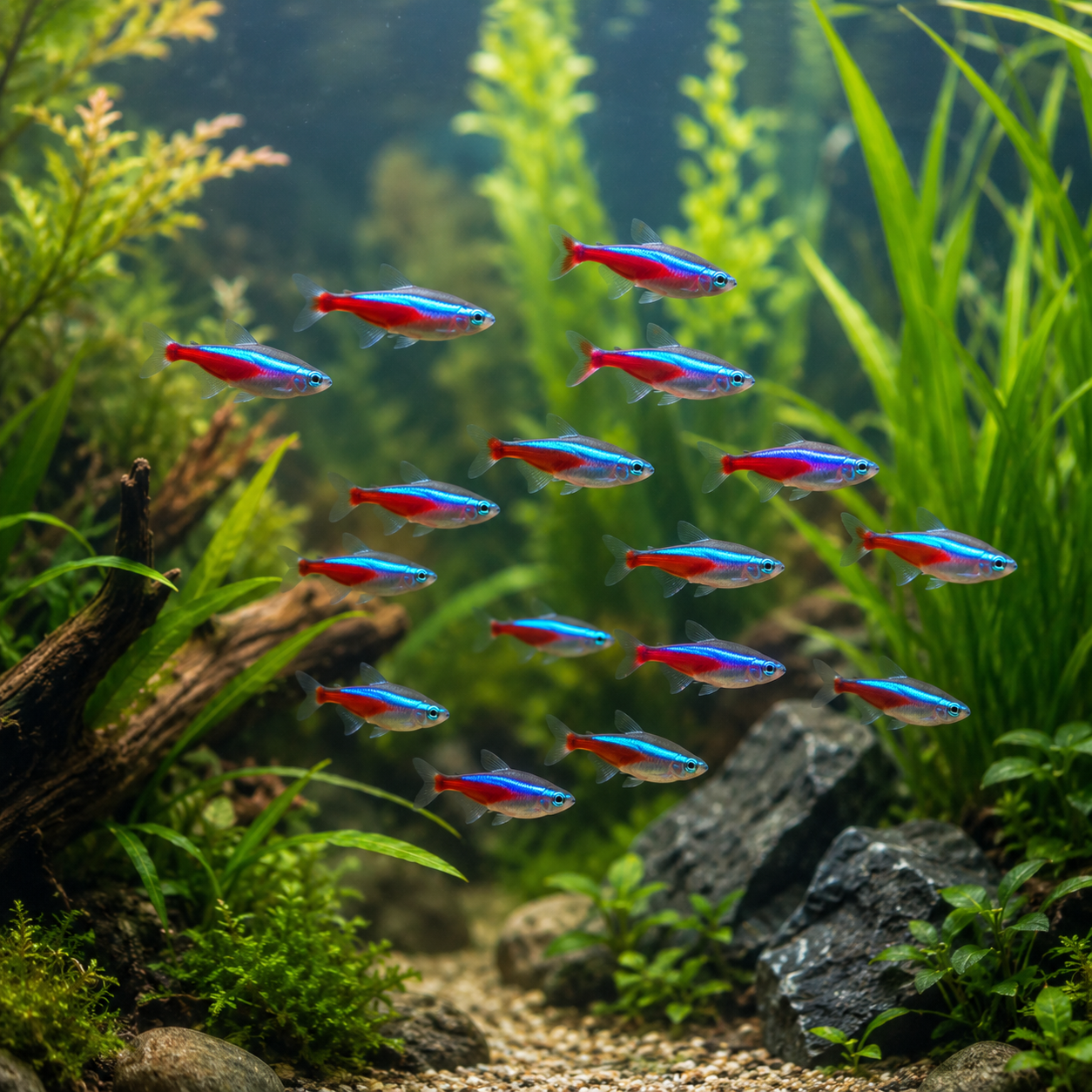
With their electric blue stripe and vivid red tail, neon tetras (Paracheirodon innesi) are among the most instantly recognisable freshwater fish in the hobby. A school of twenty or thirty neon tetras moving in unison through a planted aquarium is one of the most beautiful sights in the hobby — an iridescent ribbon of blue and red flickering through green.
Despite their delicate appearance, neon tetras are relatively hardy once settled into a well-established tank. The key phrase is "well-established" — they are sensitive to the water quality swings of a new, uncycled tank. This guide covers everything needed to keep a thriving school of neon tetras.
Quick Reference: Neon Tetra Care at a Glance
| Parameter | Ideal Range |
|---|---|
| Tank size (minimum) | 40 litres |
| Temperature | 22–26°C |
| pH | 6.0–7.0 |
| Hardness (GH) | 1–10 dGH (soft to moderately soft) |
| Diet | Omnivore — micro foods, small flake |
| Adult size | 3–4 cm |
| School size (minimum) | 6, ideally 10+ |
| Lifespan | 5–8 years with proper care |
Tank Size and Setup
A minimum of 40 litres is recommended for a school of ten neon tetras. They are small fish, but they are active swimmers that range widely across the mid-water zone. A longer, shallower tank (60 cm footprint or greater) is preferable to a tall, narrow one, as it provides more horizontal swimming space.
Ideal setup features:
- Dense planting — neon tetras feel most secure in a planted environment; java fern, anubias, and stem plants all work well
- Dark substrate — neon tetras' colours are more vivid and the fish are less stressed against a darker background
- Gentle filtration — neon tetras prefer calm water with low to moderate flow
- Dim to moderate lighting, with areas of shade provided by floating plants or tall stem plants
- Driftwood and botanicals (dried leaves, seed pods) create a blackwater effect that neon tetras find ideal
For guidance on suitable low-maintenance plants, see Low-Maintenance Aquarium Plants for Beginners.
Water Parameters: The Critical Factor
Neon tetras are more sensitive to water quality than many beginner fish. The most important rule: never add neon tetras to an uncycled tank. Ammonia and nitrite spikes that would merely stress a guppy can be lethal to neon tetras within hours.
Key water quality requirements:
- Ammonia: 0 ppm (non-negotiable)
- Nitrite: 0 ppm (non-negotiable)
- Nitrate: Below 20 ppm
- pH: 6.0–7.0; they are native to soft, acidic Amazonian waters but adapt to neutral pH
- Temperature: 22–26°C — slightly cooler than many tropical fish
Singapore context: Singapore's tap water pH is typically 7.5–8.5 out of the tap. In a well-established, planted tank with driftwood, pH naturally drops toward the neutral-to-slightly-acidic range that neon tetras prefer. In a bare or new tank, pH may remain high — consider using RO water mixed with tap, or adding driftwood and Indian almond leaves to soften and acidify the water naturally.
Always cycle your tank before adding neon tetras. See How to Cycle a Fish Tank for the full process.
Schooling Behaviour
Neon tetras are obligate schooling fish. In the wild, they form schools of thousands in the blackwater tributaries of the Amazon basin. In an aquarium, a minimum of six individuals is necessary, but the difference between a school of six and a school of fifteen is dramatic:
- Larger schools produce the rippling, coordinated movement that makes neon tetras so captivating
- Individual fish in larger schools show bolder colouration and more natural behaviour
- Stress levels are measurably lower in larger groups
Aim for at least ten neon tetras in a 60-litre tank. In a 90-litre planted aquarium, twenty or more creates a genuinely spectacular display.
Feeding Neon Tetras
Neon tetras have very small mouths. Standard flake food must be crushed finely for them to eat effectively, or use micro pellets specifically sized for small fish.
Recommended diet:
- High-quality micro pellets or finely crushed flake food as the staple
- Frozen micro foods: baby brine shrimp, micro worms, daphnia
- Live brine shrimp nauplii (excellent for triggering natural feeding behaviour)
- Spirulina-enriched flakes for colour enhancement
Feeding frequency: Twice daily, feeding only what is consumed within 2 minutes. Remove any uneaten food.
For detailed guidance on fish feeding, see How Much and How Often Should You Feed Aquarium Fish?.
Neon Tetras vs. Cardinal Tetras
These two species are frequently confused and are often sold interchangeably in local fish shops:
| Feature | Neon Tetra | Cardinal Tetra |
|---|---|---|
| Red stripe | Covers lower half of body from tail to midpoint | Covers entire lower body from tail to head |
| Adult size | 3–4 cm | 4–5 cm |
| Water requirements | More adaptable | Prefers softer, more acidic water |
| Price | Generally cheaper | Generally more expensive |
| Hardiness | Slightly hardier | More sensitive |
Both species school together happily in a mixed group, and in a planted tank the difference in their stripe patterns creates an interesting layered effect.
Suitable Tankmates
Neon tetras are peaceful and best kept with similarly sized, non-aggressive fish.
Excellent tankmates:
- Other small tetras (cardinal, ember, rummy-nose) — see Tetra Fish Guide
- Harlequin rasboras
- Corydoras catfish — see Cory Catfish Care Guide
- Otocinclus catfish
- Small livebearers (guppies, platies) — see Guppy Care Guide
- Cherry shrimp and Amano shrimp
- Nerite snails
Avoid:
- Angelfish — they eat neon tetras
- Bettas (variable; some ignore tetras, others attack them)
- Any fish large enough to fit a neon tetra in its mouth
- Aggressive or territorial species
Neon Tetra Disease
Neon tetra disease is a well-known condition caused by the microsporidian parasite Pleistophora hyphessobryconis. Symptoms include:
- Loss of colour, particularly in the blue stripe
- White or grey patches on the body
- Curved or hunched spine
- Restless, erratic behaviour
- Fish separating from the school
Unfortunately, there is no effective treatment. Affected fish should be isolated immediately and humanely euthanised if the condition progresses. The disease spreads through contact and cannibalism of infected tissue. Prevention is the only strategy: quarantine all new fish before adding them to an established tank, and purchase from reputable suppliers.
For a full quarantine protocol, see How to Quarantine New Aquarium Fish.
Frequently Asked Questions
Why do my neon tetras keep dying? The most common causes are: (1) uncycled or poorly cycled tank — ammonia poisoning is the leading killer; (2) water that is too warm (above 27°C stresses neon tetras); (3) disease introduced without quarantine; (4) pH too high for an extended period.
Can neon tetras live with bettas? It depends on the individual betta. Some bettas ignore neon tetras; others actively hunt them. A heavily planted 60-litre tank with plenty of sight breaks gives the best chance. Monitor closely for the first week.
How long do neon tetras live? With excellent water quality and care, neon tetras can live 5–8 years. Most specimens sold in shops are young — with proper care, a school established today can be a long-term display for years.
Do neon tetras need a heater in Singapore? Neon tetras prefer slightly cooler water than many tropical fish — 22–26°C. Singapore's ambient temperatures during the day (27–31°C) may actually be on the warm side for neon tetras. If your tank runs consistently above 27°C, consider a small aquarium fan to reduce surface temperature. A chiller is the most effective solution for those who want to keep neon tetras at their ideal temperature range.
How many neon tetras should I start with? Start with at least eight to ten. Buying fewer may seem economical, but small schools produce more stress and less impressive displays. A school of twelve to fifteen in a 60-litre planted tank is the sweet spot for most beginners.