
How to Quarantine New Aquarium Fish Before Adding Them to Your Tank
Quarantine is one of the most recommended practices in fishkeeping and one of the most commonly skipped. The reason is simple: quarantine requires patience and an additional setup — and when you have just bought an exciting new fish, the temptation to add it directly to your display tank is strong.
But skipping quarantine is one of the highest-risk decisions a fishkeeper can make. A single new fish carrying a parasite or bacterial infection can infect an entire established aquarium, killing every fish in it. This guide explains the quarantine process and why it is worth the extra effort every time.
Why Quarantine Matters
Fish from fish shops pass through multiple hands before reaching you:
- Wild-caught fish pass through holding facilities in multiple countries
- Farm-raised fish are held in high-density conditions that stress immune systems
- Shop tanks often house multiple species from different sources
- Shipping stress suppresses fish immune systems, making diseases that were subclinical become active
Common diseases introduced without quarantine:
| Disease | Cause | Spread method |
|---|---|---|
| Ich (white spot) | Ichthyophthirius multifiliis parasite | Highly contagious; free-swimming stages in water |
| Velvet | Oodinium parasite | Very contagious; often invisible at early stages |
| Columnaris | Bacterial infection | Waterborne; fish-to-fish contact |
| Anchor worm | Lernaea parasitic crustacean | Direct transfer on new fish |
| Fish lice (Argulus) | Parasitic crustacean | Visible on fish; transferred with water |
| Internal parasites | Various worms and protozoa | Transfer through fish faeces or infected food |
Many of these diseases are invisible in early stages. A fish can appear healthy for days or weeks before symptoms emerge — by which time, in an unquarantined situation, the entire tank may be infected.
What You Need for a Quarantine Tank
A quarantine tank does not need to be elaborate:
- Tank: 20–40 litres for small fish; larger for large fish. A cheap, simple tank is fine.
- Filter: A cycled sponge filter — the most important element. Keep a spare sponge filter running in your display tank at all times, so you have an instantly cycled filter ready for quarantine. Alternatively, use a matured filter sponge.
- Heater: To maintain the same temperature as the display tank
- Basic cover: A lid or cover to prevent jumps
- Hiding spots: A few PVC pipe sections or a small cave; bare tanks stress fish
- Water testing kit: Test ammonia and nitrite during quarantine
No substrate is necessary — bare-bottom quarantine tanks are easier to keep clean and allow medication to work more effectively.
For filter options, see Aquarium Filter Guide. For heater guidance in Singapore's climate, see Aquarium Heater Guide.
How Long to Quarantine
Minimum: 2–4 weeks. Most common diseases have incubation periods within this window.
Recommended: 4–6 weeks. This allows time to:
- Observe for any signs of disease at rest
- Complete a full treatment course if disease is detected
- Allow the fish to destress and begin eating normally before the social stress of introduction to a new community
For high-value fish (discus, arowana, rare species): 6–8 weeks minimum. The cost of quarantine is trivial compared to the potential loss.
The Quarantine Process: Step by Step
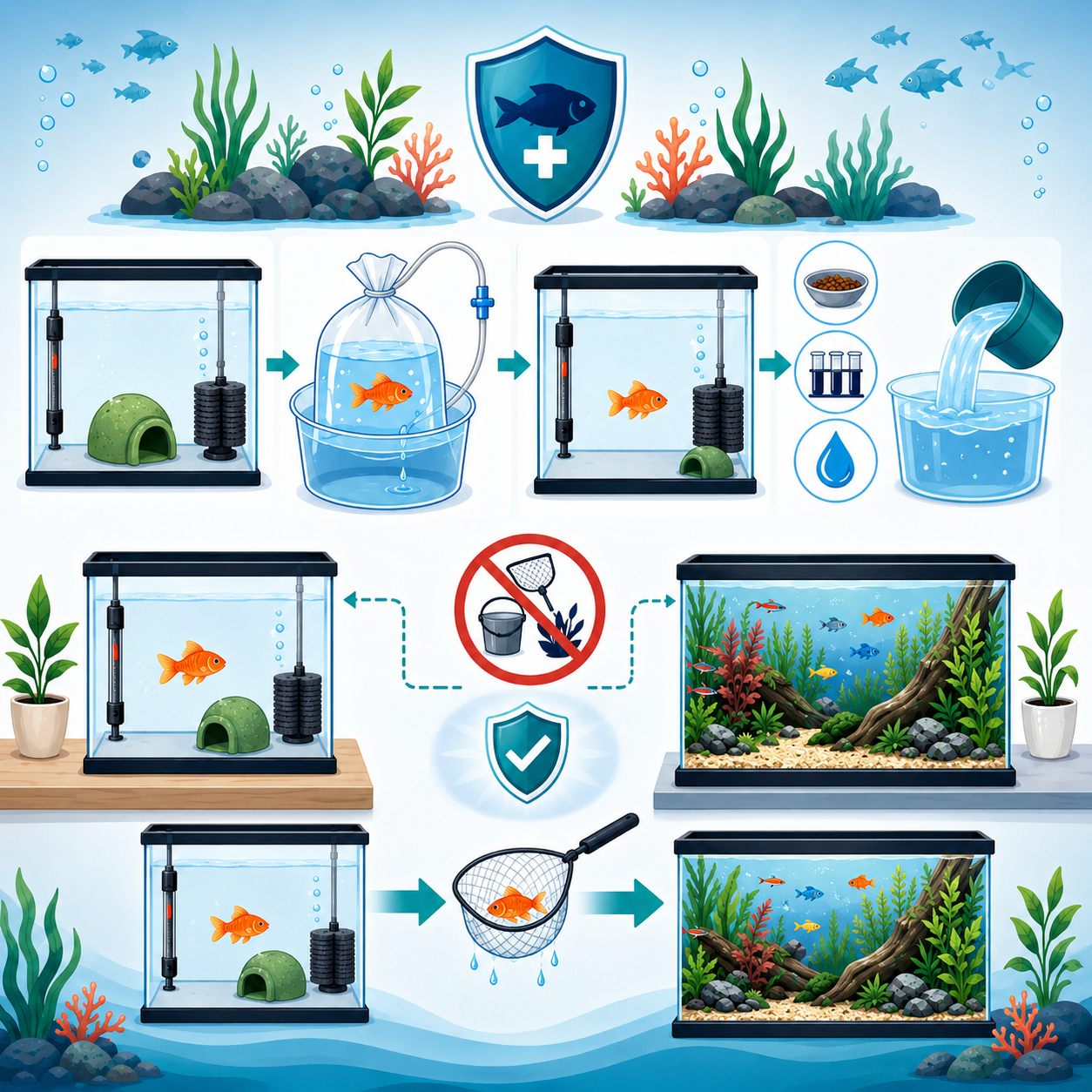
Step 1: Set Up the Quarantine Tank
- Use water from your established display tank — this is already dechlorinated and at the right parameters
- Install the pre-cycled sponge filter
- Set the heater to match your display tank temperature
- Add simple hiding structures
- Run the tank for at least 30 minutes before adding fish
Step 2: Acclimate the New Fish
New fish arrive in transport water that may have different temperature and chemistry to your tank. Drip acclimation is the gentlest method:
- Float the sealed bag in the quarantine tank for 15 minutes to equalise temperature
- Open the bag and place it in a container or bucket
- Use an airline tube to slowly drip quarantine tank water into the bag over 30–60 minutes
- Scoop the fish with a net and transfer to the quarantine tank — do not add the transport water to your tank (it may contain pathogens)
Step 3: Observe Daily
For the first two to four weeks, observe the quarantined fish daily for signs of disease:
Signs of ich: White grain-like spots on fins and body; scratching against surfaces
Signs of velvet: Fine gold or rust-coloured dust on the body; rapid gill movement; fish scratching
Signs of bacterial infection: White or grey patches on skin; fin deterioration; lethargy; loss of appetite; bulging eyes
Signs of internal parasites: Sunken belly despite eating; stringy white faeces; wasting
Signs of external parasites (anchor worm, fish lice): Visible worm-like attachments or disc-shaped organisms on the skin
Record observations — date and what you see. This helps track disease progression and treatment effectiveness.
Step 4: Feed and Monitor
Feed sparingly during quarantine — the quarantine tank has minimal biological filtration capacity. Test ammonia and nitrite every 2 days and perform 25–30% water changes as needed to prevent spikes.
If the quarantine tank is not fully cycled, daily water changes may be necessary to keep ammonia below 0.25 ppm.
Step 5: Treat If Necessary
If disease signs appear:
Ich: Raise temperature to 28–30°C and treat with a commercial ich medication (formalin or malachite green-based products). Complete the full treatment course (typically 7–14 days) even after visible spots disappear — ich has a free-swimming stage not visible on fish.
Velvet: Similar to ich treatment; treat in the dark (velvet is photosynthetic and dies without light). Formalin or copper-based medications are effective.
Bacterial infections: Use a broad-spectrum antibacterial medication appropriate for aquarium use.
External parasites: Remove manually (tweezers for anchor worm) and treat with appropriate antiparasitic medication.
Important: Complete the full treatment course, then wait one additional week after treatment ends before introducing fish to the display tank.
Step 6: Introduction to the Display Tank
After the full quarantine period with no disease signs:
- Perform a partial water change in the quarantine tank
- Acclimate the fish to display tank water conditions (drip acclimate over 30 minutes)
- Add the fish to the display tank with the lights off or dimmed — this reduces chasing from established fish
- Monitor for any stress signs or aggression from existing fish over the first 24–48 hours
Prophylactic Treatment During Quarantine
Some experienced hobbyists perform prophylactic (preventative) treatment of all new fish during quarantine, regardless of visible symptoms:
- A broad-spectrum deworming treatment (praziquantel or levamisole) to address internal parasites
- A salt treatment (1–2 teaspoons per 10 litres for 2 weeks) to address some external parasites
This is controversial — unnecessary medication stresses fish — but is standard practice for high-value fish like discus and rare wild-caught species. For routine beginner purchases, observation and treatment only if symptoms appear is the more common approach.
Disease-Specific Quarantine Considerations
For neon tetra disease, there is no treatment — isolate immediately and euthanise affected fish to prevent spread. See Neon Tetra Care Guide.
For discus quarantine, an extended 6–8 week quarantine and prophylactic treatment is strongly recommended given the sensitivity of established discus communities. See Discus Fish Care Guide.
For cherry shrimp, quarantine plants rather than shrimp themselves — most pathogens that affect shrimp are introduced on plants. A 2-week plant quarantine in plain water with no snails or shrimp is recommended for new plants before adding to a shrimp tank. See Cherry Shrimp Care Guide.
Frequently Asked Questions
What if I do not have a second tank for quarantine? A temporary container — a clean bucket, a transparent plastic tub, or a collapsible container — with a cycled sponge filter can serve as an emergency quarantine. A dedicated 20-litre tank costs very little and is a worthwhile investment for any serious hobbyist.
Do I need to quarantine plants as well as fish? Yes. Plants can carry ich cysts, snail eggs, and other pathogens. A 2-week plant quarantine in plain water (no fish) allows any ich to complete its lifecycle without a host and die, and allows snail eggs to hatch and be removed. Potassium permanganate dips or hydrogen peroxide dips are also used to disinfect plants.
Can I treat fish in the display tank instead of quarantining? Sometimes necessary in an emergency, but strongly not recommended as standard practice. Medications affect beneficial bacteria, kill inverts and shrimp, may harm plants, and treat all fish even those not affected. Quarantine allows targeted treatment in a controlled environment.
How do I keep the quarantine tank cycled between uses? Keep a spare sponge filter running in your display tank at all times. This sponge is fully cycled and ready to transfer to the quarantine tank at any time. Alternatively, keep a small amount of filter media from the display tank in a mesh bag in the display tank — transfer it to the quarantine filter when needed.
Is quarantine necessary if I buy fish from a reputable local fish shop? Yes — even from reputable sources. Reputable shops reduce (but do not eliminate) disease risk. Shipping stress, cross-contamination in holding tanks, and subclinical infections that only activate under stress are all present even in well-managed shops. Quarantine is always the right call.