

Arowana Care Guide: Tank Size, Diet, Growth, and Long-Term Commitment
Arowanas are among the most coveted and culturally significant fish in Singapore and across Asia. The Asian arowana (Scleropages formosus) in particular carries deep associations with prosperity and good fortune, commanding prices from hundreds to tens of thousands of dollars for premium colour grades. Silver arowanas (Osteoglossum bicirrhosum) are the more commonly kept species — less regulated and more affordable, but still demanding fish that are routinely underestimated by new keepers.
This guide covers what it genuinely takes to keep an arowana well — and why this is a fish that requires serious long-term planning before purchase.
Quick Reference: Arowana Care at a Glance
| Parameter | Silver Arowana | Asian Arowana |
|---|---|---|
| Tank size (minimum, adult) | 600–800 litres | 600–1,000 litres |
| Temperature | 24–30°C | 26–30°C |
| pH | 6.0–7.0 | 6.5–7.5 |
| Adult size | 60–90 cm | 60–90 cm |
| Diet | Carnivore | Carnivore |
| Lifespan | 10–15 years | 20+ years |
| Regulation (Singapore) | Unregulated | CITES Appendix I; licensed farms only |
Understanding Arowana Species Available in Singapore
Silver Arowana (Osteoglossum bicirrhosum)
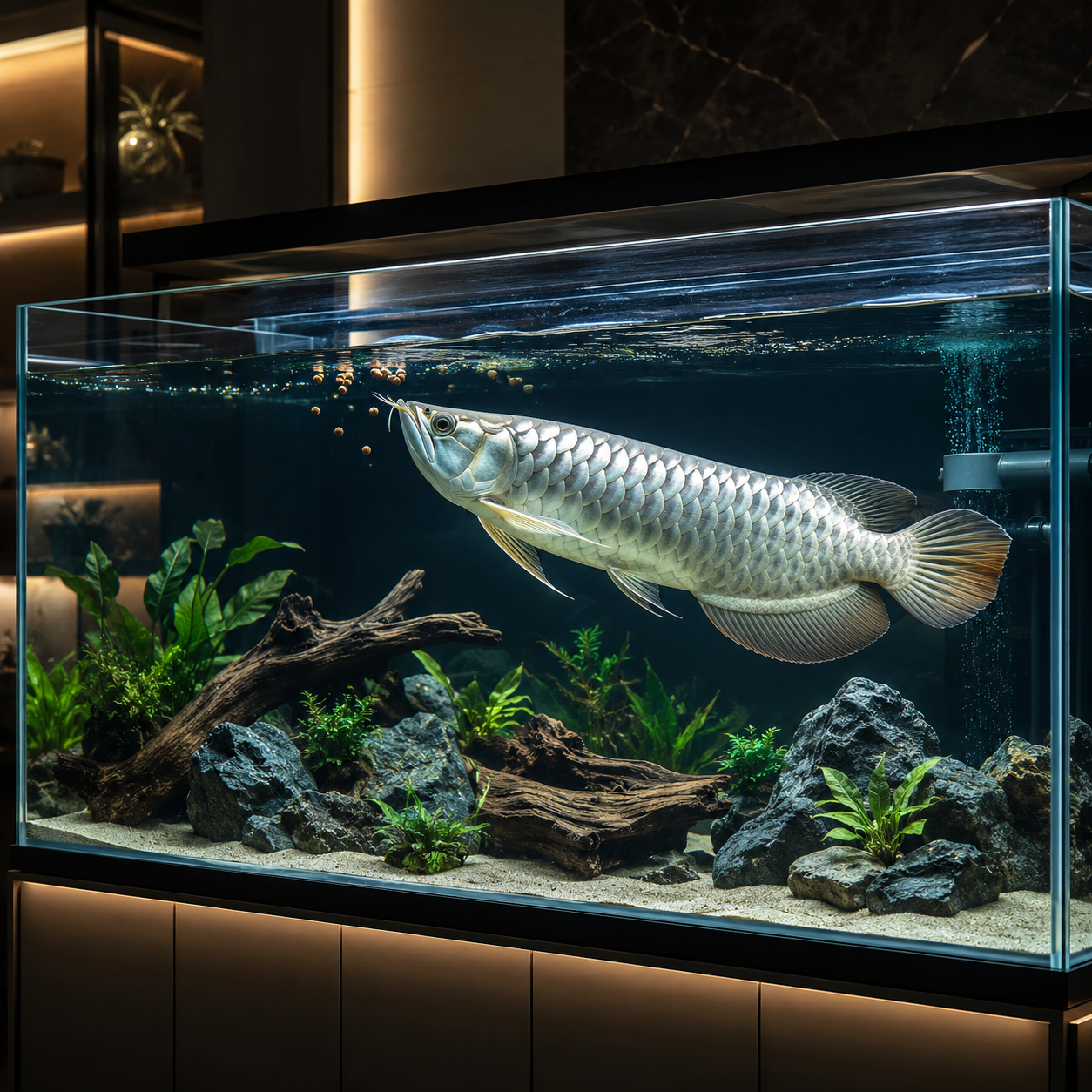
Native to the Amazon basin. Silver in colour with large, reflective scales and a distinctive dragon-like appearance. The most commonly kept arowana worldwide, and the most affordable. They grow to 60–90 cm and are not regulated under CITES in Singapore.
Asian Arowana (Scleropages formosus)
Native to Southeast Asia including rivers in Indonesia, Malaysia, and historically Singapore. Highly regulated under CITES Appendix I as an endangered species — sale is only legal from licensed farms with certified stock. Varieties include:
- Red arowana — the most valuable; deep red colouration on scales and fins
- Golden arowana — gold scales; highly prized
- Green arowana — natural colouration; the base variety; most affordable Asian arowana
- Super Red — the apex of the red arowana; extraordinary prices
Legal note for Singapore: Asian arowanas may only be purchased from licensed dealers with proper CITES certification. Ensure all documentation accompanies the fish.
Tank Size: The Most Critical Consideration
Arowanas grow large — rapidly. A silver arowana sold at 15 cm will reach 40–50 cm within a year under good feeding conditions. An adult silver arowana needs a tank of at minimum 600 litres, with 800 litres providing comfortable long-term housing.
Tank footprint is as important as volume. Arowanas are surface-dwelling fish that swim in long, sweeping arcs. A tank must be long — 180–200 cm in length for an adult arowana. A deep, narrow tank is unsuitable regardless of volume.
Lid security is critical. Arowanas are powerful jumpers — they evolved to leap out of the water to catch insects and small birds from overhanging branches. A tank without a heavy, secure lid will eventually result in a dead arowana.
Water Parameters
Silver arowanas prefer slightly soft, acidic to neutral water:
- pH: 6.0–7.0
- Temperature: 24–30°C — Singapore's ambient climate is suitable
- Ammonia/Nitrite: 0 ppm
- Nitrate: Below 20–40 ppm; large water changes are essential
Asian arowanas prefer slightly neutral to slightly alkaline conditions:
- pH: 6.5–7.5
- Temperature: 26–30°C
Filtration must be powerful — arowanas are large, metabolically active fish that produce significant waste. A high-capacity canister filter or sump system is typically required for large arowana tanks. See Aquarium Filter Guide.
Always cycle the tank before introducing an arowana. See How to Cycle a Fish Tank.
Feeding Arowanas
Arowanas are surface-feeding carnivores with a preference for live prey. Transitioning them to prepared foods requires patience but is important for nutritional balance and disease prevention.
Natural diet:
- Insects: crickets, roaches, mealworms (high in fat — use in moderation)
- Live fish (feeder fish — carry disease risk; quarantine any feeder fish before use)
- Frogs and small lizards (avoid amphibians from the wild due to pesticide risk)
- Earthworms — excellent nutritional value
- Prawns — de-shelled; eagerly eaten; nutritious
Transitioning to prepared foods:
- Freeze-dried krill, shrimp, and prawn
- Market-bought raw prawns de-shelled (fresh or thawed frozen)
- Arowana sticks (large floating pellets formulated for predatory fish) — target food long-term
- Smelt, lancetfish, or other whole small fish
Feeding frequency: Juveniles (under 30 cm): once or twice daily. Adults: every 1–2 days. Overfeeding is a significant water quality risk given the arowana's bioload.
For feeding principles, see How Much and How Often Should You Feed Aquarium Fish?.
Drop Eye: The Most Feared Arowana Problem
Drop eye (or sunken eye) is a condition where one or both eyes of the arowana develop a downward-tilting position. It significantly reduces the fish's value and is considered highly undesirable — particularly for Asian arowana owners for whom the fish's appearance carries cultural significance.
Causes:
- Feeding from the surface of the tank (fish constantly looking up)
- Reflections on the tank sides causing the fish to habitually look downward
- Genetic predisposition in some strains
Prevention:
- Feed from below water surface (use a feeding stick or cup below the surface)
- Use dark, opaque tank sides to reduce reflections
- Introduce surface cover (floating objects) to discourage constant surface staring
Treatment: No reliable cure once established. Some keepers use surgery or specialised lighting approaches, but prevention is far preferable.
Compatible Tankmates
Arowanas are predatory and will eat any fish they can fit in their mouth. Given their eventual size, this includes most community fish.
Possible tankmates for large arowana setups:
- Large plecos (common pleco, sailfin pleco — large enough to be safe)
- Large cichlids of comparable size (oscars, green terrors — with monitoring)
- Stingrays (advanced; very specific requirements; not for beginners)
- Large gourami
- Bichirs
Avoid: All small fish, shrimp, and invertebrates — they will be eaten.
The Long-Term Commitment
An Asian arowana can live over 20 years. A silver arowana 10–15 years. These are not fish to purchase impulsively:
- Tank upgrade costs as the fish grows are substantial
- Water change volume and frequency are demanding
- Electricity costs for filtration, heating, and potentially chillers are significant
- Veterinary care for arowanas exists but is specialised and expensive
Frequently Asked Questions
Is it legal to keep Asian arowana in Singapore? Yes — Singapore is one of the countries where CITES-certified Asian arowanas from licensed farms may be legally kept. All fish must be accompanied by CITES documentation. Purchase only from reputable licensed dealers.
How fast do arowanas grow? Silver arowanas grow approximately 5–7 cm per month under good conditions when young. They can reach 50–60 cm within the first two years. Growth slows after reaching approximately 60 cm.
Can an arowana live alone? Yes — arowanas are generally solitary. Multiple arowanas in the same tank typically results in aggression and injury, unless the tank is very large and the fish are introduced together as juveniles.
Why is my arowana not eating? Common causes: recent transportation stress (give 3–7 days to settle before feeding), water quality issues (test immediately), or the fish is being offered food it does not recognise. Try live food as a starting point and transition gradually to prepared foods.
What does an Asian arowana cost in Singapore? Prices vary enormously by species and grade. Green Asian arowanas start from several hundred dollars. High-grade Super Red arowanas can cost tens of thousands of dollars. Silver arowanas are far more affordable at $20–$100 for juveniles.