
How Much and How Often Should You Feed Aquarium Fish?
If there is one piece of advice that experienced fishkeepers most commonly give beginners, it is this: you are almost certainly feeding your fish too much. Overfeeding is the single most common cause of water quality problems, algae outbreaks, cloudy water, and fish health issues in home aquariums.
This guide explains why overfeeding is so harmful, how to judge the right amount and frequency for different fish, and how to avoid the most common feeding mistakes.
Why Overfeeding Is So Harmful
Every piece of uneaten food that sinks to the substrate and decomposes produces ammonia — the same toxic compound that fish waste produces. In a well-established tank, beneficial bacteria process ammonia through the nitrogen cycle. But the bacterial colony has a capacity limit. When uneaten food adds more ammonia than the bacteria can process, ammonia levels spike.
The chain of consequences from overfeeding:
- Uneaten food decomposes → ammonia spikes
- Ammonia feeds nuisance bacteria → cloudy water (bacterial bloom)
- Ammonia and phosphate from decomposing food fuel algae growth
- Elevated nitrate accumulates faster, requiring more frequent water changes
- Fish swimming through decomposing food develop bacterial infections
Overfeeding also causes direct harm to fish — obesity, fatty liver disease, and swim bladder problems from fish gorging themselves are all documented consequences of chronic overfeeding.
For guidance on cloudy water caused by overfeeding, see Cloudy Aquarium Water — Causes and Fixes.
The Fundamental Feeding Rule
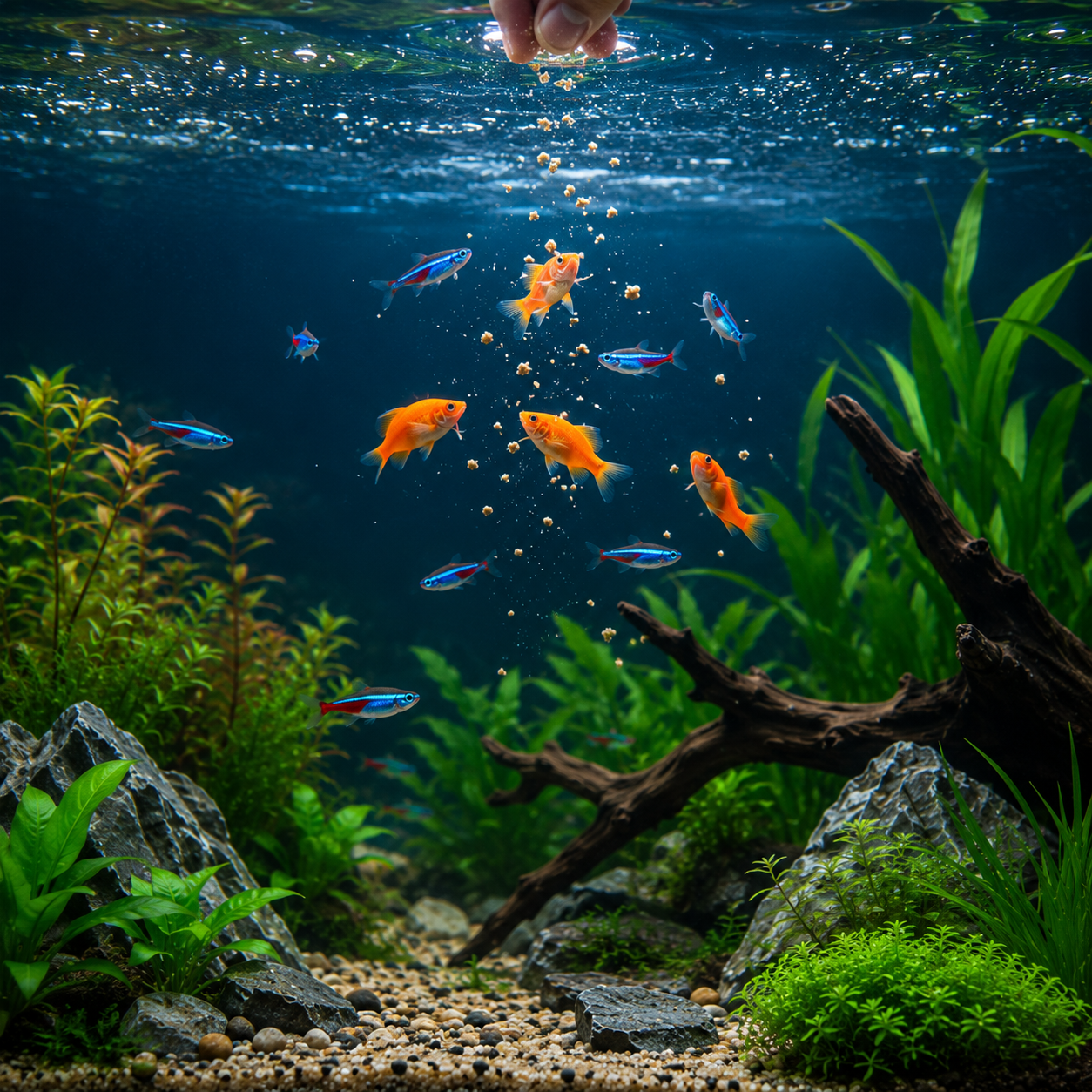
Feed only what your fish can consume in 2–3 minutes. Remove any uneaten food promptly after this time.
This applies to virtually all aquarium fish with normal appetites. It is a small amount — far less than most new hobbyists instinctively offer.
How Often to Feed Different Fish Types
Tropical Community Fish (Tetras, Rasboras, Livebearers, Small Cichlids)
Frequency: Once or twice daily
Most tropical community fish have active metabolisms and benefit from two small meals per day rather than one larger meal. The second feeding helps smaller or shyer fish compete with more aggressive feeders.
Fast one day per week. This is standard practice among experienced hobbyists and prevents constipation, obesity, and gives the beneficial bacteria a brief rest from organic loading. Fish tolerate a day without food easily — in the wild, fish routinely go days between successful meals.
Bottom-Dwellers (Corydoras, Plecos, Otocinclus)
Frequency: Once daily, in the evening
Bottom-feeders need their food to reach the substrate. Many hobbyists forget to feed their corydoras specifically because midwater fish consume all the food before it sinks.
Tips:
- Feed bottom-dwellers after lights off when midwater fish are less active
- Use a feeding cone or tube to deliver sinking food directly to the bottom
- Turn off or reduce flow briefly during feeding
- Sinking pellets, algae wafers, and blanched vegetables are appropriate
For corydoras-specific feeding, see Cory Catfish Care Guide.
Carnivorous Fish (Bettas, Oscars, Arowanas, Cichlids)
Frequency:
- Small carnivores (bettas): once or twice daily
- Medium carnivores (medium cichlids): once daily
- Large carnivores (oscars, arowanas): once daily for adults; adults can be fed every other day
Carnivorous fish have proportionally larger stomachs and eat larger, less frequent meals than small community fish. Large predatory fish should be fasted one to two days per week.
For betta feeding, see Betta Fish Tank Setup Guide. For oscar feeding, see Oscar Fish Care Guide.
Goldfish
Frequency: Two to three times daily in very small amounts
Goldfish do not have stomachs — food passes through their digestive system relatively quickly, and they benefit from more frequent, smaller meals over fewer large ones. However, they are voracious beggars and will always appear hungry regardless of how recently they were fed — do not be fooled.
For goldfish specifics, see Goldfish Tank Setup Guide.
Discus
Frequency: Three to five small feedings per day (especially for juveniles)
Discus have demanding growth and health requirements that call for more frequent feeding than most fish. This is also why discus tanks require more frequent water changes — the food load is higher. Juveniles growing rapidly need especially frequent feeding.
For discus feeding details, see Discus Fish Care Guide.
Aquarium Shrimp
Frequency: Every 1–2 days for supplemental foods
Shrimp are primarily biofilm and algae grazers — in a well-established, planted tank they feed continuously on naturally occurring food. Supplemental feeding every other day with shrimp wafers, blanched vegetables, or speciality shrimp foods is sufficient.
For cherry shrimp feeding, see Cherry Shrimp Care Guide.
How to Judge the Right Portion Size
The 2–3 minute rule is the most reliable guide, but here are additional indicators:
Signs you are overfeeding:
- Food settles on the substrate and sits there for more than a few minutes
- Cloudy white or grey water (bacterial bloom from excess organic matter)
- Unusual algae growth — particularly green hair algae or green water
- Nitrate rising faster than expected between water changes
- Fish appear bloated or constipated (floating at surface, unable to maintain position)
Signs you might be underfeeding:
- Fish are thin with visible spine or deeply sunken belly
- Fish actively searching the tank floor for food hours after feeding
- Slow or absent growth in juveniles
- Fish becoming weakened and disease-prone
In practice, underfeeding healthy adult fish is very difficult. The risk is almost always in the other direction.
The Right Foods for Different Fish
| Fish type | Staple food | Supplements |
|---|---|---|
| Small community fish (tetras, rasboras) | High-quality micro pellets or crushed flake | Frozen brine shrimp, daphnia, micro worms |
| Livebearers (guppies, platies, mollies) | Flake food + spirulina flakes | Frozen brine shrimp, blanched vegetables |
| Corydoras | Sinking pellets, algae wafers | Frozen bloodworms, blanched cucumber |
| Betta | Betta pellets | Frozen bloodworms, frozen brine shrimp |
| Angelfish | Cichlid pellets | Frozen bloodworms, brine shrimp, mysis |
| Goldfish | Sinking goldfish pellets | Blanched peas, brine shrimp, vegetables |
| Discus | Beef heart mix, discus pellets | Frozen bloodworms, brine shrimp |
| Oscars | Large cichlid pellets | Frozen krill, whole prawns, earthworms |
| Shrimp | Shrimp wafers, algae | Blanched vegetables, indian almond leaf |
Vacation Feeding
For absences of up to 5–7 days, most healthy adult fish do not need feeding at all. Healthy fish tolerate a week without food far better than the water quality decline from overfeeding by an inexperienced fish-sitter.
For longer absences:
- Use an automatic fish feeder — a programmable drum dispenser that drops a small amount of food at set times. Calibrate it carefully before leaving to avoid overfeeding.
- Ask a trusted, trained fish-keeper rather than an untrained friend — the risk of well-meaning overfeeding is high
- Feed gel food blocks only as a last resort — they dissolve slowly and pollute the water
Feeding and Water Change Connection
Feeding quantity directly determines how quickly nitrate accumulates and how often water changes are needed. A lightly fed, lightly stocked tank may maintain acceptable nitrate with a 20% biweekly water change. A heavily fed tank may need 30–40% weekly changes.
For a complete maintenance schedule, see Aquarium Maintenance Schedule for Beginners.
Frequently Asked Questions
Can fish die from being overfed? Directly, fish die from water quality problems caused by overfeeding (ammonia poisoning, bacterial infection from decaying food) rather than from eating too much themselves. However, chronic overfeeding causes fatty liver disease and obesity in fish, which shortens lifespan.
My fish always look hungry. How do I know if I am feeding enough? Fish evolved in environments of food scarcity — begging behaviour is hard-wired, not an accurate indicator of genuine hunger. Judge by body condition (not emaciated) and behaviour (active, normally coloured) rather than by how eagerly they approach the glass.
How long can fish go without food? Healthy adult tropical fish can go 5–10 days without food without significant harm. Juveniles and growing fish should not be left unfed for more than 3–4 days. Some large carnivores (oscars, arowanas) naturally go several days between feedings in the wild.
Should I remove uneaten food? Yes, always — within 5 minutes for fish food, within 24 hours for sinking foods and vegetables intended for shrimp or bottom-dwellers. Use a small net or turkey baster to remove sunken uneaten food.
Is it OK to feed fish only once a day? For most healthy adult fish, once daily is perfectly fine and is what many experienced hobbyists do. Juveniles, discus, and rapidly growing fish benefit from more frequent feedings.