

Oscar Fish Care Guide: Tank Size, Feeding, Growth, and Compatibility
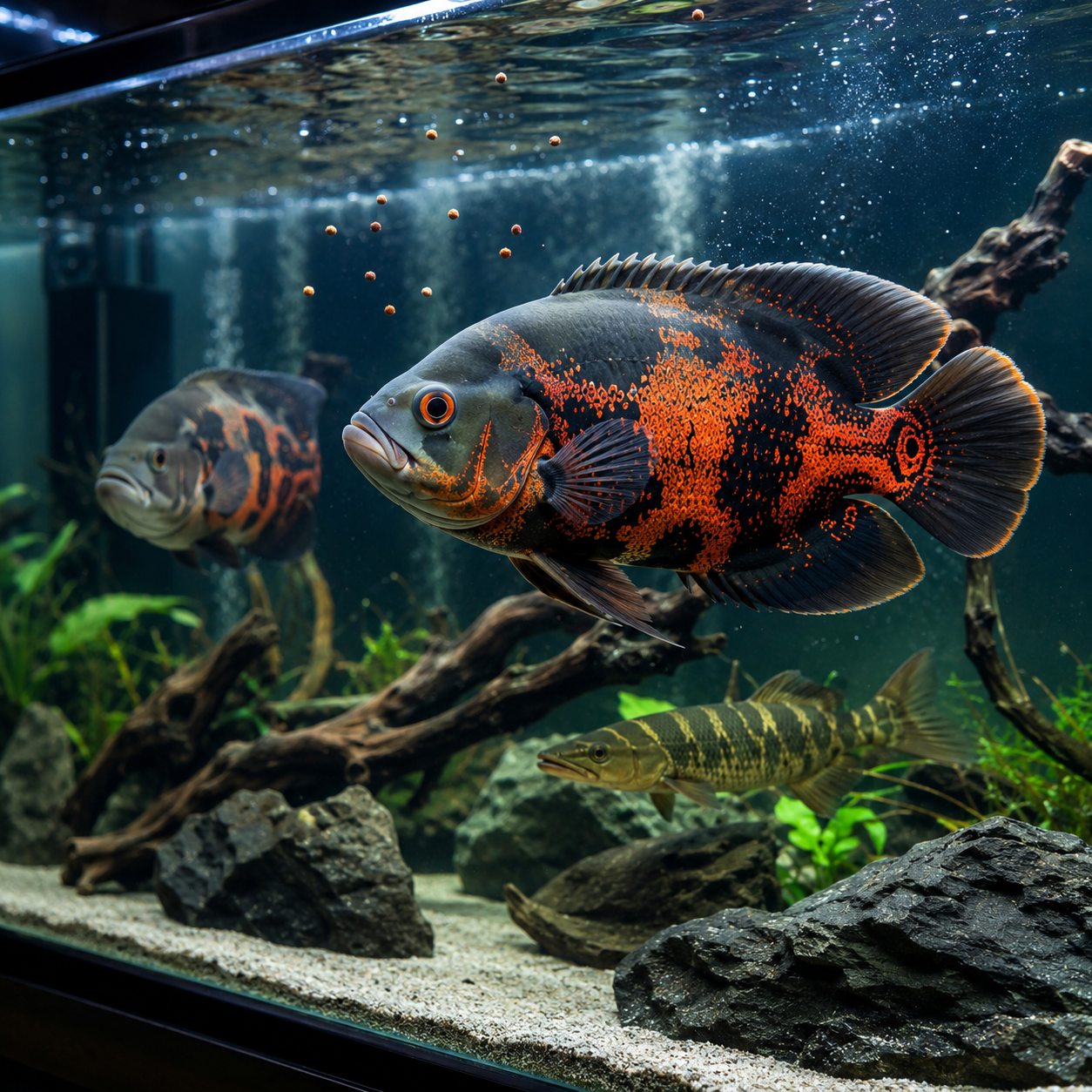
Oscars (Astronotus ocellatus) are among the most captivating fish in the freshwater hobby. They are intelligent — recognising their keepers, responding to hand movements, and even learning to accept food directly from fingers. They have genuine personality, strong individual characters, and are capable of complex social behaviour. They are also absolutely enormous, voraciously predatory, and completely unsuitable for most community aquariums.
This guide gives an honest account of what owning an oscar actually requires — so that the decision to keep one is made with full knowledge of the commitment.
Quick Reference: Oscar Fish Care at a Glance
| Parameter | Ideal Range |
|---|---|
| Tank size (minimum for one adult) | 300 litres |
| Temperature | 23–28°C |
| pH | 6.0–8.0 |
| Hardness (GH) | 5–20 dGH |
| Diet | Carnivore |
| Adult size | 30–40 cm |
| Temperament | Aggressive, territorial |
| Lifespan | 10–15 years |
Oscar Growth Rate — The Most Common Shock
Oscars are sold in fish shops at 3–5 cm — small, unremarkable juveniles that are easy to underestimate. What buyers often do not realise:
- At 6 months, an oscar typically reaches 15–20 cm
- At 12 months, 25–30 cm
- Full adult size of 30–40 cm is reached by 18 months to 2 years
This growth rate is staggering. An oscar purchased for a 100-litre "starter" tank will outgrow it within months, then months later outgrow a 150-litre upgrade. Plan for the adult size from day one.
Tank Size
One oscar: Minimum 300 litres, ideally 400+ litres Two oscars: 400–500 litres minimum, and even then, aggression between individuals can be a persistent problem
Apart from volume, tank footprint matters. Oscars are active swimmers and need a long tank — 150 cm length or more for an adult. Tall, narrow tanks are unsuitable.
Why so large?
- Oscars produce enormous amounts of waste — they are sometimes called "wet dogs" of the aquarium world for their bioload
- High ammonia production demands heavily filtered, large volumes of water
- Oscars are territorial and stressed in confined spaces
For filtration, use a high-quality canister filter rated for at least double the tank volume, or combine two filters. See Aquarium Filter Guide for filter options.
Water Parameters
Oscars are actually quite adaptable in terms of water chemistry — a relatively wide pH and hardness range is tolerated. The main challenge is not chemistry but waste load management.
- Temperature: 23–28°C — comfortable range; Singapore's ambient temperature is suitable
- pH: 6.0–8.0 — very tolerant; dechlorinated Singapore tap water is fine without modification
- Ammonia/Nitrite: 0 ppm — non-negotiable; high bioload makes this challenging without powerful filtration
- Nitrate: Aim below 20–40 ppm; large weekly water changes are essential
Water change schedule: For a single oscar, 30–40% weekly water changes are the minimum. Many oscar keepers do 2–3 water changes per week to manage nitrate from the oscar's high waste output.
Always cycle the tank before adding an oscar. See How to Cycle a Fish Tank.
Oscar Varieties
- Wild-type oscar — brown/grey base with orange-spotted patterning; the natural colour form
- Red oscar — intense red and orange patterning; the most common captive-bred variety
- Tiger oscar — striped pattern over the base colour
- Albino oscar — white or pale yellow body with red eyes and orange markings
- Lemon oscar — yellow-tinted base with red highlights
- Veil oscar — any colour morph with elongated, flowing fins
Feeding Oscars
Oscars are predatory carnivores with large appetites. They are enthusiastic feeders that will accept virtually anything offered — which requires discipline to avoid overfeeding.
Recommended diet:
- High-quality large cichlid pellets — the primary staple; choose a pellet appropriate for large predatory cichlids
- Frozen krill — excellent protein and colour enhancement
- Frozen smelt or whitebait — whole fish; nutritionally complete
- Frozen prawns (de-shelled) — enjoyed; feed in moderation
- Live feeder fish — controversial; high disease transmission risk; if used, feeder fish must be quarantined and healthy
- Earthworms — eagerly eaten; nutritious
Avoid: Feeder goldfish (associated with thiaminase issues and disease transmission), mammal meat (beef, chicken — high in fat, not digestible for fish), and anything too large to be swallowed in one piece.
Feeding frequency: Young oscars (under 15 cm): twice daily. Adult oscars: once daily, with fasting one day per week to prevent obesity and constipation.
For general feeding guidance, see How Much and How Often Should You Feed Aquarium Fish?.
Tank Decor and Environment
Oscars are famous for rearranging their tanks. They uproot plants, move rocks and gravel, and can displace decorations that are not securely anchored. Setting up a beautiful planted oscar tank is an exercise in frustration unless robust measures are taken.
Practical setup:
- Heavy, large rocks secured against the tank sides
- Large-leafed, potted aquatic plants (potted so the oscar cannot uproot them), or artificial plants
- Minimal substrate — many oscar keepers use bare-bottom or very fine sand that is easier to siphon
- Robust, oversized filter with a secure intake that cannot be displaced
Compatibility
Oscars eat anything that fits in their mouth — which is quite large. They are also territorial and aggressive toward fish that challenge or crowd them.
Possible tankmates (all must be comparable in size):
- Other large South American cichlids: severums, green terrors (with caution), jack dempseys (with caution)
- Large plecos (common or sailfin plecos are large enough to coexist)
- Large bichirs
- Silver dollars (peaceful schooling fish large enough not to be eaten)
Absolute incompatibility:
- Any small fish — they will be eaten
- Guppies, tetras, corydoras, shrimp — immediate predation
- Multiple oscars in a small tank — severe aggression is common
Common Health Problems
| Problem | Signs | Cause / Solution |
|---|---|---|
| Hole-in-the-head disease (HLLE) | Pitting and erosion around the head and lateral line | Poor water quality + nutritional deficiency; improve diet and increase water changes |
| Ich (white spot) | White spots on body | Common in new fish; treat with ich medication at appropriate dose for large fish |
| Swim bladder issues | Floating or sinking abnormally | Often from overfeeding; fast for several days |
| Pop-eye | Bulging eye | Bacterial infection; treat with broad-spectrum antibiotics |
Hole-in-the-head disease is particularly associated with oscars. It is primarily caused by chronic poor water quality and inadequate diet (insufficient vitamins). The solution is rigorous water changes and a varied, vitamin-rich diet.
Frequently Asked Questions
Can I keep an oscar in a 150-litre tank? A juvenile oscar will fit temporarily, but an adult oscar in a 150-litre tank is severely under-housed. The fish will not reach its genetic potential, chronic stress will shorten its lifespan, and water quality will be very difficult to maintain. Commit to 300+ litres before purchasing.
Are oscars aggressive to humans? Oscars can and will bite during hand-feeding — not out of aggression but opportunistic feeding. The bite is not dangerous but can be surprisingly forceful from a large adult. Use tongs for hand-feeding if preferred.
Can I keep two oscars together? Possible, but not simple. Some oscar pairs bond and coexist well; others fight destructively. Raise two oscars together from juveniles in a very large tank (400+ litres) to improve the odds. Adult oscars introduced as strangers often fight.
How big will my oscar get? With proper feeding and adequate space, 30–40 cm is typical. The largest recorded oscars have exceeded 45 cm. Do not expect the 3 cm juvenile you bought to stay small.
Do oscars recognise their owners? Yes — this is well-documented. Oscars learn to associate their keeper with feeding, will approach the glass when their keeper is present, and often respond to tapping or movement. This intelligence is a large part of their appeal.