

Aquarium Heater Guide: Choosing the Right Temperature for Tropical Fish
The aquarium heater is one of those pieces of equipment that generates genuine debate in Singapore's fishkeeping community — specifically, do you even need one? With ambient temperatures of 27–31°C for much of the year, many tropical fish are already living at or near their preferred temperature without any heating.
The answer is nuanced, and this guide explains exactly when heaters are and are not necessary, how to choose the right size, and what temperature different species genuinely need.
Why Temperature Matters
Fish are ectothermic — they cannot regulate their own body temperature. The water temperature directly controls their metabolic rate, immune function, digestion speed, and disease susceptibility.
Too cold:
- Slowed metabolism, reduced activity, and appetite loss
- Weakened immune system, increased disease susceptibility
- For tropical fish: temperatures below 22°C are stressful; below 18°C can be lethal for most tropical species
Too warm:
- Elevated metabolic rate — fish burn energy faster and require more food
- Reduced dissolved oxygen (warm water holds less oxygen)
- Accelerated biological processes — ammonia and bacteria multiply faster
- For cool-water fish (goldfish): temperatures above 24°C cause chronic stress
Inconsistent temperature: Temperature swings of more than 2–3°C in a 24-hour period are more stressful than a consistently slightly warm or slightly cool temperature. Consistency is key.
Do You Need a Heater in Singapore?
For most tropical fish kept in Singapore, a heater is not required for the temperature itself — but it may be required for stability.
Consider a heater if:
- Your home uses air-conditioning at night that drops ambient temperature to 23°C or below
- Your tank is a small nano tank (under 30 litres) that fluctuates more than a degree or two with air-conditioning cycles
- You keep temperature-sensitive fish like discus (require 28–31°C consistently) or neon tetras (prefer 22–26°C)
- Your tank is positioned near an air-conditioning vent or in a particularly cold room
You may not need a heater if:
- Your home stays consistently above 26°C (no air-conditioning, or AC set to 28°C+)
- Your tank is 60 litres or more (larger volume buffers temperature changes)
- You keep fish comfortable at 26–30°C and your home ambient is stable in that range
Temperature Requirements by Species
| Species | Ideal Temperature | Notes for Singapore |
|---|---|---|
| Guppies | 24–28°C | Comfortable at Singapore ambient; heater for AC homes |
| Neon tetras | 22–26°C | May need cooling at Singapore ambient; consider fan or chiller |
| Cardinal tetras | 24–30°C | More comfortable at Singapore ambient than neon tetras |
| Corydoras (most) | 22–26°C | Sterbai corydoras tolerate up to 30°C; others may need cooling |
| Betta | 24–28°C | Usually fine at Singapore ambient; heater for AC nights |
| Angelfish | 26–30°C | Well-suited to Singapore ambient |
| Discus | 28–31°C | Need consistent high temperature; heater essential |
| Goldfish (fancy) | 15–22°C | Need a chiller in Singapore; ambient is too warm |
| Cherry shrimp | 18–26°C | Singapore ambient is at upper end; shrimp survive but breed less |
| Oscar | 23–28°C | Usually comfortable at Singapore ambient |
| Arowana (Asian) | 26–30°C | Well-suited to Singapore ambient |
For species-specific care, see articles including Neon Tetra Care Guide, Discus Fish Care Guide, and Cory Catfish Care Guide.
Choosing the Right Heater Wattage
A general guideline is 1 watt per litre of water for tanks in ambient temperatures close to target temperature (i.e., the heater only needs to maintain, not significantly raise, the water temperature).
| Tank Volume | Singapore Ambient | Recommended Wattage |
|---|---|---|
| 20 litres | 26–28°C | 25–50W |
| 40 litres | 26–28°C | 50–75W |
| 60 litres | 26–28°C | 75–100W |
| 100 litres | 26–28°C | 100–150W |
| 180+ litres | 26–28°C | 150–200W or dual heaters |
For tanks needing significant warming (e.g., discus tanks in heavily air-conditioned rooms): increase to 2–3 watts per litre.
For large tanks (200+ litres): Use two heaters — one at each end of the tank — rather than one very large heater. Two smaller heaters provide better temperature distribution and a safety backup if one fails.
Types of Aquarium Heaters
Submersible Glass Heater
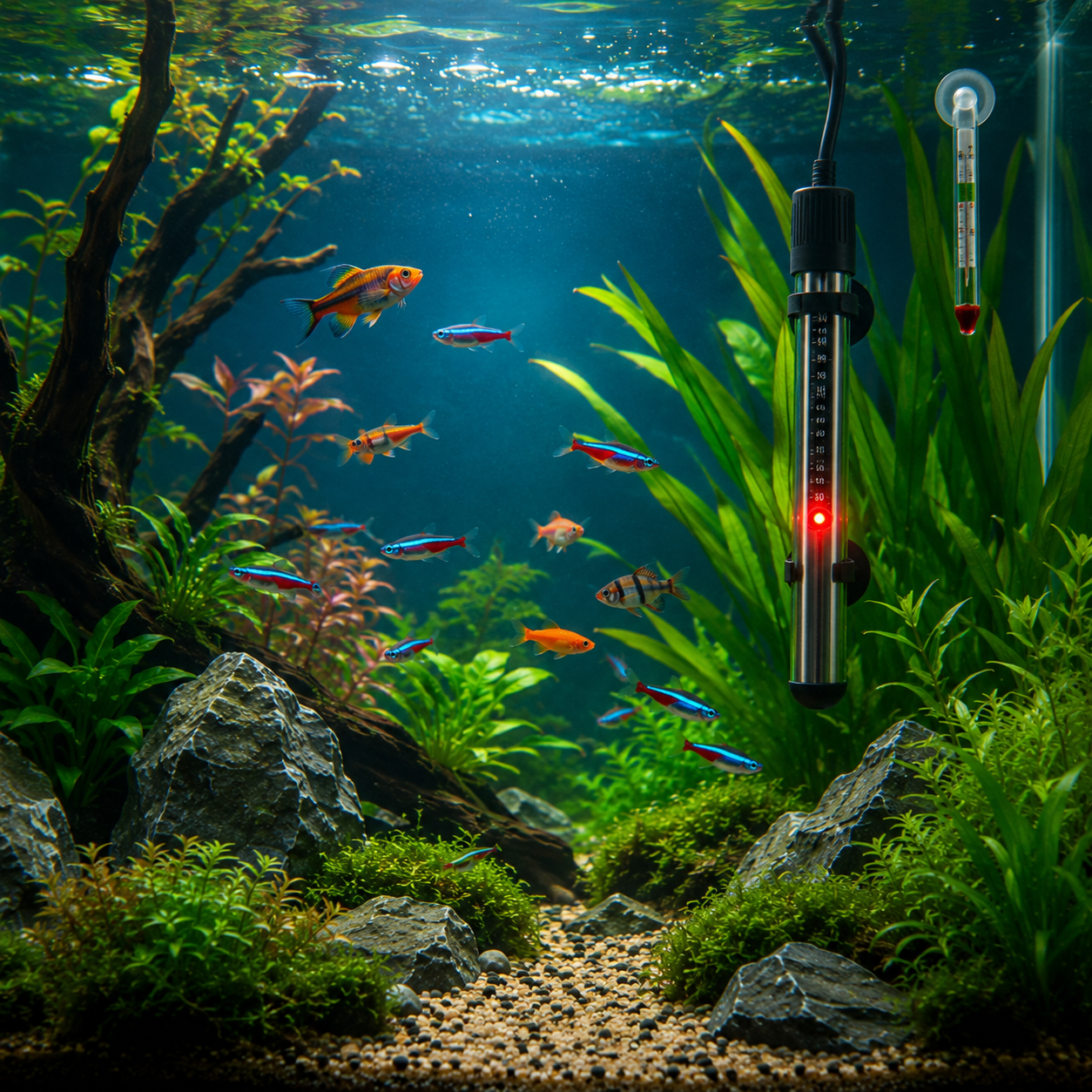
The most common type. A glass tube with a heating element and a thermostat. Submersed completely in water. Reliable, affordable, and widely available. The temperature adjustment dial is on top of the unit.
Best for: Most beginner and intermediate setups Limitation: Glass can crack if knocked; some cheaper units have inaccurate thermostats
Titanium Heater
An upgrade from glass heaters — more durable, shatter-proof, and often more accurate. Typically used with an external controller for precise temperature regulation.
Best for: Large tanks, discus setups, tanks with boisterous fish (oscars, cichlids)
Inline Heater
Installed in the return line of a canister filter — water is heated as it passes through. Keeps the heater out of the main tank.
Best for: Planted tanks where equipment visibility is important; discus and high-tech setups
All-in-One Heaters / Smart Heaters
Some modern heaters connect to smartphone apps for remote monitoring and temperature alerts. Useful for discus keepers and those who want alerts if the heater malfunctions.
Heater Placement and Use
Placement:
- Position the heater near the filter inlet or outlet — water flow distributes heat evenly
- Keep the heater off the substrate (heat can crack the glass if buried in sand or gravel)
- For tanks with a sump, placing the heater in the sump is ideal — hidden from view, evenly distributed water flow
Use:
- Always turn off the heater before removing it from water — a dry heater glass heats rapidly and can crack when re-immersed
- Allow a new heater 30–60 minutes to equilibrate before turning it on
- Check temperature with a separate thermometer — do not rely solely on the heater's built-in calibration
Safety:
- Heater failure in two modes: stuck on (cooking the tank) or stuck off (tank goes cold). A separate thermometer and regular checks are essential.
- Use a heater guard in tanks with curious fish (oscars, discus) that may bite or rest against the heater
When to Use a Chiller Instead
For species that need cooler water than Singapore's ambient (goldfish, neon tetras kept at optimal temperature, caridina shrimp), a chiller is necessary rather than a heater.
Aquarium chillers are available in Singapore from specialist shops and online. They are more expensive than heaters and consume more electricity, but they are essential for certain species in tropical climates.
For goldfish-specific cooling requirements, see Goldfish Tank Setup Guide.
Frequently Asked Questions
What temperature should I set my heater to in Singapore? For most tropical community fish: 26–27°C. For discus: 28–30°C. For bettas: 26°C. Set it and check with a separate thermometer — the heater dial calibration is often slightly off.
How do I know if my heater is working? Use a separate aquarium thermometer to verify the water temperature daily. Most heaters have an indicator light that shows when the element is active. Check the temperature at different times of day to confirm stability.
Is it dangerous to run a heater in a tank without water? Yes — extremely dangerous. A dry heater overheats within seconds and can crack, melt, or start a fire. Always ensure the heater is fully submerged before switching it on.
Do I need a heater for cherry shrimp in Singapore? Generally no — Singapore's ambient temperature (27–30°C) is at the upper tolerance limit for cherry shrimp. They survive but breed less actively. A heater to maintain temperature in an air-conditioned room (below 24°C) is useful. A chiller to bring temperature below 25°C would improve breeding rates but is an advanced consideration.
What happens if the heater fails and the tank overheats? A stuck-on heater can raise tank temperature above 35°C within hours, which is lethal for most freshwater fish. Symptoms: fish gasping at the surface, erratic behaviour, sudden deaths. If you suspect overheating: unplug the heater, do a partial water change with cooler water, and float bags of ice to bring temperature down gradually. Replace the heater immediately.