

Discus Fish Care Guide: What Beginners Should Know Before Keeping Discus
Discus (Symphysodon spp.) are widely regarded as the kings of the freshwater aquarium. Their circular, laterally compressed body, vivid colours, and impressive size make them the centrepiece of any tank they inhabit. They are also the most demanding freshwater fish that most hobbyists will ever attempt to keep.
This guide is written honestly: discus are not suitable for beginners. They require exceptional water quality, specific temperature and chemistry, a high-protein diet fed multiple times daily, and a level of attentiveness that most beginner setups cannot provide. But for intermediate to advanced hobbyists ready for the challenge, they are extraordinarily rewarding.
Quick Reference: Discus Care at a Glance
| Parameter | Ideal Range |
|---|---|
| Tank size (minimum) | 180 litres for a group of 4–6 |
| Temperature | 28–31°C |
| pH | 5.5–7.0 |
| Hardness (GH) | 1–8 dGH (soft water) |
| Diet | High-protein — beef heart, live/frozen foods |
| Adult size | 15–20 cm |
| School size | 4–6 minimum |
| Lifespan | 10–15 years |
Why Discus Are Considered Advanced Fish
Three factors make discus genuinely difficult:
1. Water quality demands are extreme. Discus cannot tolerate ammonia or nitrite even at trace levels. Nitrate above 20 ppm causes chronic stress. The pH must remain stable within a narrow acidic to neutral range. This requires meticulous filtration, frequent water changes, and consistent testing.
2. High temperature conflicts with most tankmates. Discus are kept at 28–31°C — significantly warmer than most tropical fish. The high temperature accelerates their metabolism and microbial activity, requiring more frequent water changes. Most other fish either cannot tolerate this temperature or outcompete discus for food.
3. They require multiple feedings of high-protein food daily. Discus are slow, methodical feeders. In a community tank, faster or more aggressive fish out-compete them. Uneaten food from multiple daily feedings heavily loads the water with organic matter.
Tank Size and Setup
Discus are large, tall fish that need both volume and height. A minimum of 180 litres is recommended for a group of four to six — the minimum social group.
Setup options:
Bare-Bottom Discus Tank
Many experienced discus keepers use bare-bottom tanks — no substrate at all. Advantages:
- Detritus and uneaten food are visible and easily siphoned
- No substrate to harbour bacteria and nitrate
- Easier to maintain the immaculate cleanliness discus require Disadvantage: Aesthetically stark.
Planted Discus Tank
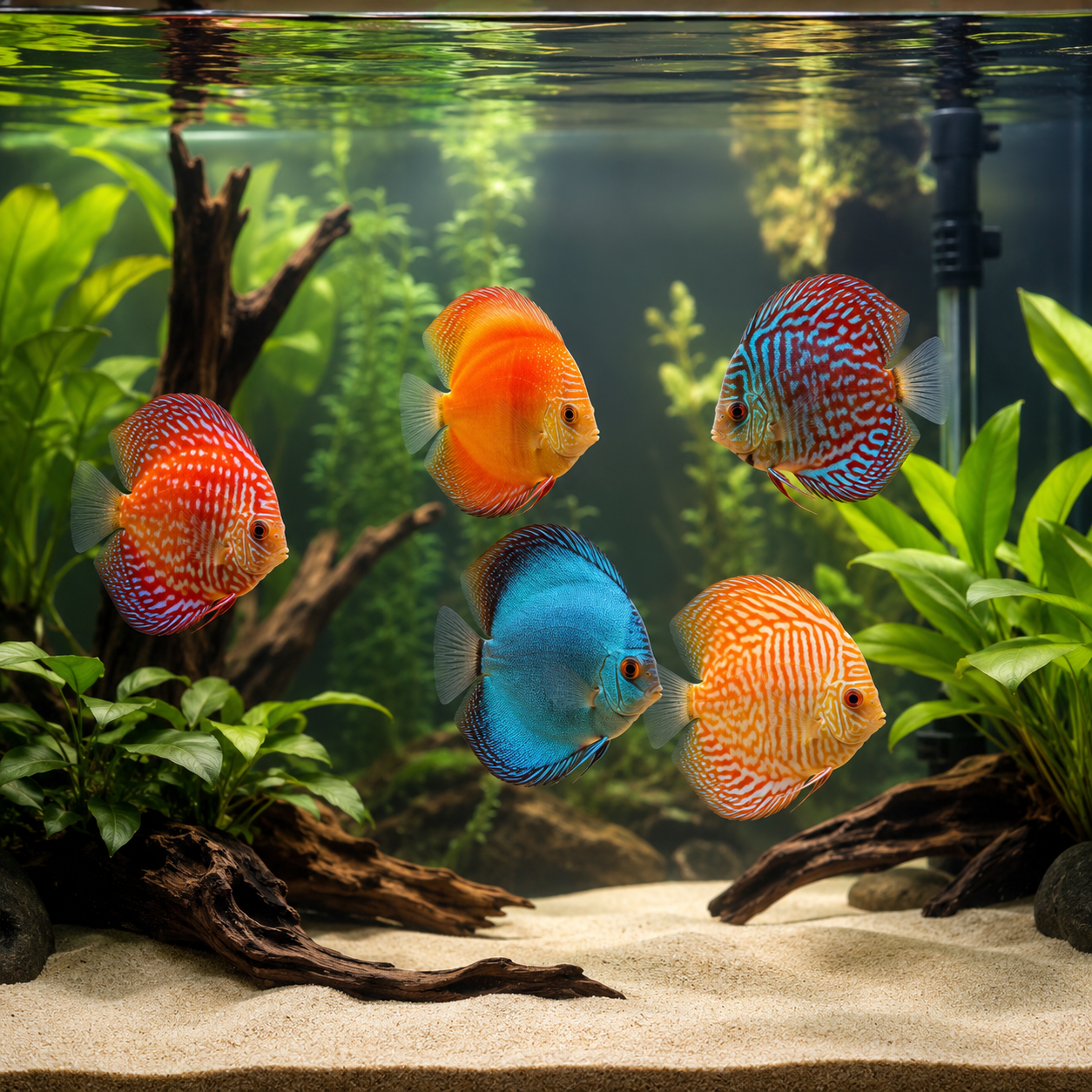
A planted discus tank with soft lighting, dark substrate, driftwood, and tall background plants like amazon sword and vallisneria is one of the most beautiful aquarium setups possible. Plants help process nitrate and create the natural blackwater aesthetic discus come from. Challenge: Plants require specific lighting and CO₂ that must be balanced against the already complex discus water chemistry.
Temperature: 28–31°C is essential. In Singapore's warm climate, the ambient temperature is often 27–30°C — a heater is still needed to maintain consistency, particularly in air-conditioned rooms.
Water Parameters: The Non-Negotiables
- Temperature: 28–31°C. Below 27°C, discus become susceptible to illness.
- pH: 5.5–7.0. Wild-caught discus need closer to 5.5–6.0; captive-bred discus can tolerate up to 7.0.
- Hardness: Very soft water preferred — 1–8 dGH. Singapore tap water (moderately hard, pH 7.5–8.5) must be modified. Mixing RO (reverse osmosis) water with tap water in a 70/30 or 80/20 ratio is the standard approach for Singapore discus keepers.
- Ammonia: 0 ppm
- Nitrite: 0 ppm
- Nitrate: Below 20 ppm; many discus keepers target below 10 ppm
Water change frequency: Many serious discus keepers perform 30–50% water changes daily, or at minimum 3–4 times per week. Daily changes are particularly important for heavily fed discus.
For the nitrogen cycle fundamentals, see How to Cycle a Fish Tank.
Sourcing Discus
This matters more for discus than almost any other fish. Discus from good breeders are healthier, better conditioned to local water, and more likely to feed readily.
Options in Singapore:
- Local breeders (available through aquarium hobbyist communities and online groups) — preferred; fish are already acclimatised to local water
- Specialist discus shops
- Imports from Thailand, Malaysia, and Germany — common source of high-quality strains
Avoid purchasing discus from general fish shops where they are kept with other species — cross-contamination risk is high and conditions are often suboptimal.
Quarantine all new discus, without exception, for a minimum of 4 weeks before introducing them to an established display tank. See How to Quarantine New Aquarium Fish.
Feeding Discus
Discus are slow, methodical feeders that need high-protein food multiple times daily.
Recommended foods:
- Discus beef heart mix — the traditional staple; handmade or commercially available frozen patties of beef heart blended with other proteins and nutrients
- Frozen bloodworms — a favourite; feed daily
- Frozen brine shrimp — accepted readily; colour-enhancing
- Freeze-dried foods — convenient but ensure the brand is reputable
- High-quality discus pellets — some strains accept pellets; others refuse them
Feeding schedule: Three to five small feedings per day for adult discus; juvenile discus need even more frequent feeding for proper growth.
Critical: Remove all uneaten food within 5–10 minutes. Uneaten food in a warm, high-temperature discus tank decomposes rapidly and crashes water quality.
For general feeding guidance, see How Much and How Often Should You Feed Aquarium Fish?.
Discus Varieties and Colours
Selective breeding has produced an enormous number of colour strains:
- Red varieties: Red melon, red turquoise, pigeon blood
- Blue varieties: Royal blue, cobalt blue, blue diamond
- Green varieties: Green discus, Heckel discus (wild-type)
- Pattern varieties: Snakeskin (intricate pattern), turquoise (blue-green grid pattern)
- High-body discus — selectively bred for a rounder, taller body
Compatible Tankmates
Most fish cannot tolerate the high temperature and specific conditions discus require. Suitable companions are limited:
Suitable:
- Cardinal tetras — actually thrive at discus temperatures and complement them visually
- Sterbai corydoras — one of the few cory species that tolerates 28–30°C; Cory Catfish Care Guide
- Rummy-nose tetras
- Otocinclus catfish
- Altum angelfish (advanced; not recommended with regular angelfish)
- Ram cichlids (Mikrogeophagus ramirezi)
Avoid:
- Regular angelfish — may bully discus or compete for food
- Any boisterous, fast-moving, or aggressive fish
- Cold-water species
- Fish that carry diseases discus are susceptible to (all new fish must be quarantined)
Frequently Asked Questions
Are discus really that difficult? Yes — but "difficult" is better framed as "demanding of consistency." Discus do not tolerate shortcuts: skipped water changes, overfeeding, fluctuating temperature, or improper water chemistry all lead to health decline. For a hobbyist prepared to commit to the routine, the difficulty becomes manageable.
Can discus live in Singapore tap water? Not ideally. Singapore tap water is too hard and too alkaline for optimal discus health. Most serious Singapore discus keepers use RO water mixed with tap water to achieve the soft, slightly acidic water discus prefer.
How many discus should I keep? A minimum of four to six. Discus are social fish that form hierarchies. Fewer than four leads to one fish becoming persistently bullied. Six or more allows hierarchy to distribute and reduces individual stress.
What is the white film on my discus? A white or grey mucous coating on discus skin is a stress response — often triggered by new tank syndrome (uncycled or unstable water), temperature fluctuations, or disease. Check all water parameters immediately and increase water change frequency.
Is discus keeping worth the effort? For hobbyists who genuinely engage with the challenge, yes — discus are extraordinary fish with a visual impact no other freshwater species matches. But they require a meaningful commitment of time, money, and attention that not everyone is in a position to make.