
Cory Catfish Care Guide: The Peaceful Bottom-Dweller Every Community Tank Needs
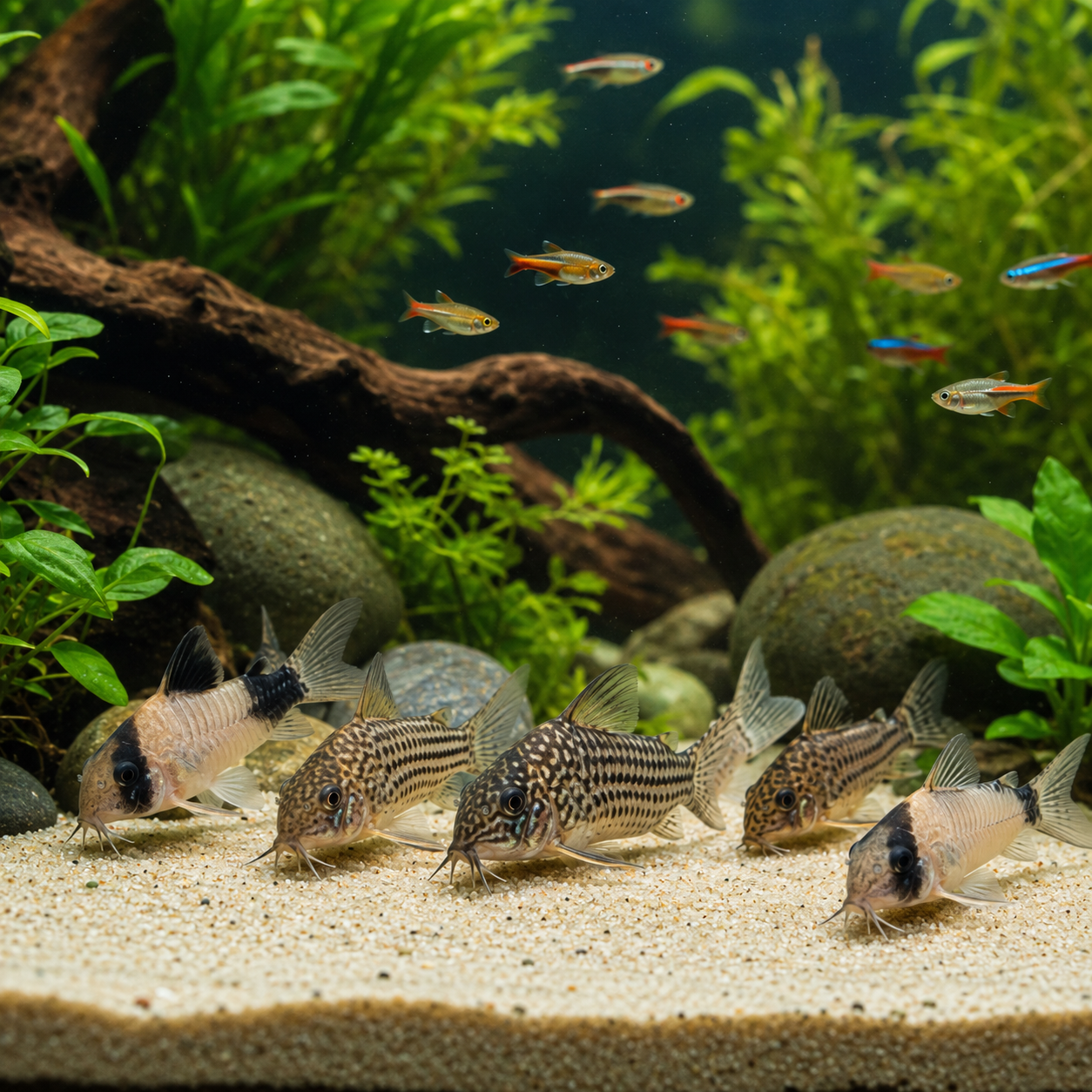
Corydoras catfish — universally known as "corys" — are among the most beloved fish in the freshwater hobby. Small, peaceful, sociable, and perpetually busy scavenging across the tank floor, they add life and utility to any community setup. They are also genuinely good-looking: many species carry attractive patterns of spots, stripes, and metallic sheen that make them worth watching even without the cleanup benefit.
This guide covers everything you need to know to keep corydoras catfish healthy and thriving in a freshwater community aquarium.
Quick Reference: Cory Catfish Care at a Glance
| Parameter | Ideal Range |
|---|---|
| Tank size (minimum) | 40 litres |
| Temperature | 22–26°C |
| pH | 6.0–7.5 |
| Hardness (GH) | 2–12 dGH |
| Diet | Omnivore — sinking pellets, frozen foods, vegetables |
| Adult size | 2.5–7 cm (species dependent) |
| Group size (minimum) | 4–6 of the same species |
| Lifespan | 5–15 years |
Why Every Community Tank Needs Corydoras
Corydoras occupy the bottom of the tank — a zone often neglected by other community fish. They serve several valuable functions:
- Scavenging: Corys pick up uneaten food that sinks to the substrate, reducing decomposition and the ammonia it would otherwise produce
- Substrate aeration: Their burrowing and foraging activity gently disturbs the top layer of substrate, preventing anaerobic pockets
- Visual interest: A group of corys moving in coordinated bursts across a sandy bottom is genuinely captivating
- Indicator species: Corys are sensitive to poor water quality — if they show signs of stress, it often indicates a developing water quality problem before other fish are visibly affected
Popular Cory Catfish Species
Bronze Corydoras (Corydoras aeneus)
The most widely available species. Robust, adaptable, and suitable for beginners. Metallic golden-green sheen on the upper body.
- Adult size: 6–7 cm
- Ideal for: 40+ litre community tanks
Peppered Corydoras (Corydoras paleatus)
Cool-water tolerant — one of the few corydoras species that can coexist with goldfish. Attractive grey-green mottled pattern.
- Adult size: 5–6 cm
- Ideal for: Cooler community tanks (20–24°C)
Pygmy Corydoras (Corydoras pygmaeus)
One of the smallest corydoras at just 2.5–3 cm. Unlike most corys, pygmy corys are mid-water swimmers as well as bottom-dwellers. Excellent for nano tanks.
- Adult size: 2.5–3 cm
- Ideal for: Nano tanks from 20 litres; small community setups
Sterbai Corydoras (Corydoras sterbai)
Highly sought after for its bold spotted pattern and orange pectoral fins. One of the few corydoras species that tolerates warmer temperatures — ideal for tanks kept at 27–29°C.
- Adult size: 6–7 cm
- Ideal for: Discus tanks, warmer community setups
Panda Corydoras (Corydoras panda)
Attractive black-and-white panda-like markings. Slightly more delicate than bronze corys but rewarding to keep.
- Adult size: 4–5 cm
- Ideal for: Planted community tanks
Julii Corydoras (Corydoras julii)
Fine spotted pattern over a pale silver base. Frequently confused with the three-stripe cory (C. trilineatus), which is more commonly sold under the julii name.
- Adult size: 5–6 cm
Tank Setup for Corydoras
Substrate — The Most Critical Factor
Corydoras have delicate barbels (whisker-like sensory organs) on their lower jaw that they use to forage in substrate. Sharp or coarse gravel damages these barbels, leaving them shortened or infected — a clear sign of unsuitable substrate.
Best substrates for corys:
- Fine sand — the gold standard; corys dig and sift naturally through it
- Smooth, fine-grain gravel — acceptable if particles are small and rounded
- Aqua soil — fine enough for most species; good for planted setups
Avoid: Sharp-edged gravel, large-grain gravel, or any substrate with jagged particles.
For a full guide to choosing substrate, see Aquarium Substrate Guide.
Filtration
Corys prefer moderate, gentle water flow. A sponge filter or a hang-on-back filter with a pre-filter sponge on the intake works well. Bare filter intakes can trap and injure small fish, including corydoras.
Decoration
Corys feel more secure with hiding places — smooth driftwood, caves formed by smooth rocks, or dense plant cover at the tank base. Java moss on the tank floor gives them cover and foraging material.
Temperature in Singapore
Most corydoras species prefer 22–26°C, which is slightly cooler than Singapore's ambient room temperature of 27–30°C. Sterbai corydoras and bronze corydoras tolerate the warmer end of this range. If your tank runs consistently warm, choose sterbai or bronze corys rather than temperature-sensitive species like panda or peppered corydoras.
Feeding Corydoras
Corys are bottom-feeders and cannot access food that floats or that midwater fish consume before it sinks. Feed specifically for bottom-dwellers:
Best foods for corydoras:
- Sinking algae wafers — widely available and eagerly eaten
- Sinking catfish pellets — nutritionally balanced and sink immediately
- Frozen bloodworms — place at the bottom or use a feeding cone; a real favourite
- Frozen brine shrimp — smaller species enjoy these
- Blanched vegetables: cucumber, zucchini, peas (remove skins) — occasional treat
Feeding frequency: Once daily, in the evening (corys are more active at night). Ensure sinking food reaches the bottom before midwater fish consume it — turn off strong flow briefly during feeding if necessary.
For more on aquarium fish feeding, see How Much and How Often Should You Feed Aquarium Fish?.
Social Behaviour and Group Size
Corydoras are highly social fish that must be kept in groups of at least four to six individuals of the same species. Lone corys or pairs are stressed, tend to hide constantly, and often decline in health over months.
A group of corydoras in a well-maintained tank displays fascinating social behaviour: they forage together in coordinated bursts, rest in contact with one another, and engage in what appears to be play. In good breeding conditions, males will pursue females in a classic T-formation spawning embrace.
Corydoras from different species do not school together but can coexist peacefully. Housing six bronze corys alongside four peppered corys in a 90-litre tank, for example, is entirely workable.
Compatible Tankmates
Corydoras are among the most universally compatible fish in the hobby. Their peaceful nature, small size, and bottom-dwelling lifestyle means they coexist with almost everything:
Excellent tankmates:
- Neon tetras, cardinal tetras, ember tetras — Neon Tetra Care Guide
- Guppies, platies, and mollies — Guppy Care Guide
- Harlequin rasboras
- Dwarf gouramis
- Cherry shrimp and Amano shrimp (corys generally ignore shrimp)
- Male bettas (corys are too armoured and peaceful to trigger betta aggression)
- Otocinclus catfish
Avoid:
- Oscars and other large predatory cichlids
- Any fish large enough to swallow a cory whole
- Aggressive species that may nip at the cory's unprotected eyes or fins
Corydoras Health
Barbel Erosion
Shorter or deteriorating barbels indicate unsuitable substrate (too sharp or coarse), poor water quality, or bacterial infection. Switch to fine sand and improve water quality — barbels can regrow in clean conditions.
Red Blotch Disease
Red patches on the body or around the face indicate a bacterial infection, usually related to water quality. Treat with a broad-spectrum antibacterial medication and perform large water changes.
Ich (White Spot)
Corydoras are susceptible to ich. Standard ich treatment works but use half-dose copper-based medications as catfish can be sensitive to copper.
Frequently Asked Questions
How many corydoras should I keep? A minimum of four to six of the same species. More is always better for their wellbeing — a group of eight to ten shows the most natural, active behaviour.
Can corydoras clean the tank? Corys are scavengers, not cleaners. They help by consuming uneaten food, but they produce waste themselves and cannot substitute for regular water changes and gravel vacuuming.
Do corydoras need a heater in Singapore? Most corydoras species prefer cooler water (22–26°C) than Singapore's typical ambient room temperature. They can tolerate warmer conditions, but if your tank runs above 28°C consistently, choose sterbai or bronze corydoras, which are the most heat-tolerant species.
Can I mix different cory species? Yes — different cory species coexist peacefully. They will not school together as a mixed group but will forage alongside each other without aggression. Ensure each species has at least four individuals.
How long do corydoras live? With excellent care, bronze corydoras and peppered corydoras can live 10–15 years. Even the average lifespan with good care is 5–10 years — they are long-term companions in the hobby.