

Aquarium Substrate Guide: Gravel, Sand, Soil, and Planted Tank Substrates Explained
Substrate is the material that covers the bottom of your aquarium — and while it might seem like a simple aesthetic choice, it significantly affects plant growth, fish health, water chemistry, and the practical day-to-day experience of maintaining your tank.
Choosing the right substrate before setting up a tank is far easier than replacing it later (a process that requires completely breaking down the aquarium). This guide explains the main substrate types, their advantages and disadvantages, and which suits different setups.
Why Substrate Matters
For fish:
- Bottom-dwelling species like corydoras and kuhli loaches require soft, smooth substrate to protect their delicate barbels
- Some species burrow into substrate (loaches, some cichlids) and need adequate depth
- Fish behaviour and stress levels are affected by substrate colour — many fish feel more exposed over white or very light substrate
For plants:
- Root-feeding plants (amazon sword, cryptocoryne, vallisneria) require nutrient-rich substrate or supplementation with root tabs
- Some substrates are inert (provide no nutrients); others actively release nutrients into the water column
- Substrate depth affects root development — planted tanks typically need 5–7 cm
For water chemistry:
- Some substrates (crushed coral, certain limestones) release minerals and raise pH and hardness
- Aqua soils typically lower pH and soften water — ideal for soft-water fish and plants, but requiring management in alkaline-water setups
- Inert substrates (most commercial gravels, fine sand) do not affect water chemistry
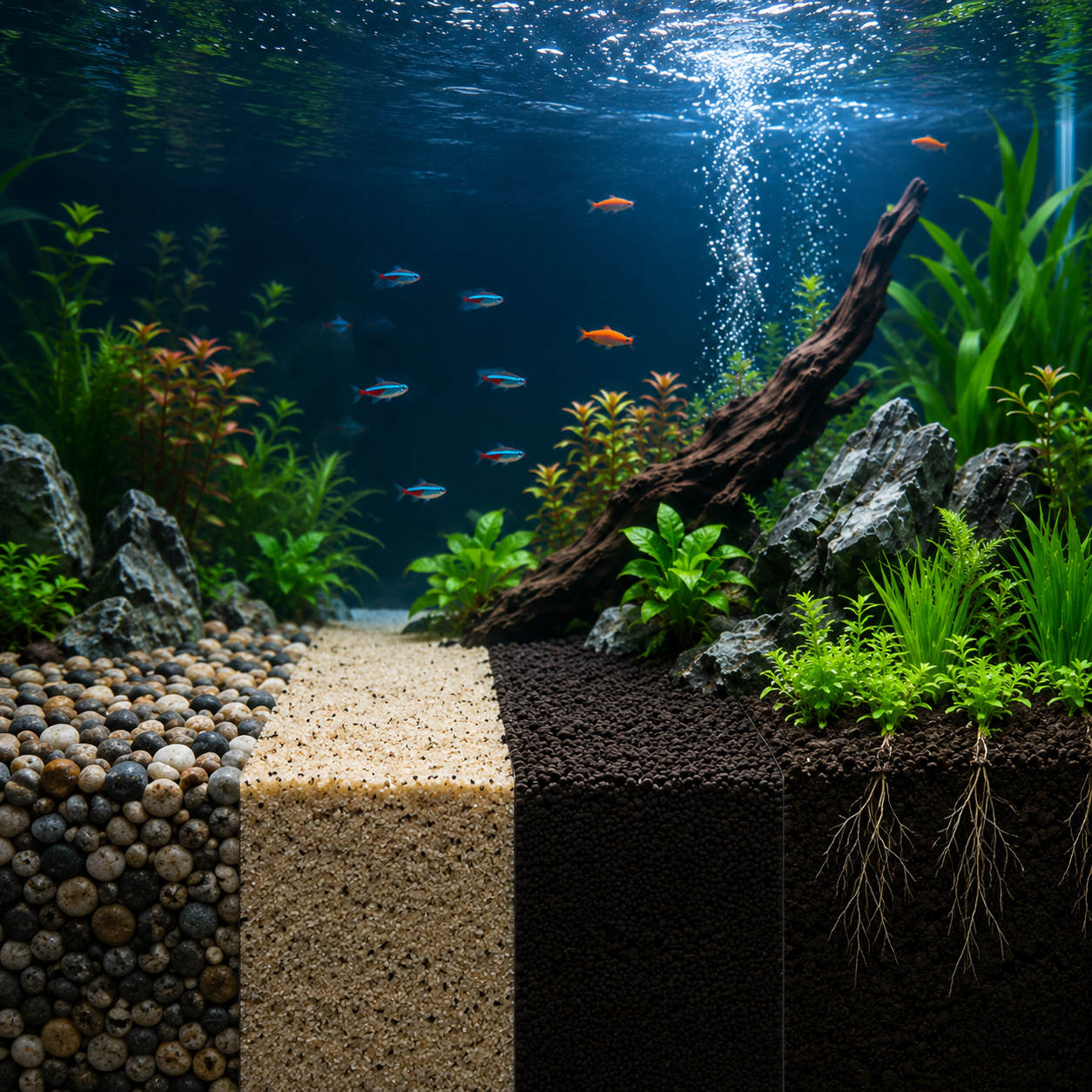
Gravel
Best for: Fish-only tanks; beginner setups; cichlid tanks; tanks where plants will be grown in pots
Gravel is the classic aquarium substrate — widely available, inexpensive, and available in dozens of colours and sizes. For most beginner fish-only tanks, plain natural-coloured gravel (2–5 mm grain size) is a perfectly adequate choice.
Types:
- Natural gravel (pea gravel): Smooth, rounded stones; suitable for most fish including corydoras if grain size is small enough
- Coarse aquarium gravel: Standard fish shop variety; practical and easy to vacuum
- Coloured gravel: Dyed or coated gravel in various colours; some cheap brands leach dye over time — buy reputable brands
- Crushed coral gravel: Raises pH and hardness significantly; suitable only for alkaline-water fish (African cichlids, mollies, goldfish)
Advantages:
- Inexpensive
- Easy to vacuum (detritus sits on top; not drawn into the substrate like sand)
- Widely available
- Durable and long-lasting
Disadvantages:
- Provides no plant nutrients — root-feeding plants require root tabs
- Coarse gravel injures corydoras barbels — use fine smooth gravel or switch to sand if keeping corydoras
- Some colour choices look unnatural and can increase fish stress
- Large gravel gaps trap debris that decomposes and releases ammonia
Grain size recommendation: 2–4 mm for most setups; 1–2 mm for tanks with corydoras or other delicate bottom-dwellers.
Sand
Best for: Corydoras tanks; bichir and loach tanks; natural-looking biotope setups; planted tanks as a top layer over soil
Fine sand is the gold standard substrate for any tank housing bottom-dwelling fish that sift or burrow. Corydoras in particular are significantly healthier and more active over sand, where their barbels can develop normally.
Types:
- Pool filter sand / play sand: Widely available and inexpensive; rinse very thoroughly before use (releases lots of fine particles)
- Fine aquarium sand: Pre-rinsed, packaged sand from aquarium brands; convenience at a higher cost
- Black sand: Natural or coated; darkens the tank aesthetically; vivid fish colours against dark substrate
- White/sugar sand: Very bright; can cause stress in many fish species that feel exposed against light substrate
Advantages:
- Safest substrate for bottom-dwelling fish
- Natural, attractive appearance in the right colour
- Malaysian trumpet snails burrow through it, preventing anaerobic pockets
- Works well as a cap layer over aqua soil in planted tanks
Disadvantages:
- Compacts over time, creating anaerobic pockets if not stirred — requires MTS or regular disturbance
- Fine particles disturbed by burrowing fish or powerheads can get into filter intakes
- Harder to vacuum — the siphon pulls up sand along with detritus
- Does not provide plant nutrients
Depth: 3–5 cm is sufficient for most setups. Avoid very deep sand beds (over 7 cm) without active substrate inhabitants to prevent anaerobic zones.
For corydoras-specific substrate needs, see Cory Catfish Care Guide.
Aqua Soil (Planted Tank Substrate)
Best for: Planted tanks; shrimp tanks; soft-water biotope setups; serious planted aquariums
Aqua soil is a broad category of granular substrates made from baked clay, volcanic ash, or other organic-mineral compounds. The defining feature is that they are nutrient-rich — they actively release ammonia, minerals, and plant nutrients into the water. The leading brands include ADA Aqua Soil, Tropica Aquarium Soil, Fluval Stratum, and Controsoil.
Advantages:
- Rich in plant-available nutrients — significantly accelerates plant growth without root tabs
- Naturally lowers pH and softens water — ideal for soft-water plants and shrimp
- Fine granule size is gentle on bottom-dwelling fish and shrimp
- Dark colour (most brands) reduces fish stress and enhances colour display
Disadvantages:
- Releases ammonia into the water when new — requires a "new tank" period where ammonia spikes before the cycle stabilises. Never add fish immediately after adding fresh aqua soil.
- More expensive than gravel or sand
- Depletes nutrients over time (typically 12–24 months for the nutrient layer); eventually needs replacement or supplementation
- Lowers pH — unsuitable for fish that require alkaline conditions (mollies, goldfish, African cichlids)
- Cannot be vacuumed aggressively — the granules break down if heavily disturbed
How to use:
- Add 5–7 cm depth
- Fill with water and run the filter for 2–4 weeks before adding livestock (allow ammonia to cycle through)
- Or cycle the tank during the aqua soil's initial ammonia release — the cycling period and substrate conditioning happen simultaneously
For cycling guidance, see How to Cycle a Fish Tank. For shrimp tank setups, see Cherry Shrimp Care Guide.
Dirted Substrate (The Walstad Method)
A popular DIY alternative to commercial aqua soils. A layer of organic potting soil (without perlite, vermiculite, or fertilisers) is capped with a layer of sand or gravel. The organic soil releases nutrients slowly over years without the initial ammonia spike of commercial aqua soils.
Advantages: Very inexpensive; long-lasting nutrient supply; minimal maintenance once established
Disadvantages: Messy to set up; difficult to control initial water chemistry; requires an established cap layer to prevent soil particles from floating
Best for: Experienced planted tank hobbyists looking for a low-tech, low-cost long-term solution
Specialty Substrates
Crushed Coral
Raises pH and carbonate hardness significantly. Used specifically for African cichlid tanks, goldfish tanks, and tanks housing alkaline-water species. Not suitable for most tropical community fish or planted tanks.
Black Diamond Blasting Sand (BDBS)
An industrial abrasive sometimes used in aquariums due to its fine, dark grain. Very inexpensive. Does not affect water chemistry. Works well for bottom-dwelling fish and planted tanks with root tabs.
Inert Clay-Based Substrates
Some commercial substrates (e.g., Eco-Complete) are clay-based and provide a porous surface area for bacterial colonisation without releasing significant nutrients. A middle ground between plain gravel and nutritive aqua soil.
Substrate for Planted Tanks: A Layered Approach
For serious planted tanks, a layered substrate works well:
- Base layer: 3–4 cm of aqua soil or dirted substrate
- Mid layer (optional): Additional aqua soil or root tab zones
- Cap layer: 1–2 cm of fine sand or small gravel
The cap prevents substrate particles from floating and provides a surface for corydoras and shrimp to forage on, while the nutrient-rich base feeds plant roots.
For plant recommendations that work with different substrates, see Low-Maintenance Aquarium Plants for Beginners.
Frequently Asked Questions
How much substrate do I need? For a planted tank: 5–7 cm depth. For fish-only tanks: 3–5 cm. For corydoras: 3–5 cm of fine sand. As a rough calculation, 1 kg of substrate covers approximately 15–20 cm² at 5 cm depth.
Can I change my substrate without breaking down the tank? Possible but disruptive. The best approach is to do it in sections over several weeks, moving fish to a bucket temporarily and rinsing the new substrate before adding it. A full substrate change in an established tank disturbs the beneficial bacteria and triggers a partial cycle. Plan substrate choice carefully before setting up.
Does substrate colour affect fish? Yes. Most fish look more vivid and behave more naturally against darker substrate (black, natural brown, or dark grey). White or bright-coloured substrate increases reflectivity and can cause fish to appear stressed or washed out.
Is play sand from a hardware store safe for aquariums? Yes, if you rinse it very thoroughly. Rinse until the water runs completely clear — this takes multiple bucket changes and can take 30–60 minutes. Check that it contains no added salts, fertilisers, or coatings.
How do I vacuum sand without losing it in the siphon? Hold the siphon tube 2–3 cm above the sand surface and allow the water current to lift debris without touching the sand. With practice, you can effectively clean a sand substrate without removing significant amounts of sand.