

Guppy Care Guide: Tank Setup, Feeding, Breeding, and Tankmates
Guppies are often the first fish a new hobbyist ever keeps, and for good reason. They are forgiving of minor water quality lapses, available in an extraordinary range of colours and fin shapes, inexpensive to purchase, and genuinely entertaining to watch. A well-maintained guppy tank is one of the most rewarding setups in the freshwater hobby.
This guide covers everything you need to know to keep guppies healthy and thriving — from tank size and water parameters to feeding, breeding management, and choosing compatible tankmates.
Quick Reference: Guppy Care at a Glance
| Parameter | Ideal Range |
|---|---|
| Tank size (minimum) | 40 litres |
| Temperature | 24–28°C |
| pH | 6.8–7.8 |
| Hardness (GH) | 8–12 dGH |
| Diet | Omnivore — flake food, live/frozen supplements |
| Adult size | Males 3–4 cm, females 5–6 cm |
| Temperament | Peaceful |
| Lifespan | 2–3 years |
Tank Size and Setup
Guppies are small, but they are active swimmers and breed prolifically. A minimum of 40 litres is recommended for a small group of six to eight guppies. A 60-litre tank gives significantly more stability and room for additional tankmates.
In Singapore's tropical climate, ambient temperatures of 27–30°C during the day are usually suitable for guppies without a heater. However, if your home uses air-conditioning overnight, the tank may cool below 24°C — a small adjustable heater set to 26°C prevents this stress.
Ideal tank features for guppies:
- Dense planting (java moss, water wisteria, floating plants) for cover and fry hiding
- Gentle filtration — guppies prefer low flow; use a sponge filter or baffle a hang-on-back filter
- A tight-fitting lid — guppies are occasional jumpers, especially when startled
For general setup guidance, see The Complete Freshwater Aquarium Setup Guide.
Water Parameters
Guppies are adaptable, but they do best in slightly hard, neutral to alkaline water. Singapore's tap water, after dechlorination, is typically close to ideal — pH around 7.5 and moderate hardness.
Key points:
- Always dechlorinate tap water before adding it to the tank — Singapore water contains chlorine and chloramine
- Perform 25–30% water changes weekly to keep nitrate below 20 ppm
- Guppies tolerate a pH range of 6.8–7.8 but prefer the higher end of that range
For a full maintenance routine, see Aquarium Maintenance Schedule for Beginners.
Feeding Guppies
Guppies are omnivores with a preference for small, protein-rich foods. Their mouths are small and upward-facing — they feed best at or near the water surface.
Recommended diet:
- High-quality flake food as the staple — look for a product with a protein source as the first ingredient
- Micro pellets — useful for more precise feeding
- Frozen bloodworms — excellent protein supplement; feed 2–3 times per week
- Frozen brine shrimp — promotes colour vibrancy and is eagerly eaten
- Daphnia — good for digestive health
- Spirulina flakes — beneficial for female guppies during pregnancy
Feeding frequency: Once or twice daily, only what the fish consume within 2–3 minutes. Remove uneaten food promptly.
Overfeeding is one of the most common causes of water quality problems. For guidance on correct feeding amounts, see How Much and How Often Should You Feed Aquarium Fish?.
Understanding Guppy Varieties
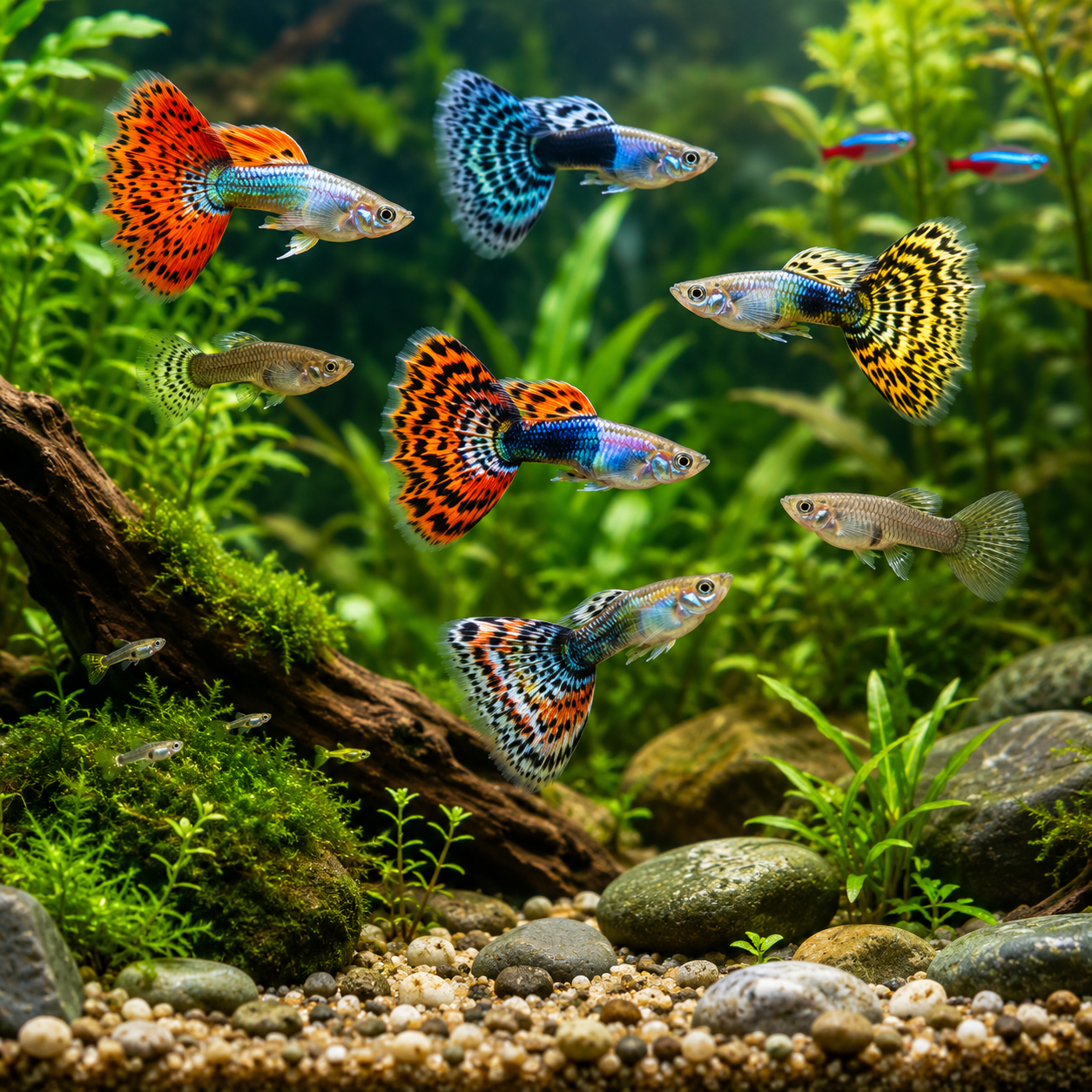
Guppies have been selectively bred for decades, resulting in an enormous range of tail shapes, fin types, and colour patterns:
By tail shape:
- Fantail / delta tail — broad, triangular tail; very common
- Lyretail — forked tail with elongated tips
- Swordtail — single elongated lower or upper tail ray
- Roundtail — compact, circular tail
- Moscow guppy — large, solid-coloured varieties
By colour: Virtually every colour of the rainbow is represented — solid red, blue, yellow, green, black, and multicoloured patterns including cobra, tuxedo, and mosaic variants.
Females are typically larger but far less colourful — they are grey-brown with clear or slightly coloured fins. This sexual dimorphism makes sexing guppies straightforward.
Guppy Breeding
Guppies are livebearers — females give birth to live, free-swimming fry rather than laying eggs. They are extraordinarily prolific. A single female can give birth to 20–60 fry every 28–30 days, and she can store sperm from a single mating to fertilise multiple subsequent batches.
The breeding process:
- A male courts the female with displays and persistent following
- The male delivers sperm via his gonopodium (modified anal fin)
- The female's abdomen expands gradually — the dark gravid spot near the anal fin darkens as birth approaches
- Birth occurs over several hours; the female may hide during delivery
- Fry are immediately free-swimming and instinctively seek cover
Managing guppy breeding:
If you do not want large numbers of fry:
- Keep only males (a single-sex male tank is colourful and peaceful)
- Keep a heavily planted tank — fry naturally hide but some predation by adults occurs
- Separate pregnant females into a breeding box before birth (note: breeding boxes cause stress and should be used minimally)
If you want to raise fry:
- Dense java moss or floating plants give fry the best survival chance in a community tank
- Separate fry into a grow-out tank and feed micro foods: powdered fry food, infusoria, or crushed flake
Compatible Tankmates
Guppies are peaceful community fish that coexist well with many species. Avoid tankmates large enough to eat them or aggressive enough to nip their flowing fins.
Excellent tankmates:
- Neon tetras and ember tetras — see Neon Tetra Care Guide
- Corydoras catfish — see Cory Catfish Care Guide
- Platies and mollies — fellow livebearers with similar requirements
- Harlequin rasboras
- Otocinclus catfish
- Nerite snails and mystery snails
- Cherry shrimp (if the tank is well planted)
Avoid:
- Male bettas (will attack guppies, particularly males with flowing fins)
- Tiger barbs (persistent fin nippers)
- Angelfish (may eat guppy fry and juveniles)
- Any large, predatory, or aggressive fish
For a complete guide to combining species, see Freshwater Community Tank Compatibility Guide.
Common Health Problems
| Problem | Signs | Cause / Solution |
|---|---|---|
| Fin rot | Ragged, disintegrating fins | Poor water quality; treat with water changes + antibacterial medication |
| White spot (ich) | White grains on fins and body | Parasitic infection; raise temperature to 28°C + ich medication |
| Wasting disease | Weight loss despite eating | Internal parasites; treat with antiparasitic food |
| Dropsy | Swollen abdomen, raised scales | Internal bacterial infection; difficult to treat; isolate fish |
| Swim bladder issues | Floating upside down or sinking | Constipation or injury; fast for 2–3 days then feed daphnia |
Good water quality prevents the majority of guppy health problems. The most important intervention is consistent weekly water changes.
Frequently Asked Questions
How many guppies can I keep in a 40-litre tank? A group of six to eight guppies (mixed sex) is appropriate for a 40-litre tank. If keeping all males, eight to ten is feasible. Account for potential fry if keeping mixed sexes.
Can I keep only male guppies? Absolutely — an all-male tank is a popular choice that avoids the population explosion of mixed-sex keeping. Males are the colourful ones, and a well-chosen group of different colour varieties in a 40-litre tank is visually stunning.
How long are guppies pregnant? The gestation period is approximately 21–30 days depending on temperature — warmer water shortens it. The gravid spot (dark patch near the anal fin) darkens and the abdomen becomes noticeably boxy as birth approaches.
Do guppies eat their fry? Adult guppies may eat fry if given the opportunity. Dense planting with java moss or floating plants gives fry places to hide and significantly improves survival rates in a community tank.
Do I need a heater for guppies in Singapore? During the day, Singapore's ambient temperature is usually sufficient. If air-conditioning runs through the night and cools your home below 24°C, a heater set to 26°C is advisable. Consistent temperature matters more than the exact value.