

Molly Fish Care Guide: Tank Size, Water Parameters, Diet, and Breeding
Mollies (Poecilia sphenops and related species) are enduring favourites in the freshwater hobby — and for good reason. They are hardy, available in a spectacular range of colour morphs, compatible with a wide variety of community fish, and interesting to watch as they graze continuously on algae and biofilm between meals. They are livebearers like guppies, giving birth to live, free-swimming fry, which adds a fascinating dimension to keeping them.
This guide covers everything you need to set up a successful molly tank, feed them well, manage breeding, and keep them in peak health.
Quick Reference: Molly Fish Care at a Glance
| Parameter | Ideal Range |
|---|---|
| Tank size (minimum) | 60 litres |
| Temperature | 24–28°C |
| pH | 7.5–8.5 |
| Hardness (GH) | 10–25 dGH (prefer hard water) |
| Diet | Omnivore — flake, algae, live/frozen supplements |
| Adult size | Males 6–8 cm, females 8–10 cm |
| Temperament | Generally peaceful; males may harass females |
| Lifespan | 3–5 years |
Molly Fish Varieties
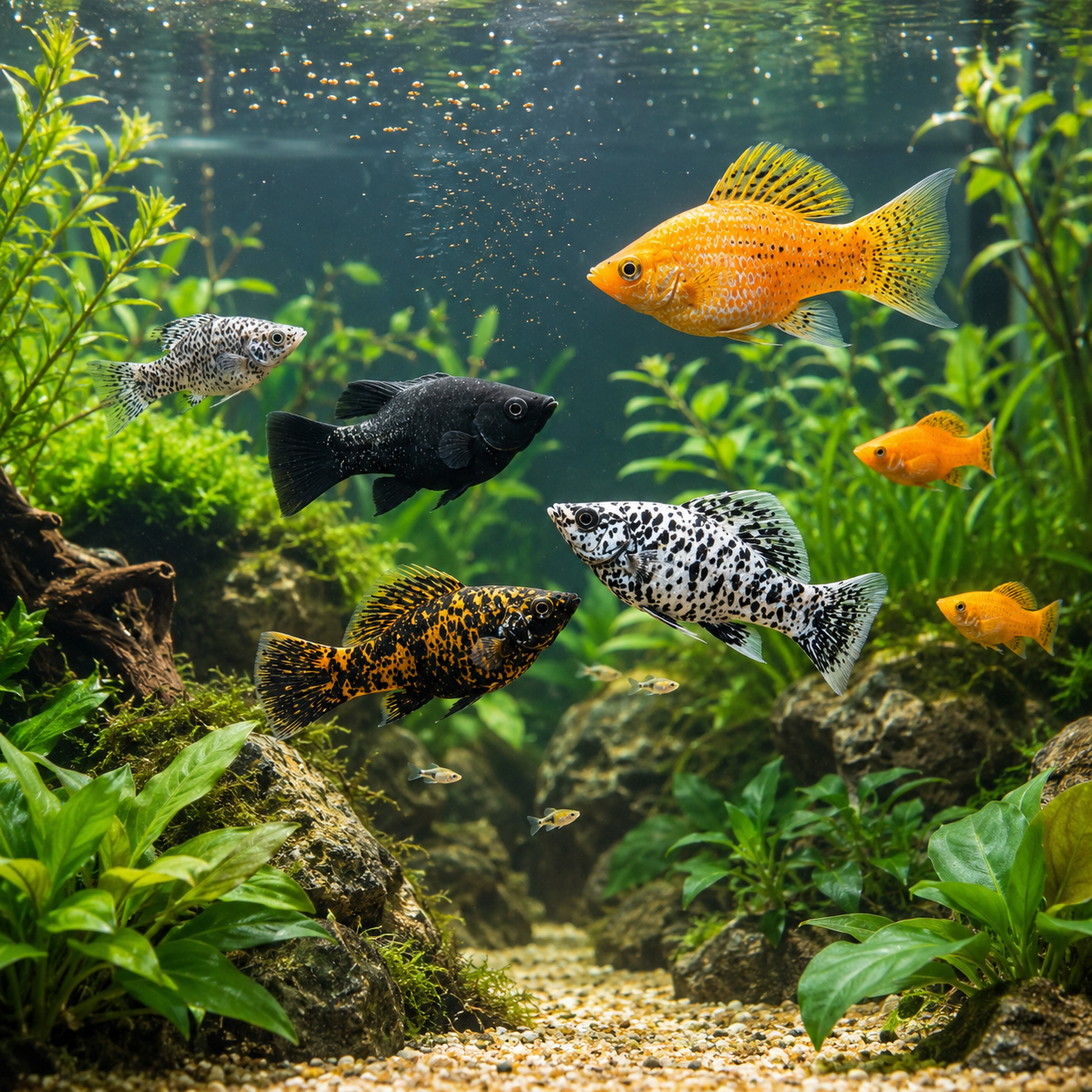
Mollies have been selectively bred into numerous striking colour forms. The most commonly available include:
- Black molly — solid velvety black; one of the most striking fish in the hobby
- White or silver molly — bright white with clear fins
- Dalmatian molly — white body with irregular black spots
- Gold molly — bright yellow-orange
- Sailfin molly (Poecilia latipinna) — males develop a dramatically enlarged dorsal fin; require more space
- Balloon molly — bred with a shortened, rounded body; somewhat controversy exists around the health implications of this body form
- Lyretail molly — elongated tail rays; available in various colour morphs
Tank Size and Setup
Mollies are larger than guppies and more active. A minimum of 60 litres is recommended for a small group of three to five mollies. Sailfin mollies, which grow larger, need at least 90 litres.
Ideal setup features:
- Moderate to strong filtration — mollies produce considerable waste relative to their size
- Hard, alkaline water — see water parameters below
- Algae growth on surfaces is beneficial — mollies graze on biofilm and algae between feedings
- Live plants provide cover, though mollies will nibble on tender plants; choose hardy species like java fern, anubias, or hornwort
- Open swimming space alongside areas of cover
For general setup guidance, see The Complete Freshwater Aquarium Setup Guide.
Water Parameters
Mollies have more specific water requirements than many beginner fish. They are one of the few freshwater fish that genuinely prefer hard, alkaline water — and they can even tolerate brackish conditions (lightly salted water).
Key requirements:
- pH: 7.5–8.5 — they struggle in soft, acidic water
- Hardness: Prefer hard water, 10–25 dGH
- Temperature: 24–28°C; comfortable in Singapore's ambient range
- Salt: Many experienced molly keepers add a small amount of aquarium salt (1–2 teaspoons per 10 litres) — it reduces osmotic stress and can help with some disease conditions. This is optional but beneficial.
Singapore tap water is moderately hard and has a pH of 7.5–8.5 out of the tap — close to ideal for mollies after dechlorination. This makes mollies a particularly suitable choice for Singapore aquarists who do not want to adjust water chemistry.
Always cycle the tank before adding mollies. See How to Cycle a Fish Tank for details.
Feeding Mollies
Mollies are omnivores with a strong preference for plant matter and algae. Unlike purely carnivorous fish, they need vegetable matter in their diet for optimal health.
Recommended diet:
- Algae-based flake food or spirulina flakes as the primary staple
- Standard flake food — supplement alongside algae flakes
- Algae wafers — mollies will share these with corydoras and plecos
- Blanched vegetables: zucchini, cucumber, spinach, lettuce — provide 2–3 times per week
- Frozen brine shrimp and bloodworms — protein supplements, 2–3 times per week
- Live or frozen daphnia — good for digestive health
Feeding frequency: Once or twice daily. Mollies are grazers and will supplement their diet with tank algae between feedings — this is healthy and natural.
See How Much and How Often Should You Feed Aquarium Fish? for general guidance.
Social Dynamics and Male-to-Female Ratio
Molly males relentlessly pursue females for mating. In a small tank with equal numbers or more males than females, females become chronically stressed — refusing food, hiding, and developing health problems.
Recommended ratio: Two to three females per male. This distributes male attention and allows females rest periods.
In practice, if you want to avoid breeding altogether, keep only females or only males. An all-female molly tank is peaceful and colourful. An all-male tank may have occasional sparring displays but generally remains manageable.
Molly Fish Breeding
Mollies are livebearers — females give birth to 20–100 live fry approximately every 28–40 days. Like guppies, they store sperm from a single mating and can produce multiple batches without re-mating.
Signs of impending birth:
- Gravid spot (dark patch near anal fin) becomes very dark
- Abdomen becomes noticeably squared off
- Female becomes less active and may seek cover
- Birth usually occurs over several hours
Fry management:
- Fry are large enough that adults in a community tank rarely eat them all — a heavily planted tank with floating plants provides enough cover for some to survive
- Separate fry into a grow-out tank if you want maximum survival
- Feed fry crushed flake food, micro pellets, or powdered fry food; they are robust and easy to raise
Population control is a real consideration with mollies — a single female can produce hundreds of fry per year. Plan accordingly: know where surplus fish will go (other hobbyists, local fish shops, or as live food for larger fish).
Compatible Tankmates
Mollies are generally peaceful community fish, though males may occasionally chase each other or harass smaller fish.
Excellent tankmates:
- Guppies and platies — see Guppy Care Guide and Platy Fish Care Guide
- Corydoras catfish (ensure pH compatibility — use hardier species like bronze corydoras)
- Swordtails
- Harlequin rasboras
- Larger tetras (black skirt tetras, congo tetras)
- Nerite snails — excellent algae management partners
Avoid:
- Neon tetras and small, delicate fish (mollies may bully or nip at them)
- Bettas (fins at risk; bettas may also attack mollies)
- Aggressive or territorial cichlids
- Soft-water species that cannot tolerate the alkaline conditions mollies require
Common Health Problems
| Problem | Signs | Cause / Solution |
|---|---|---|
| Molly disease (shimmying) | Side-to-side shimmying without moving forward | Salt deficiency, low temperature, or poor water quality; add aquarium salt, raise temperature slightly |
| Fin rot | Ragged fins with dark or red edges | Bacterial infection; water changes + antibacterial treatment |
| Ich | White spots on fins and body | Raise temperature to 28°C; ich medication |
| Constipation | Bloated abdomen, stringy white faeces | Insufficient plant matter in diet; fast for 2–3 days then feed daphnia or blanched peas |
Frequently Asked Questions
Why is my molly shimmying? Shimmying (side-to-side rocking movement without swimming forward) is a classic molly stress response. Common causes include cold water, low mineral content in the water, or poor water quality. Raise temperature slightly, add a small amount of aquarium salt, and check water parameters.
Can mollies live with guppies? Yes — mollies and guppies have similar water requirements and coexist peacefully. They can even hybridise occasionally, producing "muppies" or "gollies" that are usually sterile.
How many mollies can I keep in a 60-litre tank? A trio (one male, two females) plus some community tankmates is a comfortable stocking level for a 60-litre tank. A larger group requires a larger tank.
Do mollies need salt in their water? Salt is beneficial but not strictly required. Many mollies thrive in freshwater without added salt. However, if mollies show chronic stress symptoms (shimmying, disease susceptibility), adding 1–2 teaspoons of aquarium salt per 10 litres often resolves the issue.
How often do mollies give birth? Approximately every 28–40 days, depending on temperature (warmer water shortens the cycle). A healthy female can produce multiple batches per year from a single mating.