

Platy Fish Care Guide: Easy, Colorful Fish for Beginner Aquariums
Platies (Xiphophorus maculatus and Xiphophorus variatus) are one of the most recommended beginner fish in the freshwater hobby — and genuinely deserve that reputation. They are robust, peaceful, colourful, and easy to feed. They tolerate a wide range of water conditions, breed readily, and get along with most community fish. If guppies are the default beginner fish, platies are the equally excellent alternative that is sometimes overlooked.
This guide covers everything needed to keep platies successfully — from tank setup and water parameters to feeding, breeding, and choosing the right tankmates.
Quick Reference: Platy Fish Care at a Glance
| Parameter | Ideal Range |
|---|---|
| Tank size (minimum) | 40 litres |
| Temperature | 18–28°C |
| pH | 7.0–8.3 |
| Hardness (GH) | 10–28 dGH |
| Diet | Omnivore — flake, algae, vegetables, live/frozen |
| Adult size | Males 4–5 cm, females 5–7 cm |
| Temperament | Peaceful |
| Lifespan | 3–5 years |
Why Choose Platies?
Platies sit in a similar niche to guppies and mollies but have some distinct advantages:
- Wider temperature tolerance: Platies tolerate temperatures from 18°C to 28°C, making them compatible with a broader range of setups
- Prefer harder, alkaline water: Singapore's tap water (pH 7.5–8.5) suits them very well without adjustment
- Less harassment: Male platies are less relentlessly persistent in pursuing females compared to male guppies
- Hardier fry: Platy fry are born larger and more robust than guppy fry, with better survival rates in a community tank
- No fin-length issues: Unlike fancy guppies, platies have no delicate flowing fins to worry about with potential fin-nippers
Popular Platy Varieties
Platies have been selectively bred into dozens of colour and pattern combinations:
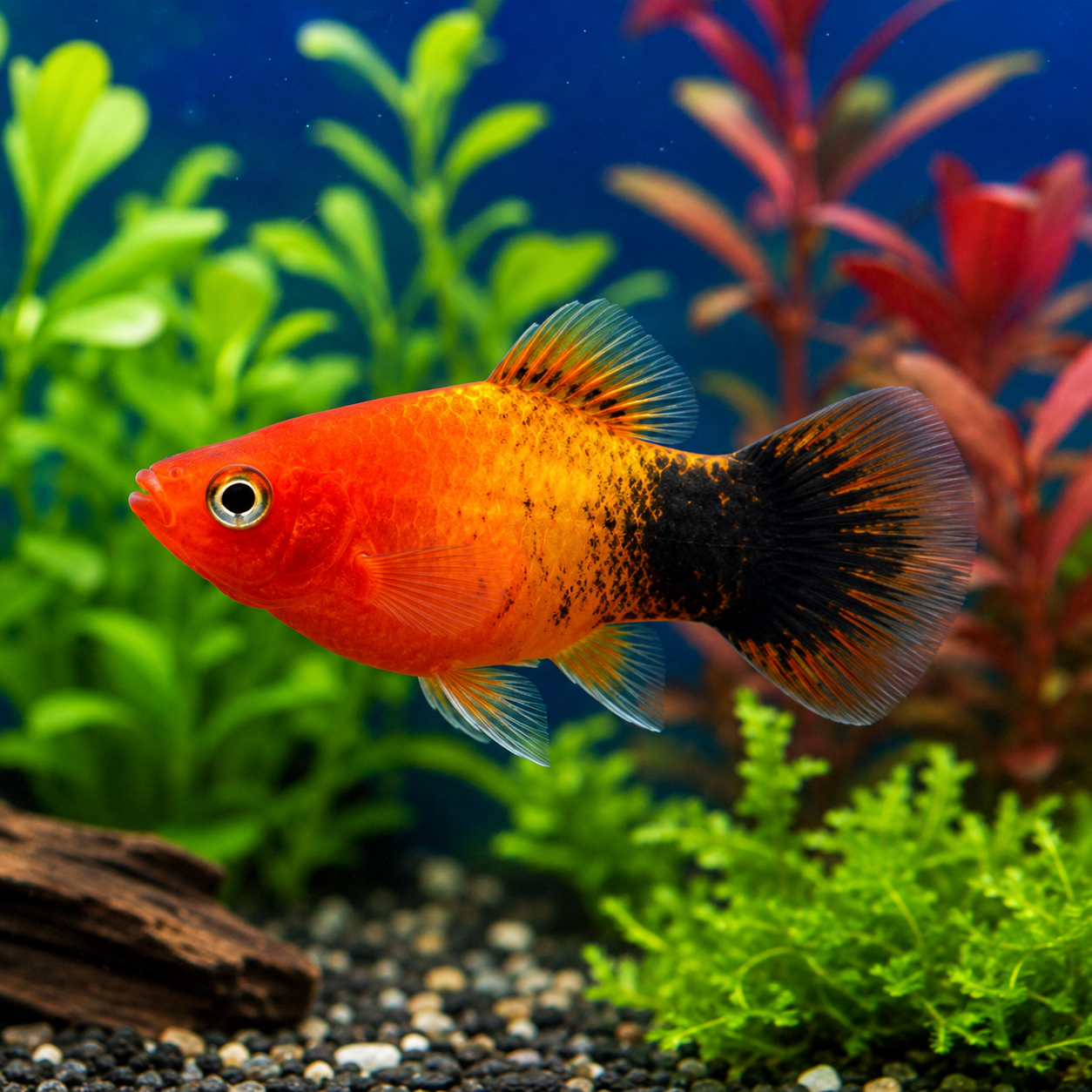
- Sunset platy — orange graduating to yellow, one of the most attractive varieties
- Blue platy — silvery-blue body; subtle and elegant
- Red wagtail platy — red body with black fins
- Mickey Mouse platy — pale yellow-orange with a distinctive Mickey Mouse silhouette at the tail base
- Tuxedo platy — bicoloured with a dark rear half
- Gold platy — bright golden yellow
- Panda platy — white body with black patches
- Variatus platy (X. variatus) — wild-derived varieties with natural striped patterns; often slightly more robust than bred forms
Tank Size and Setup
A 40-litre tank comfortably houses a small group of four to six platies. For a community setup with platies and additional species, a 60-litre or larger tank is preferable.
Ideal setup features:
- Moderate filtration — platies are active and produce moderate waste
- Live plants — platies do not typically destroy plants and benefit from the cover; java fern, anubias, and water wisteria all work well
- Open swimming space — platies are active mid-water swimmers that need room to move
- A tight lid — platies can jump when startled
For substrate, standard gravel or sand both work well. Platies are not substrate-specific and do not disturb the tank floor significantly.
For general tank setup guidance, see The Complete Freshwater Aquarium Setup Guide.
Water Parameters
Platies are among the most adaptable livebearer species in terms of water chemistry. They prefer hard, alkaline water — which aligns well with Singapore's dechlorinated tap water.
Key requirements:
- pH: 7.0–8.3 — strongly prefer neutral to alkaline conditions
- Hardness: 10–28 dGH — harder water is generally better
- Temperature: 18–28°C — exceptionally wide range; comfortable in Singapore's ambient conditions
- Ammonia / Nitrite: 0 ppm at all times
- Nitrate: Below 20 ppm
Singapore context: Dechlorinated Singapore tap water is very well-suited to platies without any modification. This is a genuine advantage over softer-water species like neon tetras.
Cycle the tank before adding platies. See How to Cycle a Fish Tank.
Feeding Platies
Platies are omnivores that benefit from dietary variety. Unlike purely carnivorous fish, they actively need plant matter in their diet.
Recommended diet:
- High-quality flake food as the staple
- Spirulina flakes or algae wafers — important for the vegetable component of their diet
- Blanched vegetables: zucchini slices, cucumber, spinach, peas (de-shelled) — 2–3 times per week
- Frozen brine shrimp and bloodworms — protein variety, 2–3 times per week
- Daphnia — excellent for digestive health
- Live foods — platies enjoy live daphnia and brine shrimp nauplii
Feeding frequency: Twice daily, only what is consumed in 2–3 minutes. Remove uneaten food promptly.
See How Much and How Often Should You Feed Aquarium Fish? for general guidance.
Platy Breeding
Platies are livebearers that give birth to live fry approximately every 28–35 days. They are not as prolific as guppies — typical broods are 20–50 fry — but they do breed readily.
Sexing platies:
- Males are smaller and have a gonopodium (rod-shaped anal fin)
- Females are larger with a fan-shaped anal fin and a gravid spot when pregnant
Managing breeding:
- To reduce fry production: keep only males, or only females
- To maximise fry survival: provide dense java moss or floating plants where fry can hide
- To raise fry: separate them into a grow-out tank; feed crushed flake or commercial fry food
Platy fry are born larger and more capable than guppy fry, meaning more survive even in a community tank with dense planting. Some hobbyists deliberately let platies breed to provide live food for larger fish.
Compatible Tankmates
Platies are peaceful and compatible with a wide range of community fish.
Excellent tankmates:
- Guppies and mollies — Guppy Care Guide, Molly Fish Care Guide
- Corydoras catfish — Cory Catfish Care Guide
- Tetras (black skirt, serpae, larger ember tetras)
- Harlequin rasboras and zebra danios
- Dwarf gouramis
- Otocinclus catfish
- Nerite snails and mystery snails
Avoid:
- Bettas (variable; platies may be safe, but flowing-fin male guppies that often accompany them are not)
- Aggressive cichlids
- Fin-nipping species like tiger barbs
- Soft-water acidic species (discus, wild-type South American fish that need pH below 6.5)
Common Health Problems
| Problem | Signs | Cause / Solution |
|---|---|---|
| Ich (white spot) | White grains on body and fins | Temperature stress or new fish introduction; raise temperature to 28°C + ich treatment |
| Fin rot | Ragged, darkening fin edges | Bacterial infection; improve water quality + antibacterial treatment |
| Wasting | Weight loss, sunken belly | Internal parasites; treat with antiparasitic medication |
| Swim bladder issue | Floats, sinks, or swims tilted | Often constipation; fast 2–3 days then feed daphnia or peas |
Frequently Asked Questions
Are platies good for beginners? Absolutely — platies are one of the top recommendations for first-time fish keepers. They are forgiving of minor water quality lapses, peaceful, easy to feed, and widely available at local fish shops.
How many platies should I keep? A group of four to six (at a ratio of two to three females per male) is a good starting point for a 40-litre tank. Single-sex groups are also viable.
Can platies live with guppies? Yes — they have very similar water requirements and coexist peacefully. Both are livebearers and will breed independently; manage population accordingly.
Do platies eat plants? Occasionally platies nibble at very soft, tender plant growth, but they are not destructive plant eaters. Hardy plants like java fern, anubias, and hornwort are completely safe with platies.
Can platies and mollies interbreed? Generally not — they are different genera (Xiphophorus vs Poecilia) and do not naturally hybridise. Guppies (Poecilia) and mollies (Poecilia) can occasionally hybridise, but platies and mollies do not.