

Angelfish Care Guide: Tank Size, Temperament, and Community Tank Tips
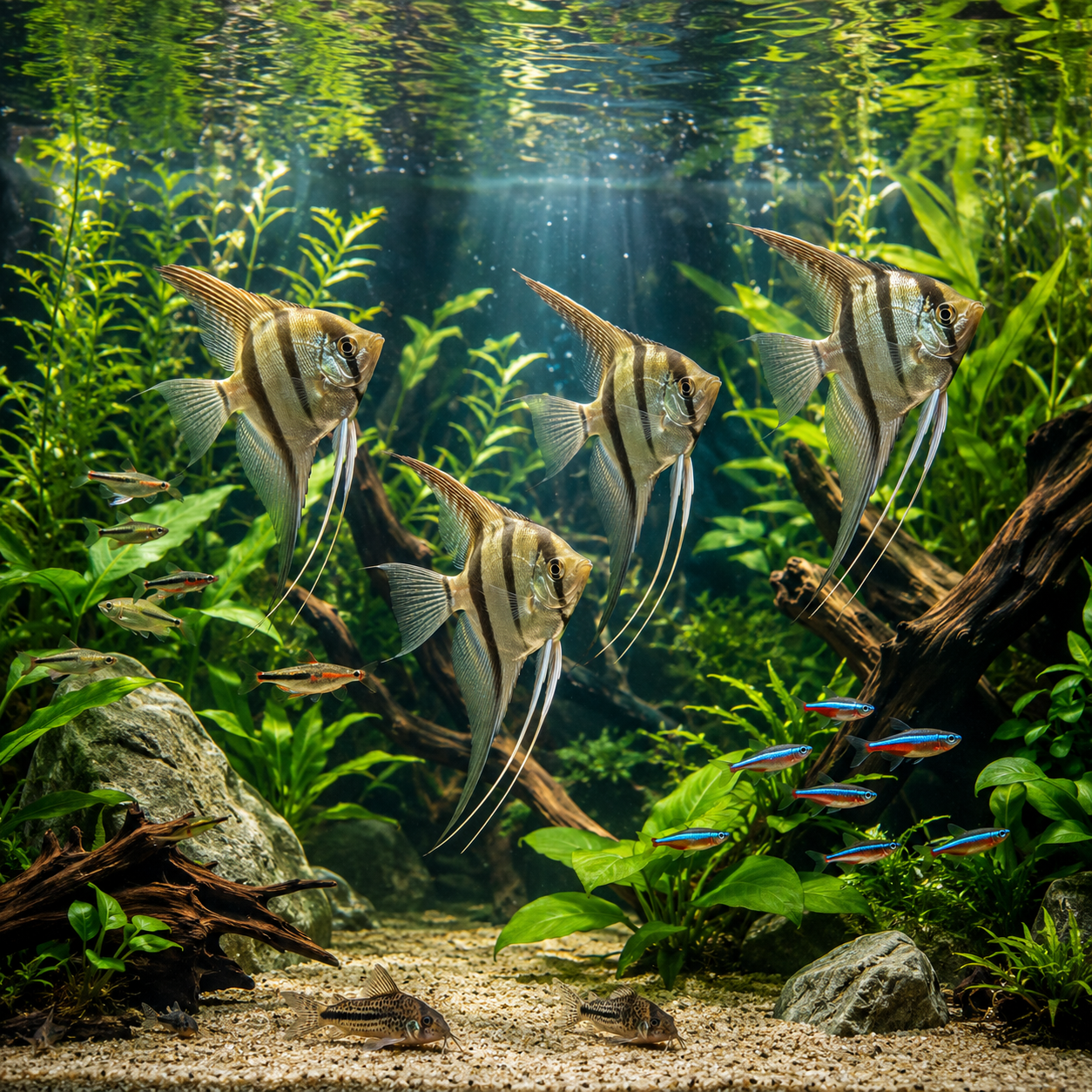
Angelfish (Pterophyllum scalare) are one of the most iconic freshwater fish in the hobby. Their elegant, disc-shaped body, dramatically elongated fins, and regal bearing make them instantly recognisable. They are cichlids — which means they come with more personality, more territory awareness, and more complexity than the average beginner fish.
With the right tank size, compatible tankmates, and consistent care, angelfish are enormously rewarding. This guide covers what intermediate hobbyists need to know before bringing them home.
Quick Reference: Angelfish Care at a Glance
| Parameter | Ideal Range |
|---|---|
| Tank size (minimum) | 100 litres (tall tank preferred) |
| Temperature | 26–30°C |
| pH | 6.0–7.5 |
| Hardness (GH) | 3–8 dGH (soft to moderately soft) |
| Diet | Carnivore-leaning omnivore |
| Adult size | 15 cm body; 25 cm fin-to-fin height |
| Temperament | Semi-aggressive, territorial when breeding |
| Lifespan | 10–15 years |
Tank Size and Shape
Angelfish are tall fish — an adult angelfish can measure 25 cm from dorsal fin tip to ventral fin tip. A standard shallow tank is unsuitable. They need tall aquariums with a minimum height of 45 cm, and ideally 55–60 cm.
Minimum volume is 100 litres for a single pair, but 150–200 litres is preferable for a group of four to six young angels raised together.
Why raise a group? A single pair of angelfish can become oppressively territorial in a community tank. A group allows them to form their own hierarchy and disperse aggression. The natural pair bonds that form within a group are fascinating to observe.
Water Parameters
Angelfish are native to the Amazon basin — slow-moving blackwater rivers with soft, warm, slightly acidic water. Captive-bred angels (which is the vast majority sold in shops) are more adaptable than their wild counterparts, but they still do best in:
- pH: 6.0–7.5 — neutral to slightly acidic is ideal
- Temperature: 26–30°C — warmer than many tropical fish; suits Singapore's ambient climate well
- Hardness: Soft to moderately soft water
- Ammonia/Nitrite: 0 ppm — absolutely non-negotiable; angelfish are sensitive to ammonia
Singapore context: Dechlorinated Singapore tap water (pH 7.5–8.5) may be somewhat alkaline for ideal angelfish conditions. Adding driftwood, Indian almond leaves, or mixing with RO water can bring pH into a better range. Captive-bred angels do often adapt to pH up to 7.5 without significant issues.
Always cycle the tank before adding angelfish. See How to Cycle a Fish Tank.
Angelfish Varieties
Selective breeding has produced numerous colour and pattern varieties:
- Silver angelfish — wild-type patterning with vertical black stripes
- Marble angelfish — irregular black-and-gold marbling
- Koi angelfish — orange, white, and black patterning resembling koi
- Gold angelfish — solid gold without stripes
- Black angelfish — deep black or near-black
- Veil angelfish — any colour with dramatically elongated, flowing fins
- Platinum angelfish — solid metallic silver-white
- Ghost angelfish — pale with faint striping
Feeding Angelfish
Angelfish are primarily carnivores in the wild, feeding on small fish, crustaceans, and invertebrates. In a community tank, they should never be kept with fish small enough to fit in their mouths.
Recommended diet:
- High-quality cichlid pellets or angelfish-specific pellets as the staple
- Frozen bloodworms — eagerly taken; excellent protein source
- Frozen brine shrimp — good variety and colour enhancement
- Frozen mysis shrimp — high nutritional value
- Live foods — live bloodworms, daphnia, brine shrimp nauplii
- High-quality flake food — acceptable as a supplement
Feeding frequency: Once or twice daily. Angelfish can be trained to feed from specific spots and will often follow their keeper's hand expectantly — a charming behaviour.
For feeding guidance, see How Much and How Often Should You Feed Aquarium Fish?.
Temperament and Community Tank Dynamics
Angelfish are cichlids, which means they have territorial instincts — particularly during breeding. Understanding their temperament is essential for a successful community setup.
General behaviour:
- Young angelfish (under 6 cm body size) are relatively peaceful in groups
- As they mature, hierarchy and pair bonding emerge; an established pair will aggressively defend territory during spawning
- Angelfish may chase or injure smaller, slower fish — especially at feeding time
- They will eat any fish small enough to swallow (neon tetras are a common victim)
Managing aggression:
- Raise a group of six to eight juvenile angelfish together — natural pairs form, and aggression distributes across the group
- Provide tall plants (amazon sword, vallisneria) and driftwood to break sightlines
- Remove the bonded pair to a dedicated breeding tank if they spawn and become overly aggressive toward tankmates
Compatible Tankmates
Good community tankmates (for adult angelfish):
- Larger tetras — rummy-nose tetras, black skirt tetras, congo tetras (large enough not to be eaten)
- Corydoras catfish — relatively safe; too large and armoured to be threatened; Cory Catfish Care Guide
- Bristlenose plecos
- Dwarf gouramis (with caution — observe for aggression)
- Mollies — Molly Fish Care Guide
- Swordtails
Do not keep with angelfish:
- Neon tetras and cardinal tetras — they will be eaten
- Guppies — eaten or fin-nipped
- Tiger barbs — will shred angelfish fins
- Discus (unless you can maintain the very specific conditions both require; often better kept separately)
- Bettas — stress and aggression on both sides
Breeding Angelfish
Angelfish are substrate spawners that form monogamous breeding pairs. Breeding in a community tank is possible but raises challenges:
- The pair selects a flat surface — broad plant leaves, smooth slate, or the filter intake pipe
- They clean the spawning surface and lay 100–1,000 eggs in rows
- Both parents fan and guard the eggs intensely, becoming aggressive toward all tankmates
- Eggs hatch in 48–60 hours; larvae become free-swimming in another 5–7 days
For serious breeding, set up a dedicated 80-litre breeding tank with soft, warm water (pH 6.5–7.0, 27–29°C) and no other fish.
Frequently Asked Questions
Can angelfish live in a 60-litre tank? Not comfortably for adults. A pair of adult angelfish need at least 100 litres, and a tall tank is essential given their height. A 60-litre tank may suit juveniles temporarily, but they will need upgrading within a year.
Why is my angelfish aggressive? Angelfish become territorial during pair formation and spawning. If a dominant pair is forming in your tank and attacking all other fish, they may need to be moved to their own tank.
How do I sex angelfish? Sexing angelfish before they breed is notoriously difficult — body shape and fin length are unreliable indicators. The most reliable method is observing breeding behaviour: the female has a blunt, rounded breeding tube (ovipositor); the male's is pointed.
Can angelfish and discus live together? In theory, yes — they share similar water requirements. In practice, discus need extremely stable, pristine water conditions that are difficult to maintain alongside the more active, feeding-competition-prone angelfish. Keeping them separately is usually recommended. See Discus Fish Care Guide.
How long do angelfish live? With excellent care — clean water, quality feeding, and appropriate tank size — angelfish can live 10–15 years. They are a long-term commitment.